

Evidence-backed transition briefings for executives, investors, policymakers, utilities, and industry audiences deciding what actually scales.
Michael Barnard delivers transition briefings for audiences that need decision clarity on resilience, affordability, security, and what actually scales. His talks separate scalable pathways from costly choices that do not work operationally or commercially before capital, procurement, policy, or reputation gets committed.
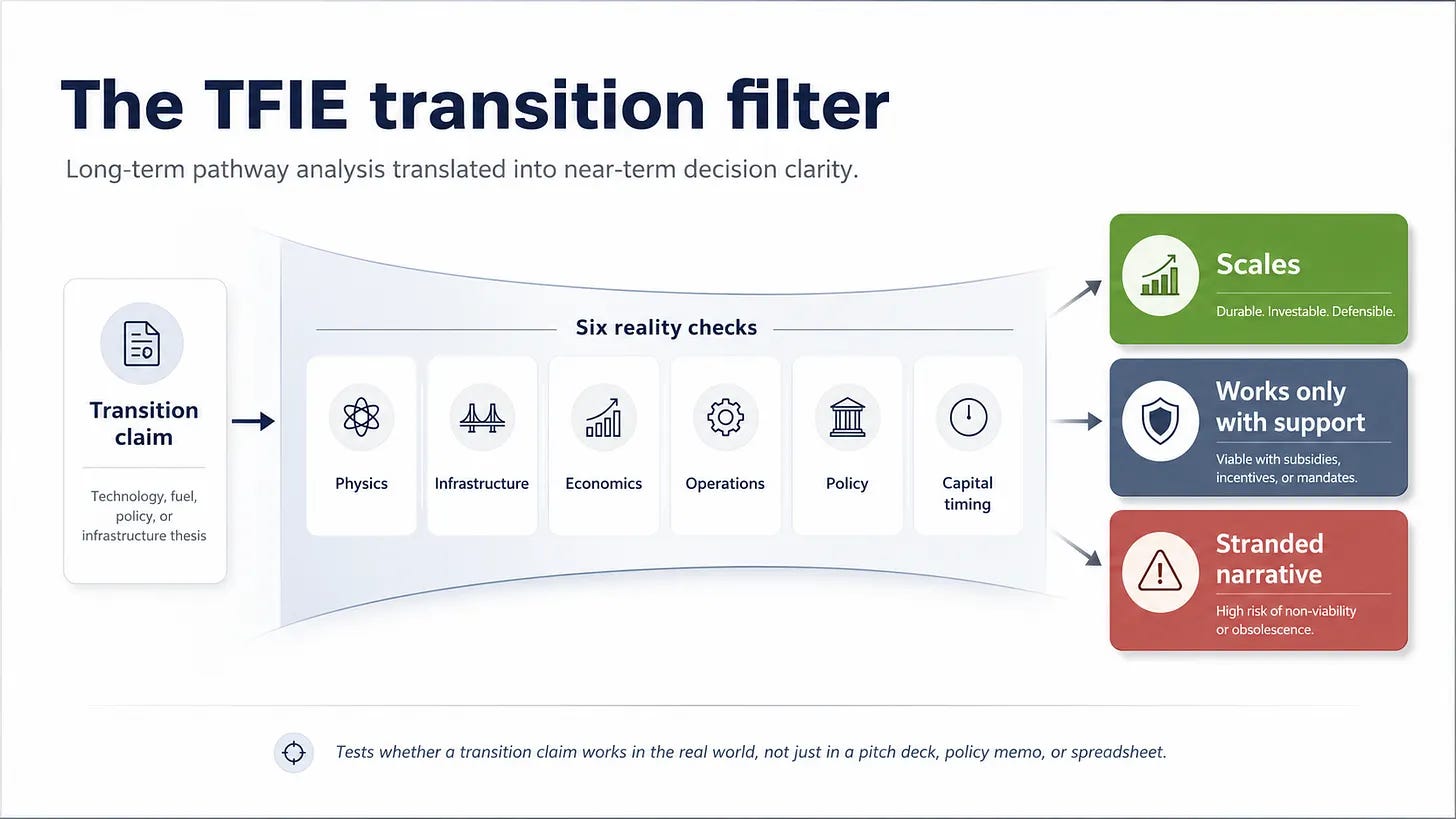
The work draws on TFIE Strategy Briefing’s formal pathway assessments, decades of corporate and public communication experience, and a long public record of testing clean-technology claims against physics, infrastructure, economics, operations, policy, and capital timing.
For audiences making real decisions
Barnard is best suited to audiences that have to make choices, not merely applaud ambition. That includes investors testing technology theses, utilities and grid organizations planning infrastructure, ports and maritime organizations sorting fuel claims, aviation and fuels audiences confronting hard denominators, policymakers comparing pathway credibility, and executive teams trying to avoid expensive choices that do not survive contact with operations, infrastructure, and economics.
His talks are direct, data-driven, and practical. They are not built around generic transition optimism, vendor talking points, or one-size-fits-all technology claims. They are built around the harder question serious audiences eventually have to answer: what works when it leaves the slide deck and meets physics, infrastructure, operating reality, capital discipline, and time?
Signature talks
What’s real, what’s hype, and what to ask before capital gets committed
A keynote for investors, executives, policy teams, and industry audiences facing a crowded transition landscape. The talk walks through how to test claims against physical constraints, infrastructure requirements, operating realities, economics, policy dependence, and timing. The goal is not to make audiences cynical. It is to make them harder to fool.
Electrons, molecules, and magical thinking
Most transition pathways sort quickly once energy efficiency, infrastructure, and end-use requirements are treated seriously. This talk explains where electrification dominates, where molecules remain useful, and where hydrogen, synthetic fuels, ammonia, and carbon capture narratives drift away from system reality.
What will still be standing in 2100?
A long-horizon transition talk translated back into near-term decisions. Drawing on TFIE Strategy Briefing’s pathway assessments, this session tests which technologies, fuels, and infrastructure pathways are likely to scale, which will remain niche, and which will become stranded narratives.
Pockets of the future
Clean technology is not arriving evenly. It appears first in pockets where policy, infrastructure, economics, industrial capability, and social acceptance align. This talk explores what those pockets reveal about the future already under construction, and why they matter more than generic forecasts.
The trillion-dollar transition filter
A capital-allocation talk for investors, infrastructure funds, boards, and strategy teams. It focuses on how to distinguish durable, investable, defensible transition pathways from subsidy-shaped markets, policy-dependent niches, and elegant dead ends.
Formats
Barnard is available for keynotes, executive briefings, board and investor sessions, fireside conversations, panels, and sector pathway workshops. Commercial engagements are scoped by audience, format, location, preparation, customization, and strategic fit. The strongest fit is with organizations making material decisions about capital, infrastructure, procurement, policy, resilience, affordability, security, or reputation.
Selected proof
Barnard has delivered keynotes, seminars, investor briefings, academic lectures, strategy workshops, and media conversations across North America, Europe, India, and China-facing executive education contexts.
Public examples include investor and executive-facing work such as Jefferies investor sessions and TenneT scenario workshops; international institutional audiences including the Tsinghua PBC School of Finance ESG lecture series, the India Smart Grid Forum seminar series, and the University of Twente Climate Event; and public keynote or media-platform work including the Green Builder Sustainability Symposium, Distributed Wind Energy Association keynote, Burnaby Board of Trade Clean Energy Summit keynote, Simon Fraser University sustainable engineering seminar, and Redefining Energy – Tech.
He has also appeared on Canadian national television, hosted and participated in energy-transition podcast conversations, and brings extensive corporate presentation experience from his IBM years, along with live-stage experience from improv and community theatre.
Not ready to discuss an event yet? Subscribe to TFIE Strategy Briefing for ongoing transition-pathway analysis, scorecards, and evidence-backed assessments.
The right room
The strongest fit is an audience that needs sharper questions and better filters. Investors considering climate-tech theses. Utilities and grid organizations sorting infrastructure realities from aspirations. Ports, maritime firms, aviation groups, and fuel suppliers facing molecule-heavy narratives. Policymakers and agencies deciding where public money and regulatory attention should go. Boards and executive teams trying to understand which transition pathways are durable, which are support-dependent, and which are likely to become stranded stories.
This is not a talk for audiences looking for reassurance that every pathway is equally promising. It is for audiences that want to know what scales, what needs continuing support, and what is unlikely to survive contact with denominators.
About Michael Barnard
Michael Barnard is Chief Strategist at TFIE Strategy Inc. and publisher of TFIE Strategy Briefing. He works with investors, executives, policymakers, utilities, NGOs, and industry leaders on decarbonization strategy, transition pathway assessment, and clean-technology due diligence.
His public work spans grids, storage, hydrogen, shipping, aviation, ports, industrial heat, steel, cement, critical minerals, carbon capture, nuclear, China’s clean-technology scale, and the practical limits of energy-transition narratives. His style combines systems analysis, dry humour, and a willingness to say no when the evidence says no.
Speaking inquiries
For keynotes, executive briefings, board sessions, investor discussions, or sector pathway workshops, contact Michael. Please include the audience, format, location, timing, and whether the session is public, private, or part of an executive decision process.
Serious audiences do not need more slogans. They need sharper questions, better denominators, and a clearer view of what actually scales.