

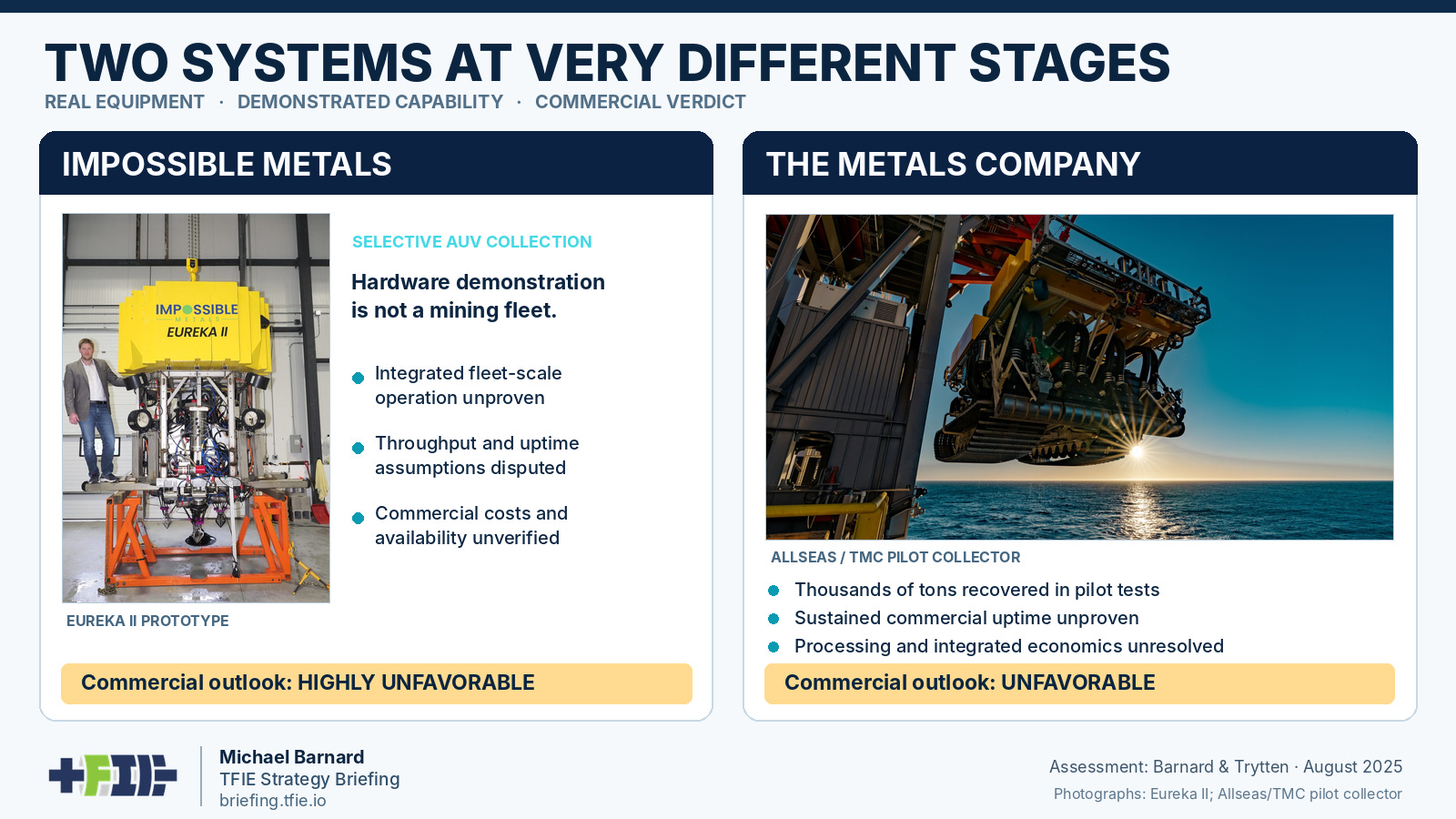
In 2022, The Metals Company (TMC) and offshore contractor Allseas recovered 3,021 wet tons of polymetallic nodules from the Clarion-Clipperton Zone in the Pacific Ocean. Their pilot system achieved a sustained collection rate of 86.4 tons per hour during production runs, using a tracked seabed collector and a hydraulic riser extending more than four kilometers to a converted drillship. It was a substantial engineering achievement, but its economics remain unproven.
Four years later, TMC is targeting 1 million wet tons of annual production from an upgraded system, rising to 1.5 million in its second year. Its longer-term ambition is 12 million tons annually across four production vessels. These figures, reiterated in the company’s November 12, 2026 corporate update, represent a scale of operations that has not been demonstrated.
Impossible Metals faces a considerably greater challenge. Its proposed fleet of autonomous underwater vehicles would identify, select and collect individual nodules, then return to the surface with their cargo. In September 2026, the company successfully recovered a small scientific sample from more than 4,000 meters depth. The experiment demonstrated selective collection and recovery, not commercial payload capacity or industrial fleet productivity. The company’s larger commercial system remains a proposed engineering architecture rather than a demonstrated mining operation.
In our August 2025 techno-economic assessment of seabed mining, metallurgical specialist Lyle Trytten and I found that neither approach had a credible path to the sustained production rates and operating costs assumed in its financial projections. Impossible Metals’ integrated fleet concept was exceptionally speculative. TMC had more mature collection technology, but its projected costs and operating performance remained unconvincing. The issue is not whether machines can collect nodules. It is whether they can keep collecting enough material, at low enough cost, to justify the enormous investment required.
How many productive hours would TMC need to deliver a million tons a year? Can Impossible Metals’ robotic collection cycle achieve its proposed industrial output? What happens to capital requirements and investment returns when either system falls short? Subscribe to see the engineering calculations and financial sensitivities behind our unfavorable assessment.
