

RMI is too important not to criticize. Its research shapes decisions by governments, investors and industrial companies. When its analysis improves, the benefits extend beyond the organization. When its recommendations don’t follow that analysis, so do the consequences. Nearly three years after my critique of RMI’s hydrogen strategy, the verdict is mixed. The research has become more realistic, but the strategy has not fully caught up.
In January 2024, I argued that RMI should concentrate its hydrogen work on decarbonizing persisting industrial demand instead of promoting hydrogen as a broad energy carrier. I recommended a strategic reset using Richard Rumelt’s framework of diagnosis, guiding policy and coherent actions. RMI’s CEO and hydrogen-initiative leadership have not changed since then, but the more important question is whether its published analysis and recommendations have changed.
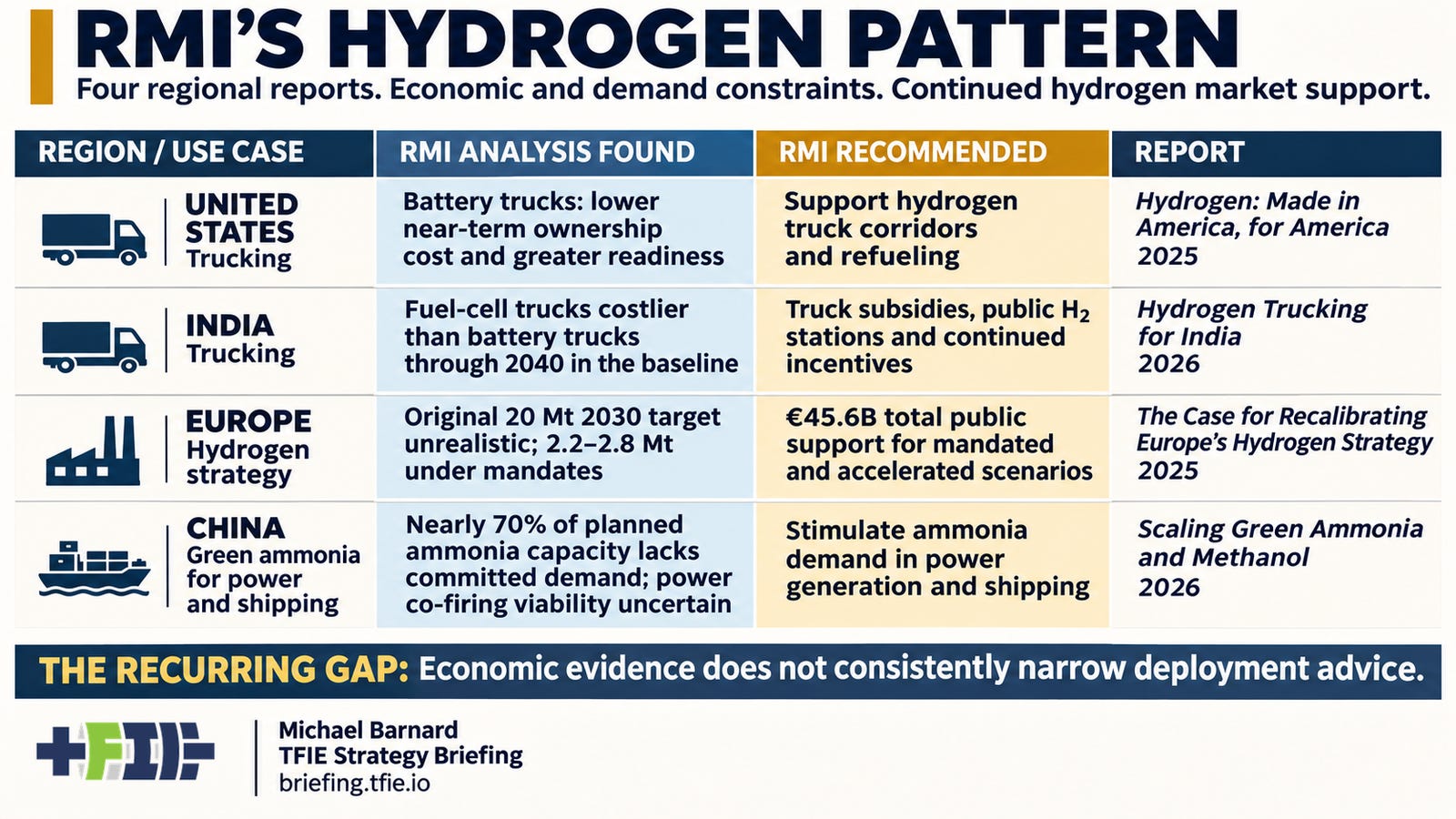
There has been meaningful progress. RMI’s March 2025 report, The Case for Recalibrating Europe’s Hydrogen Strategy, rejected Europe’s original 20-million-ton 2030 hydrogen ambition as unrealistic. It estimated mandate-driven renewable hydrogen demand at 2.2–2.8 million tons, with additional demand dependent on stronger policy support. It recommended concentrating infrastructure around realistic industrial demand rather than treating the original targets as inevitable. That is a substantial correction, reflected in some of its recommendations.
Other parts of RMI continue producing strong comparative analysis. Its July 2026 steel assessment separates hydrogen’s chemical role in iron reduction from its use as fuel for process heating. For the illustrative plant, direct electric heating requires about 850 GWh annually, compared with 1,300 GWh to produce additional hydrogen for combustion. September’s Green Ammonia Buyers Alliance supports lower-emission fertilizer production through purchasing commitments. Both address existing industrial requirements rather than creating new hydrogen energy markets.
The unresolved problem emerges when RMI moves from economic comparisons to market-development recommendations. Its 2025 US report, Hydrogen: Made in America, for America, acknowledges on page 14 that battery trucks have greater market readiness and lower total cost of ownership, especially in the near term. Yet Exhibit ES1 in the executive summary positions hydrogen trucking as an opportunity requiring policy support, while page 32 recommends hydrogen distribution and refueling infrastructure along trucking corridors. The battery advantage is acknowledged but does not constrain the investment recommendations. Hydrogen trucking remains a market to develop rather than an application required to demonstrate an advantage over batteries.
RMI’s February 2026 hydrogen trucking assessment for India makes the disconnect clearer. Its baseline analysis finds that fuel-cell trucks do not reach battery-truck ownership-cost parity through 2040, including long-haul operations. Exhibits 4 and 5 establish the disadvantage, while Exhibit 6 explores favorable hydrogen-price assumptions that could bring the technologies closer to parity. RMI deserves credit for publishing both.
Yet under “Pathway to Unlocking Hydrogen Trucking,” RMI recommends vehicle subsidies, public refueling infrastructure support, hydrogen production incentives and tax reductions. Exhibit 12 extends these measures into commercial deployment. The report identifies possible payload and refueling-time advantages without demonstrating that they overcome the ownership-cost disadvantage. Its baseline supports making batteries the default for the modeled duties, with hydrogen pilots testing specific operational exceptions. Instead, the recommendations support establishing a parallel market.
The broader freight evidence reinforces that conclusion. The April 2026 NACFE Run on Less ownership-cost assessment, developed within RMI’s freight-research ecosystem, projects batteries achieving the lowest costs across every modeled duty cycle by 2035 without incentives. Hydrogen remains the most expensive option across almost all of them. These are conditional projections, but they strengthen the case against broad hydrogen trucking infrastructure support.
China offers a different example. RMI’s August 2026 Scaling Green Ammonia and Methanol acknowledges that green production costs remain two to three times conventional costs and that demand creation has lagged supply ambitions. Green ammonia faces oversupply risk. The report nevertheless promotes ammonia and methanol as prospective energy carriers, including for shipping and power generation, and recommends stronger downstream market development. Replacing fossil-derived ammonia in fertilizer manufacturing has a credible decarbonization rationale. Creating new demand to burn ammonia for electricity is another proposition. Comparing green ammonia with fossil-derived ammonia does not establish its competitiveness against renewable electricity, storage and other grid flexibility options. That comparison is missing from the case for expanding ammonia power generation.
Europe provides the clearest example of improved demand realism without a comprehensive investment test. RMI’s recalibration estimates €13.9 billion in public funding to support demand under existing mandates and another €31.7 billion for its accelerated transition scenario, totaling €45.6 billion. Its analysis estimates premiums against conventional fossil-based products, incorporating willingness-to-pay and regulatory effects, and recognizes that imported green commodities may reduce costs. But this is not a full comparison of pathways delivering equivalent industrial products, transport services and emissions outcomes. The recommendation to commit approximately €46 billion should be supported by that additional test, not just the estimated cost of achieving greater hydrogen uptake.
These four cases differ. US and Indian trucking have direct battery comparisons. Europe has reduced demand expectations but retains an ambitious publicly supported expansion scenario. China acknowledges weak ammonia demand and expensive production while promoting new fuel markets. Their common feature is that unfavorable economic or demand evidence does not consistently narrow the recommendations. Too often, a cost disadvantage becomes a reason to seek additional incentives rather than reconsider hydrogen’s role.
My updated TFIE scorecard is partial course correction. RMI has improved its demand assumptions, comparative analysis and attention to industrial feedstocks. Its recommendations remain less selective than the evidence supports. Confidence is high in the documented differences between analytical findings and policy recommendations, and moderate regarding explanations involving internal governance or institutional incentives. The evidence quality is strong for the published comparisons, although long-term projections remain conditional. Across affordability, security, resilience, emissions and scale, the necessary comparator is the cost and consequence of delivering the same industrial product or useful service through credible alternatives.
The original 2024 critique used Rumelt’s framework of diagnosis, guiding policy and coherent actions. Returning to it reveals how the challenge has changed. RMI’s diagnosis has improved. Its guiding policy still emphasizes developing hydrogen markets, while its recommended actions do not consistently follow its economic comparisons. The problem is no longer primarily the absence of rigorous analysis. It is the failure to let that analysis govern strategic choices, including decisions not to develop a market.
Earlier this month, I submitted an 18-page assessment of Europe’s hydrogen strategy to the European Commission, supported by an evidence workbook, reproducible Python model and interactive dashboard. The approach starts with the industrial products and transport services Europe requires, allows competing technologies and production locations to supply them, and calculates the resulting hydrogen demand. The scenarios cover selected markets under explicit cost and technology assumptions, distinguishing economic competition from compliance with existing hydrogen mandates. Their purpose is to expose assumptions and alternatives, not declare a definitive forecast.
The results illustrate why the order of decisions matters. In the central 2050 scenario, European green ammonia produced using on-site hydrogen costs about €1,222 per ton, compared with €755–839 for qualifying imported green ammonia. These are modeled costs, not supplier bids, and domestic production may warrant a premium for security, resilience or industrial reasons. But importing ammonia for European fertilizer and chemical manufacturers avoids equivalent hydrogen production inside Europe. The industrial product is the requirement. The production method and location are choices.
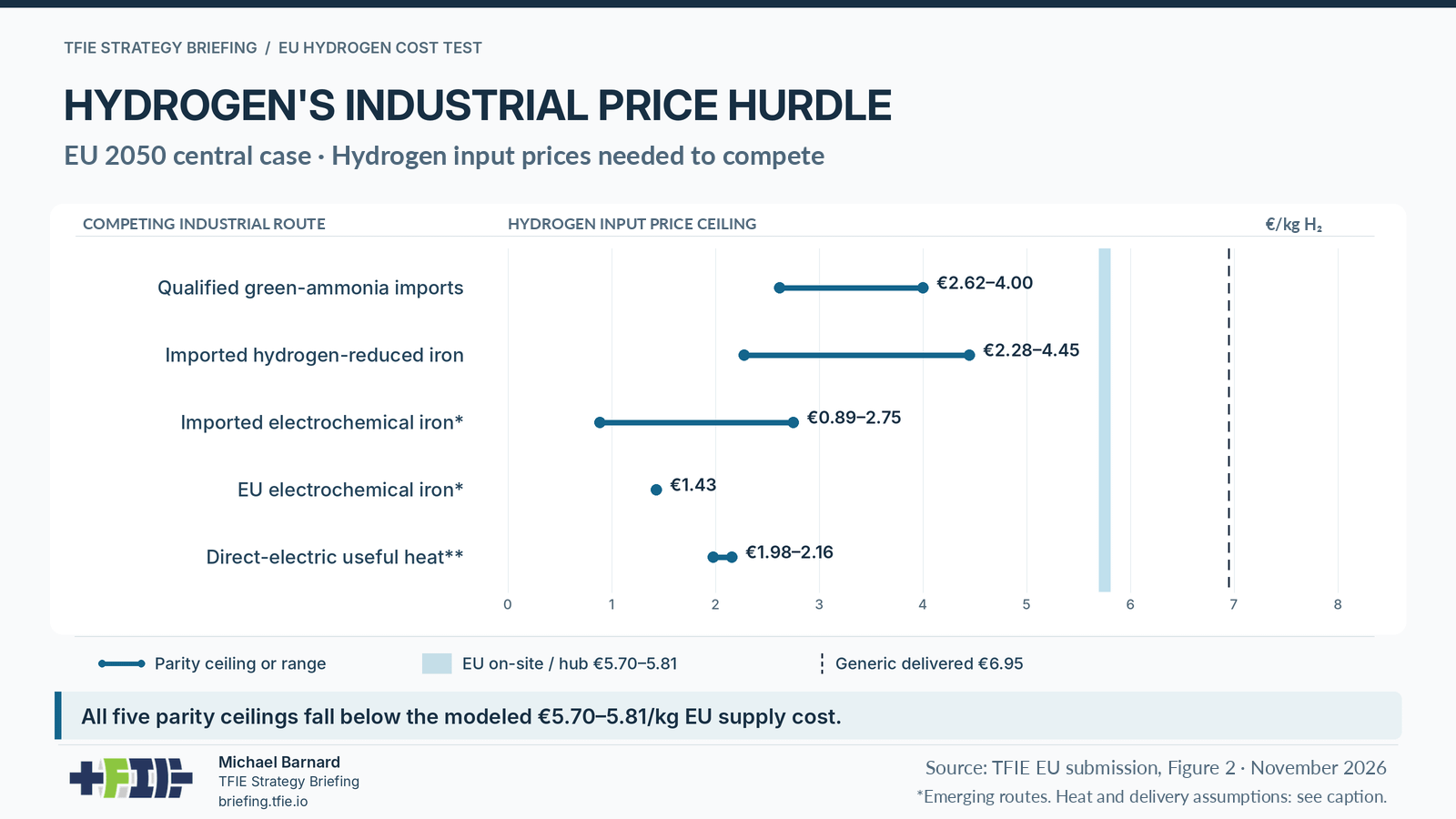
The submission recommends that Europe’s network planners test proposed infrastructure unchanged under both policy-aligned and economic-competition scenarios before considering smaller, staged or alternative investments. If industrial customers import green inputs, electrify processes or reduce hydrogen consumption, the resulting underutilization and financial exposure should be visible. Governments can still justify strategic capacity, but must identify its benefits, costs and risk bearers.
RMI could apply the same discipline across its hydrogen programs. Executive summaries should state the implications of unfavorable comparative findings, including when another technology is preferable. Commercial hydrogen deployment support should depend on demonstrated economic, operational or emissions advantages, with explicit thresholds and exit criteria. Cross-program review should bring electrification, industrial-process and energy-system expertise into recommendations before infrastructure and market-creation measures are proposed.
RMI has the researchers, analytical capabilities and institutional influence to make that change. Much of the necessary work is already happening within the organization. The next step is translating it consistently into guiding policy and coherent actions. RMI’s value to the energy transition comes from helping decision-makers select effective decarbonization pathways, not preserving the widest possible range of hydrogen applications. It is too important an institution not to insist on that distinction.
Subscribe to TFIE Strategy Briefing for independent assessments of the technologies, economics and strategic decisions shaping decarbonization.