

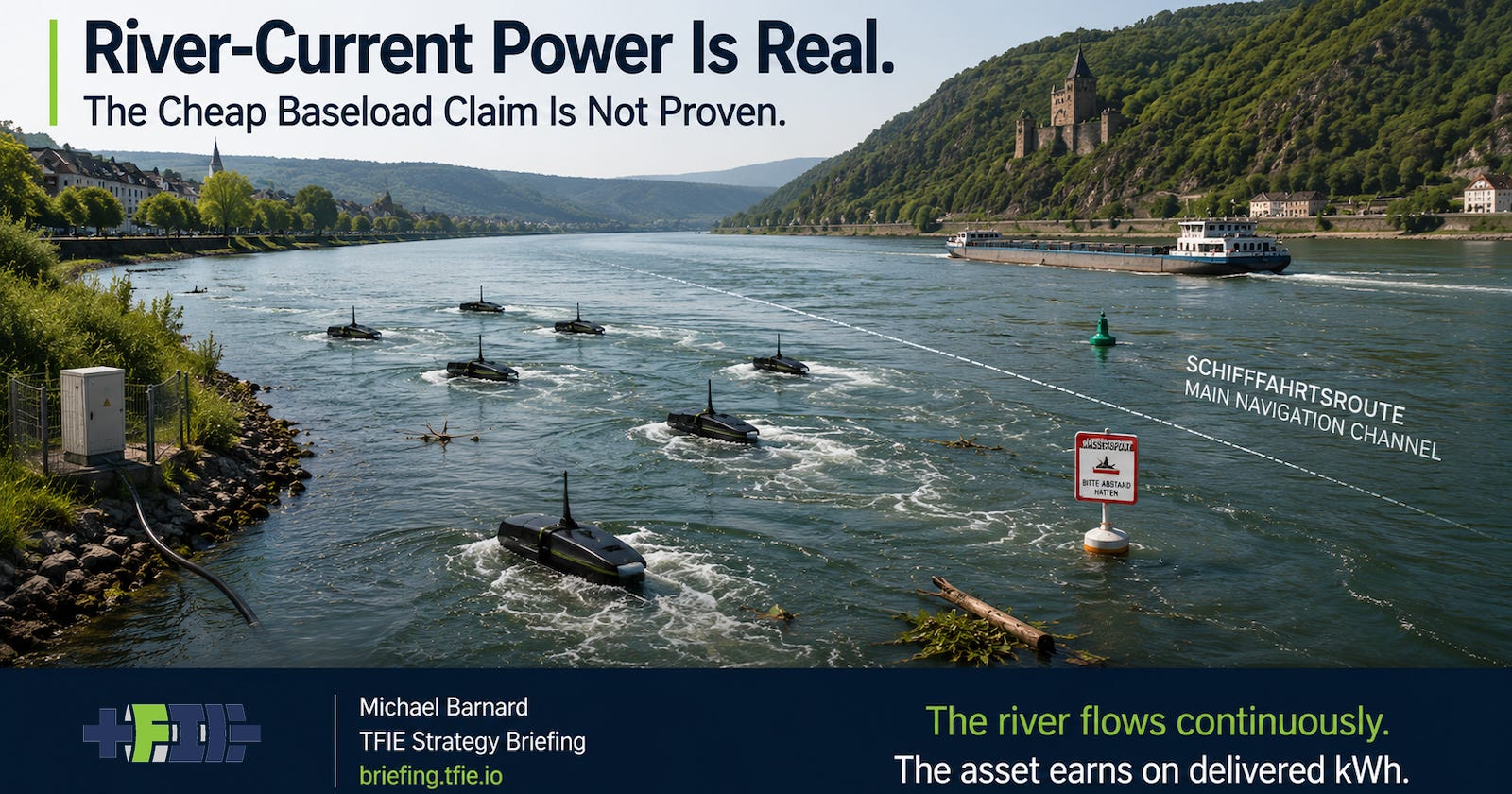
A video about the world’s first approved “swarm power plant” on the Rhine caught my attention because it had all the elements of a climate-tech story that tends to outrun the evidence. There was real hardware, a strong image, a river everyone recognizes, the promise of power day and night, and an electricity-cost number that sounded competitive with wind and solar. The project is Energyminer’s Energyfish deployment near Sankt Goar, where 124 small floating river-current turbines are planned in a Rhine side channel.
The video was the trigger, not the evidence base. That distinction matters. In this review I am not testing a YouTube headline, a journalist’s flourish, or a social-media summary unless the same claim can be traced to Energyminer, a public agency, a buyer, an investor source, or another primary stakeholder. The claims worth testing are the ones in Energyminer’s own materials and primary-stakeholder statements: baseload-capable generation, 24/7 operation, low maintenance, flood response, fish compatibility, 15 MWh/year per unit, 100 units producing 1.5 GWh/year, 124 units at St. Goar, and the company-attributed 8 c/kWh cost framing.
That framing is not a trivial claim. It moves Energyfish from “interesting niche hydropower technology” to “cheap, firm-like renewable generation.” The first claim is plausible. The second is not yet demonstrated on public evidence.
Energyfish is not vaporware. Energyminer’s own technical page describes a compact hydrokinetic underwater power plant for rivers. The company says each unit weighs about 80 kg, measures roughly 2.8 m by 2.4 m by 1.4 m, has a maximum output of 6 kW, an average output of 1.8 kW, and produces about 15 MWh/year. It says a fleet of 100 units can produce about 1.5 GWh/year, enough for roughly 470 households, and it describes the St. Goar project as 124 Energyfish units being connected stepwise into a swarm plant.
The Rhineland-Palatinate environment ministry gives the project stronger public grounding. Its release says the Sankt Goar project has approval for 124 floating current turbines, that three were already in operation, and that 21 more are planned in the next step. It also says the Rhine section has flow speeds of 1.5 to 2 m/s, that 100 Energyfish units produce 1.5 GWh/year, and that this can supply 400 to 500 four-person households.
That is a meaningful early deployment, and it looks like a reasonable place to test the concept. The strongest version of Energyminer’s case is not that it replaces conventional hydro where conventional hydro works. It is that it extracts useful electricity in river sections where dams, weirs, diversions, powerhouses, fish ladders, and major civil works are not acceptable. Energyminer co-CEO Georg Walder has described the company’s approach as a complement to classic hydropower, not a replacement, aimed especially at river sections not suitable for conventional plants. The project deserves to be taken seriously, which is why the claim deserves a serious denominator.
The category itself is old enough to have one. Hydrokinetic river-current generation has been studied and trialed for decades. The physics is simple enough: flowing water carries kinetic energy, a turbine extracts some of it, and a generator turns that mechanical work into electricity. The hard part is not proving that moving water can turn a rotor. The hard part is delivering reliable, low-cost electricity from devices that live in rivers.
That is a different problem than conventional hydropower. Run-of-river hydro typically uses head, civil works, intakes, turbines, and controlled flow paths. A river-current device extracts kinetic energy from the moving water itself. That avoids many of the permitting and ecological problems of dammed hydro, but it also lowers the energy density and moves the bottlenecks into the river: wakes, debris, floods, low water, biofouling, silt, anchors, cables, inspection, navigation, small craft, and site-specific permitting. A river is not a clean conveyor belt of free energy. It is a working hydrological, ecological, navigation, flood, sediment, and recreation system, and that becomes the system boundary.
Energyminer’s gross arithmetic is straightforward. At 6 kW maximum output and 1.8 kW average output, each Energyfish has an implied gross capacity factor of about 30%. At 15 MWh/year per unit, a 124-unit fleet would produce about 1.86 GWh/year before any additional derates. That is useful local generation. It is not a material grid-scale wedge.
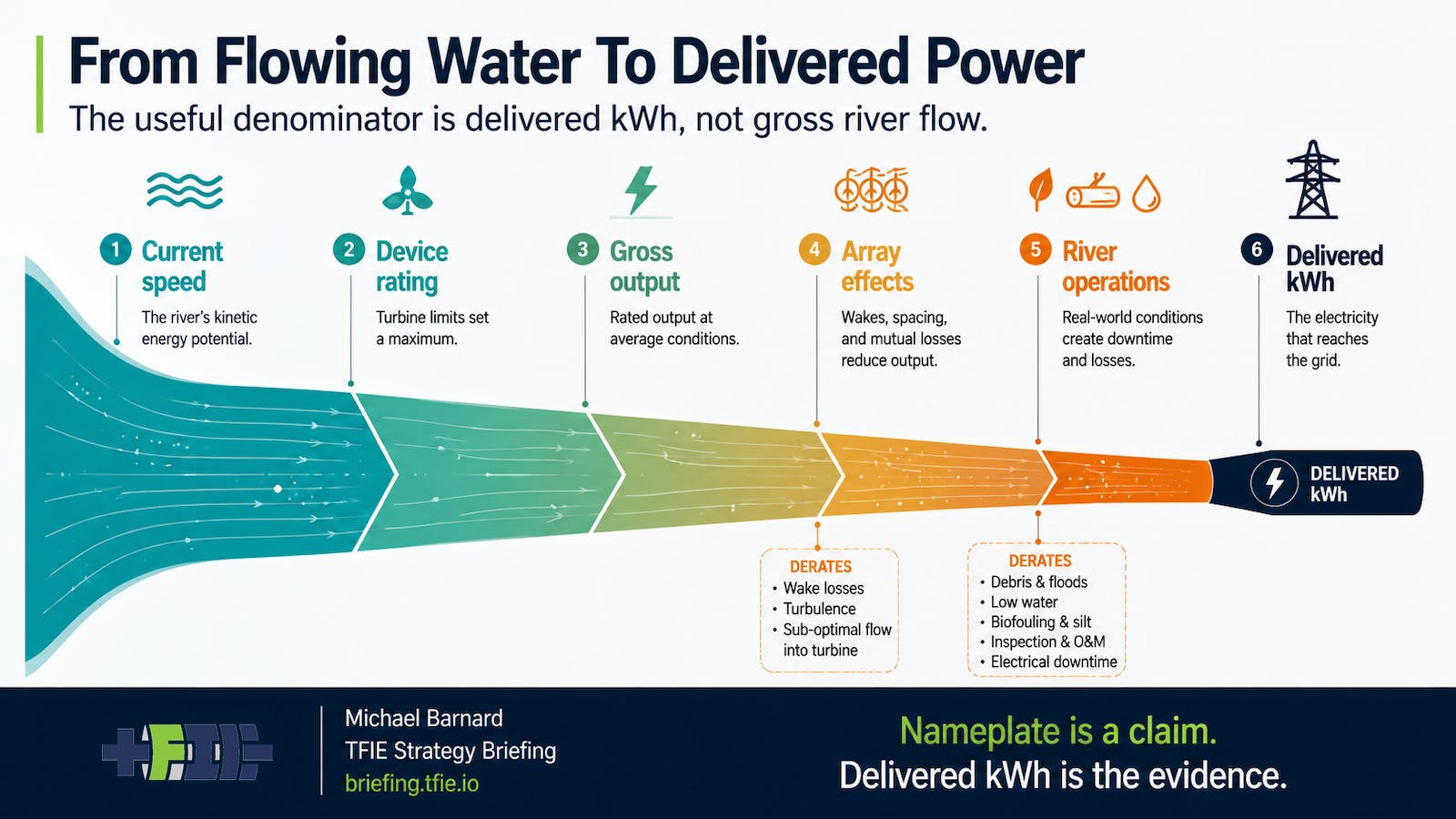
The decision-grade denominator is not nameplate capacity, gross average output, or the fact that the river flows day and night. It is delivered kWh after array wakes, flow variability, low-water periods, flood response, floating debris, submerged debris, biofouling, silt, inspection, retrieval, cleaning, repairs, replacement, anchors, cables, monitoring, grid interface, navigation restrictions, insurance, and site-specific permitting.
That distinction weakens the “baseload” language. A river can flow continuously while an asset produces variable, degraded, or interrupted output. Energyminer says the Energyfish needs at least 1 m depth and 1 m/s flow velocity, with maximum output at 2.5 m/s. TU Darmstadt’s Boris Lehmann made the same limitation explicit in a public note on the project: swarm plants may complement more powerful conventional hydro, but output falls during low water, and low flow can make floating machines ineffective or cause them to run aground. That does not make Energyfish a bad idea, but it does make “baseload” imprecise. The useful phrase would be steadier-than-solar local generation from suitable river sections, subject to river operating constraints. That is less exciting than “baseload,” but it is closer to the engineering problem.
Energyfish is real, and the Rhine deployment is worth watching. The low-civil-works niche is real as well. A small, modular river-current device may make sense where conventional hydropower is blocked, where local electricity has value, and where the site has the right flow, depth, grid connection, ecological profile, and navigation conditions.
The stronger claim is not yet proven. A company-attributed dpa report in Die Zeit says generation costs are around 8 c/kWh including investment, operation, and maintenance, and that buyers can expect an average annual return of at least 8% over a 20-year project life. The same article reports a 50 TWh technical potential in the DACH region from a company-cited potential study. Those are high-burden claims for a river-current category with a long pilot history and limited evidence of broadly commercial deployments.
My view is simple: Energyfish is a niche-valid technology candidate. The cheap baseload-like framing is not decision-grade on public evidence. The proof will be audited delivered kWh, O&M, downtime, replacement, insurance, and repeat buyers after multiple river seasons.
Below the paywall is the professional layer: the Executive Diligence Scorecard, a source-ranked claim map separating Energyminer and stakeholder claims from media amplification, the delivered-kWh denominator, the reference-class forecast, the 8 c/kWh stress test, the simplified sensitivity workbook, update triggers, decision implications and the questions I would use before treating river-current swarm power as a financeable low-cost generation pathway.
