

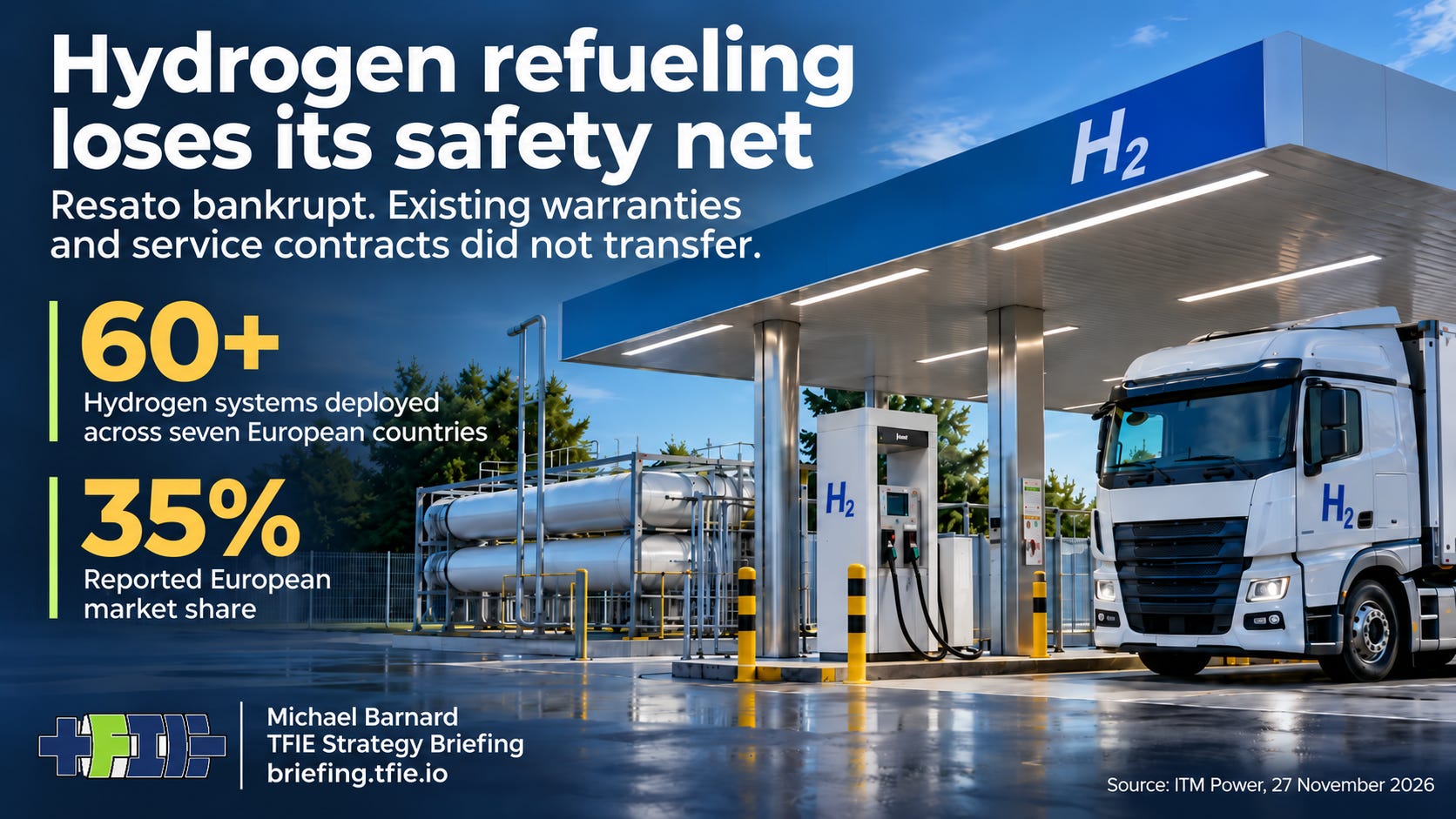
The hydrogen transportation death spiral has another mechanism. When a manufacturer of hydrogen refueling stations goes bankrupt, the stations it supplied remain in operation, but the warranty protection and commercial arrangements that keep them operating may disappear. Owners of expensive, specialized infrastructure face higher costs in a market where revenues are already inadequate.
On October 20, a Dutch court declared Resato Hydrogen Technology bankrupt. On November 27, British electrolyser manufacturer ITM Power announced that it had acquired Resato’s technology, intellectual property, inventory and brand for €3 million. Resato had deployed more than 60 hydrogen systems across seven European countries and held a reported 35% share of the European hydrogen refueling market. Despite that market position, it lost €13.4 million on revenues of €24 million in 2025.
For the owners of Resato’s refueling stations, the most consequential part of ITM’s announcement was the exclusion of existing customer contracts and warranty obligations from the acquisition. ITM acquired much of what it needs to sell maintenance services without acquiring the obligation to provide them under existing terms. Its CEO described the installed base as an “attractive aftermarket service opportunity.” Station owners are unlikely to share his enthusiasm.
Hydrogen refueling stations have substantial maintenance requirements. Compressors, high-pressure storage vessels, cooling systems, valves, seals and dispensers require inspection, maintenance and periodic replacement. Resato manufactured much of its own equipment, limiting the options available to operators seeking alternative sources of parts and specialist maintenance. These stations already have high fixed costs and homeopathic revenues, a problem documented by the EU-funded Hydrogen Mobility Europe programme, which identified insufficient station utilization as a threat to commercial viability.
Resato’s bankruptcy also undermines the argument that heavy transportation will rescue the hydrogen refueling industry from the collapse of the passenger car market. The company supplied 350-bar and dual-pressure 350- and 700-bar stations for buses and heavy trucks. Its installation in Güstrow, Germany, was designed to supply a fleet of more than 50 hydrogen buses. Its installations in Sweden were part of efforts to build a refueling network for heavy road freight. The pivot to heavy transportation didn’t save one of Europe’s leading refueling equipment manufacturers.
How will the loss of warranty and maintenance contracts affect station economics? Which stations are most exposed to premature closure, and what happens to the fleets that depend on them?