

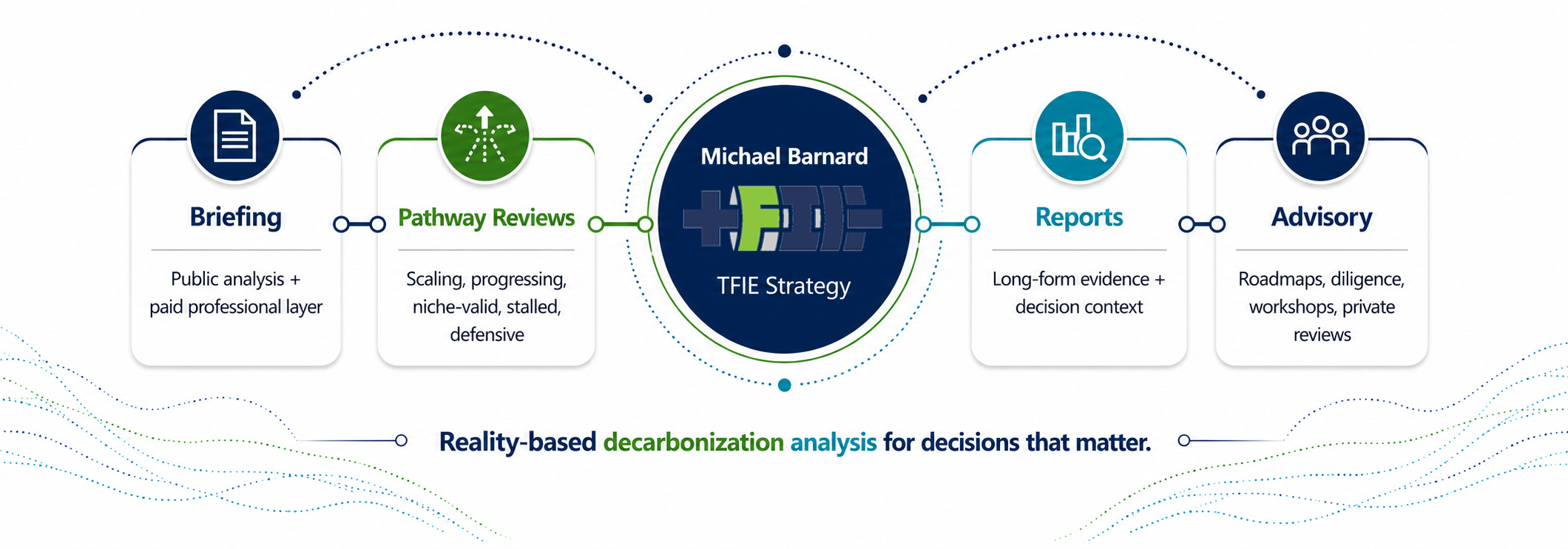
TFIE Strategy Briefing publishes pathway reviews, scorecards, and reports, and applies the same evidence discipline to advisory work, roadmaps, and investment diligence.
Decarbonization has moved past the stage where broad direction is the hard question. Electricity will do more. Combustion will do less. Batteries will keep improving. Transmission will matter more. Efficiency will remain underrated. Fossil fuel demand will not vanish in a straight line, but it will face structural pressure from cheaper, cleaner alternatives in more and more markets.
The harder question now is where the real transition pathway is, where the story has run ahead of the evidence, and what questions should be asked before capital, policy, procurement, or reputation gets committed. That is what Michael Barnard’s TFIE Strategy Briefing is for.
This is not a general climate blog. It is not a home for every press release with a green label attached. It is not a place where pilots become industries by narrative magic, where a prototype becomes a market, or where one impressive project is allowed to stand in for a global denominator.
The Briefing is built around a simpler discipline. Look at what is scaling. Look at what is stalling. Look at the denominator. Compare the proposed pathway with the boring alternatives that already work. Ask what has to be true for the claim to matter. Then ask whether those conditions exist outside the slide deck.
The public argument and the professional layer
Free posts carry the public argument. They make the core analysis visible, testable, and useful to readers who want a clear view of the transition without having to wade through promotional fog.
Paid subscribers get the professional layer: pathway reviews, scorecards, evidence notes, denominator checks, update triggers, and decision-grade context. That layer is designed for people who need more than an opinion and less than a 200-page consultant report that buries the useful bits under process theatre.
The question is not whether something is interesting. Many things are interesting. The question is whether it is material, scalable, affordable, timely, and competitive against alternatives that are already moving.
A technology can be real and still be niche-valid. A pathway can be technically possible and commercially defensive. A company can be competent and still be pointed at a shrinking opportunity. A policy can be well-intentioned and still subsidize delay. A pilot can be worth watching and still not deserve procurement-scale confidence. Those distinctions matter. They are where bad decisions usually hide.
What the Briefing covers
TFIE Strategy Briefing focuses on transition pathways, not isolated announcements. The work looks across electricity, grids, storage, industrial heat, fuels, aviation, shipping, road transport, critical minerals, hydrogen, carbon capture, nuclear, geothermal, water infrastructure, and related industrial systems.
The common thread is not sector coverage for its own sake. The common thread is evidence discipline.
A pathway review asks whether a solution is scaling, progressing, niche-valid, stalled, or defensive. A scorecard turns fuzzy claims into comparable judgments. A report goes deeper on evidence, context, risks, and decision implications. An evidence note tracks a claim that needs a denominator. An update trigger identifies what would change the assessment.
This matters because transition decisions are often made in the gap between technical possibility and operational reality. That gap is where hydrogen buses look plausible until maintenance, fuel cost, station uptime, and battery-electric alternatives are put on the same page. It is where small modular reactors sound tidy until supply chains, first-of-a-kind risk, construction duration, fuel constraints, and actual order books are compared with the scale of the problem. It is where aviation fuel claims sound decisive until biomass limits, carbon accounting, competing demand, and delivered cost are included. The denominator is annoying, but it is also usually the point.
Who it is for
The Briefing is written for people who have to make or influence decisions, not just follow the news.
That includes executives, investors, board members, policy professionals, infrastructure strategists, procurement leaders, analysts, advisors, and technically literate readers who want the energy transition discussed with numbers, comparators, and consequences attached.
Some readers will come for the public essays. Some will subscribe for the professional layer. Some will use the work as a filter before commissioning their own analysis, investing time in a market, attending a conference, backing a company, buying a solution, or putting a claim in front of a board. The point is not to replace judgment. The point is to make judgment harder to fool.
How TFIE Strategy advisory work fits
TFIE Strategy applies the same evidence discipline privately through advisory work, roadmaps, diligence, workshops, and pathway reviews.
That work is for situations where the question is live. Should this technology be treated as strategic or peripheral? Is this procurement pathway robust? What does the reference class suggest about likely cost and schedule? Where does the risk sit in the value chain? Which claims are decision-grade and which are just confident words wearing a hard hat?
The Briefing is the public face of that discipline. Advisory work applies it to specific decisions where the data, constraints, stakeholders, and consequences are particular.
The same pattern holds in both places. Start with the claim. Find the denominator. Compare with alternatives. Look for deployment evidence. Test the economics. Separate engineering possibility from market probability. Identify the conditions for success. Then decide whether the pathway is scaling, progressing, niche-valid, stalled, or defensive.
What to expect
Expect clear arguments. Expect numbers where numbers matter. Expect skepticism about claims that rely on missing denominators, heroic assumptions, or category errors. Expect respect for boring infrastructure, because boring infrastructure is often where decarbonization succeeds.
Expect some technologies to be treated as central and others as edge cases. Expect occasional sharpness when the gap between evidence and enthusiasm gets too wide. Also expect assessments to change when the evidence changes. A serious pathway can improve. A promising niche can grow. A weak claim can become stronger if deployment, cost, reliability, and supply chains start lining up. But the burden of proof stays where it belongs.
The energy transition is not short of narratives. It is short of disciplined comparison. That is what TFIE Strategy Briefing is built to provide.
TFIE Strategy Briefing is where the public argument lives. Paid subscribers get the working material behind selected analyses: report access, source tables, calculation checks, expanded graphics, and the questions I would ask before capital, policy, procurement, or reputation gets committed.