

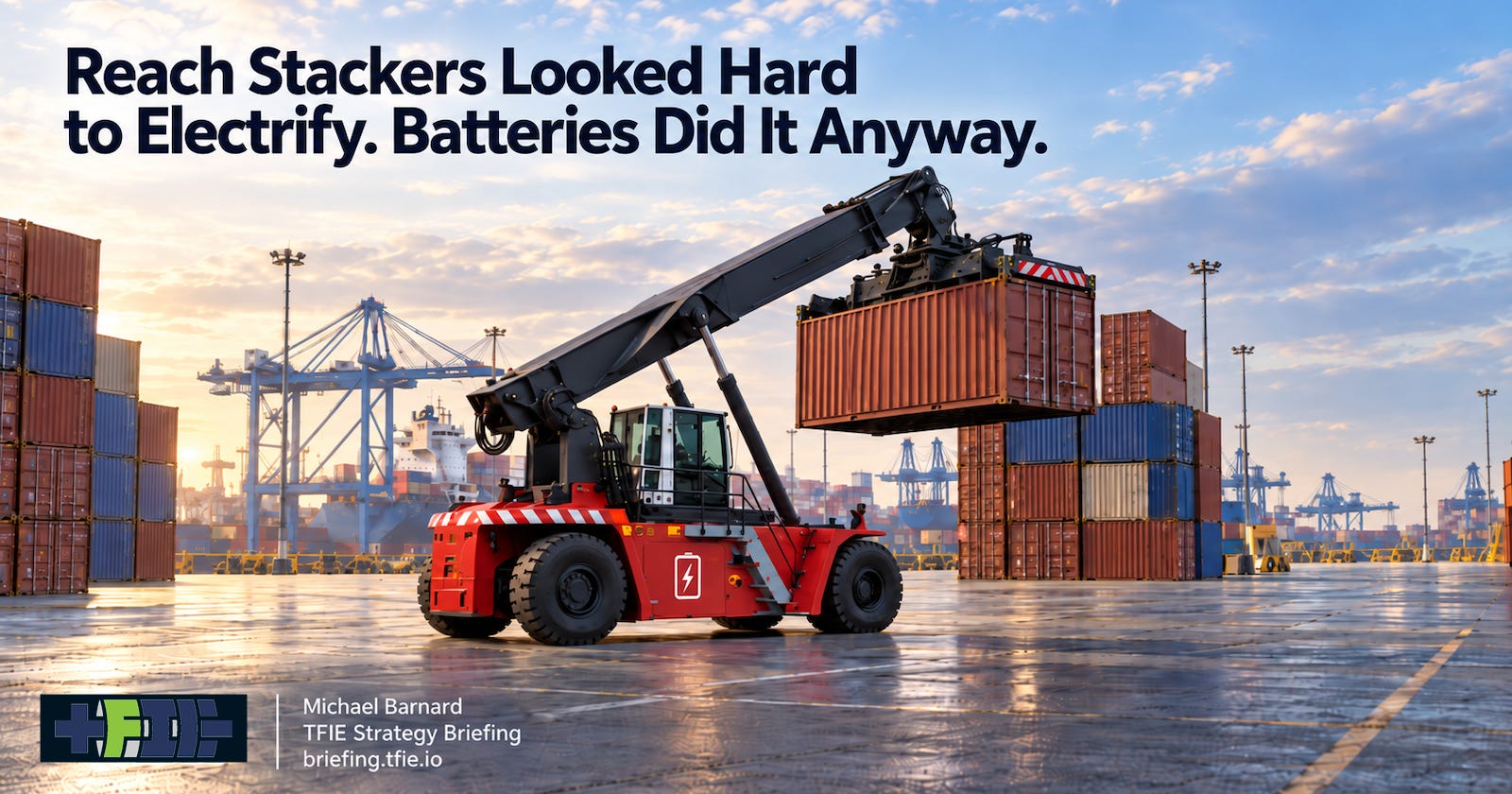
The Port of Tilbury put a hydrogen fuel-cell reach stacker into service this month. Hyster and Tilbury describe the machine as a pre-production trial, with 32 kilograms of hydrogen onboard and enough stated endurance for a 12-hour shift. I assumed it would join a small but recognizable population of hydrogen reach-stacker trials around the world, perhaps high single digits and conceivably low teens once Chinese prototypes and poorly publicized demonstrations were included. That expectation turned out to be generous. After following actual machines rather than announcements, I could substantiate only the earlier Hyster prototype at Valencia and the new Tilbury machine as hydrogen reach stackers that have clearly performed real terminal work. Valencia’s pilot concluded in 2025; Tilbury’s has just begun. Hyster explicitly describes Tilbury as building on the completed Valencia pilot.
The more consequential finding was on the battery side. My assembled estimate from manufacturer disclosures, production data, named fleets and orders puts the global battery-electric reach-stacker population at roughly 1,500 machines, with something like 1,200 to 1,800 a reasonable uncertainty range. This is not a census and I would not pretend otherwise, but several independent pieces fit together well. Work led by Sahar Rashidbeigi at APM Terminals and carried into the Zero Emission Port Alliance put the worldwide reach-stacker population at about 9,300 machines. A commercial market estimate puts 2025 electric reach-stacker production at about 460 units, while the same research publisher estimates total 2025 port reach-stacker production at about 2,460 units. Those two estimates imply electric machines were already approaching one-fifth of current production. Against a stock of roughly 9,300, an electric installed base somewhere around 1,500, or roughly 15% to 16%, no longer looks aggressive. It looks like what might be expected when fleet turnover meets improving economics.
Reach stackers are a good machine for exposing bad intuition about electrification. A large one can weigh 70 tonnes or more before it picks anything up, then grab a loaded ISO container weighing around 40 to 45 tonnes with a telescoping boom, move it around a yard and stack it several containers high and more than one row deep. The enormous ship-to-shore cranes get the photographs, but reach stackers do much of the flexible work once containers are on land: repositioning boxes, dealing with exceptions, feeding trucks and trains and working in terminal areas where fixed gantries are inappropriate. In my earlier work on port-equipment electrification and later in From Quay To Sea, the recurring point was that ports have to be understood as logistics and energy systems, not collections of isolated engines. Reach stackers make the argument almost embarrassingly concrete. Looking at a 70-tonne machine lifting a 40-tonne box encourages the thought that it must require a high-energy-density fuel. Looking at what the machine actually does leads somewhere else entirely.
It travels slowly on flat, paved surfaces over short distances inside a bounded industrial site. It needs very high peak power to accelerate, lift and operate hydraulics, but much less average energy than its size suggests. It brakes frequently, lowers heavy loads from which some potential energy can be recovered, waits while containers and vehicles are positioned, and repeatedly returns to predictable parts of the terminal. The machine does not need enough stored energy to cross a continent. It needs enough energy to get through the next natural charging opportunity. That distinction between power and energy is crucial, and real operating data show just how large it is. New Zealand freight operator Reliance Transport reports that its 74-tonne SANY electric reach stacker consumes only about 33 kWh per operating hour while routinely getting through full eight-hour shifts and handling around 100 container moves a day during busy periods. A machine capable of enormous instantaneous loads is averaging energy consumption equivalent to only about 33 kW over the working hour.
The battery-electric fleet looked surprisingly large until I checked the economics. Then the surprise mostly disappeared. What operators are buying is not merely a lower-carbon reach stacker, but increasingly a lower-cost one.
