

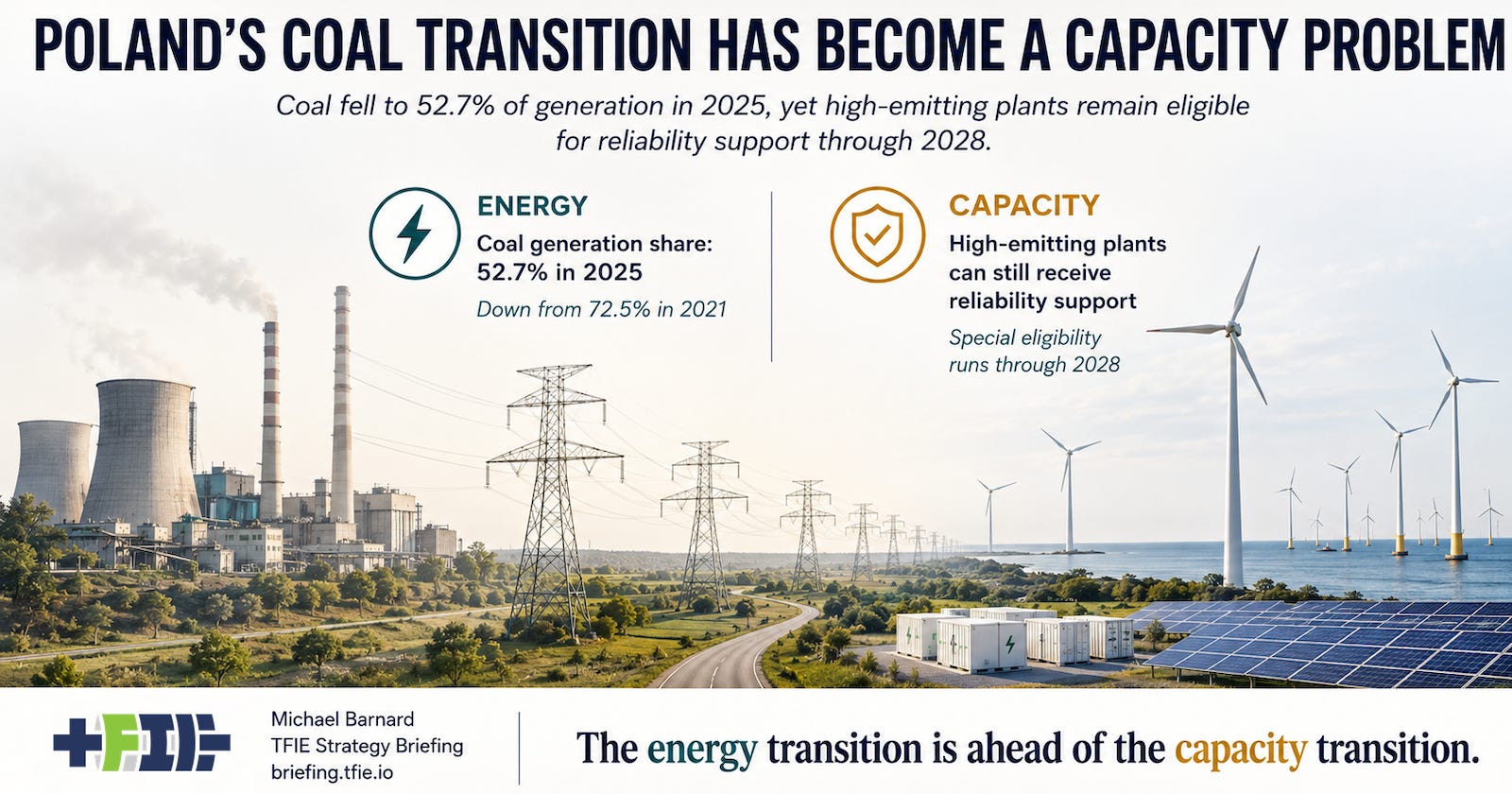
In May 2025, I wrote that Poland’s coal generation had fallen from more than 90% to 63% since 1990, “all due to renewables.” That sentence aged badly in two ways. The original CleanTechnica article was directionally right about the decline of coal, but final 2024 data subsequently put coal at just 56.2% of gross electricity generation, with renewables at 29.4%. Then 2025 pushed coal down again, to 52.7%, while renewables rose to 31.4%.
The second correction matters just as much. It was too simple to say renewables were responsible for all of coal’s decline. Solar and wind are doing much of the structural displacement, but gas has been gaining share as well. In both 2024 and 2025, natural gas recorded the largest increase in generation share, rising by more than two percentage points each year. In 2025, hard coal still generated 57.6 TWh and lignite 33.5 TWh, but gas was up to 24.4 TWh, onshore wind supplied 23.8 TWh and solar 20.3 TWh. Poland is replacing coal with a mixture of renewables and gas, not executing a clean one-for-one coal-to-renewables swap.
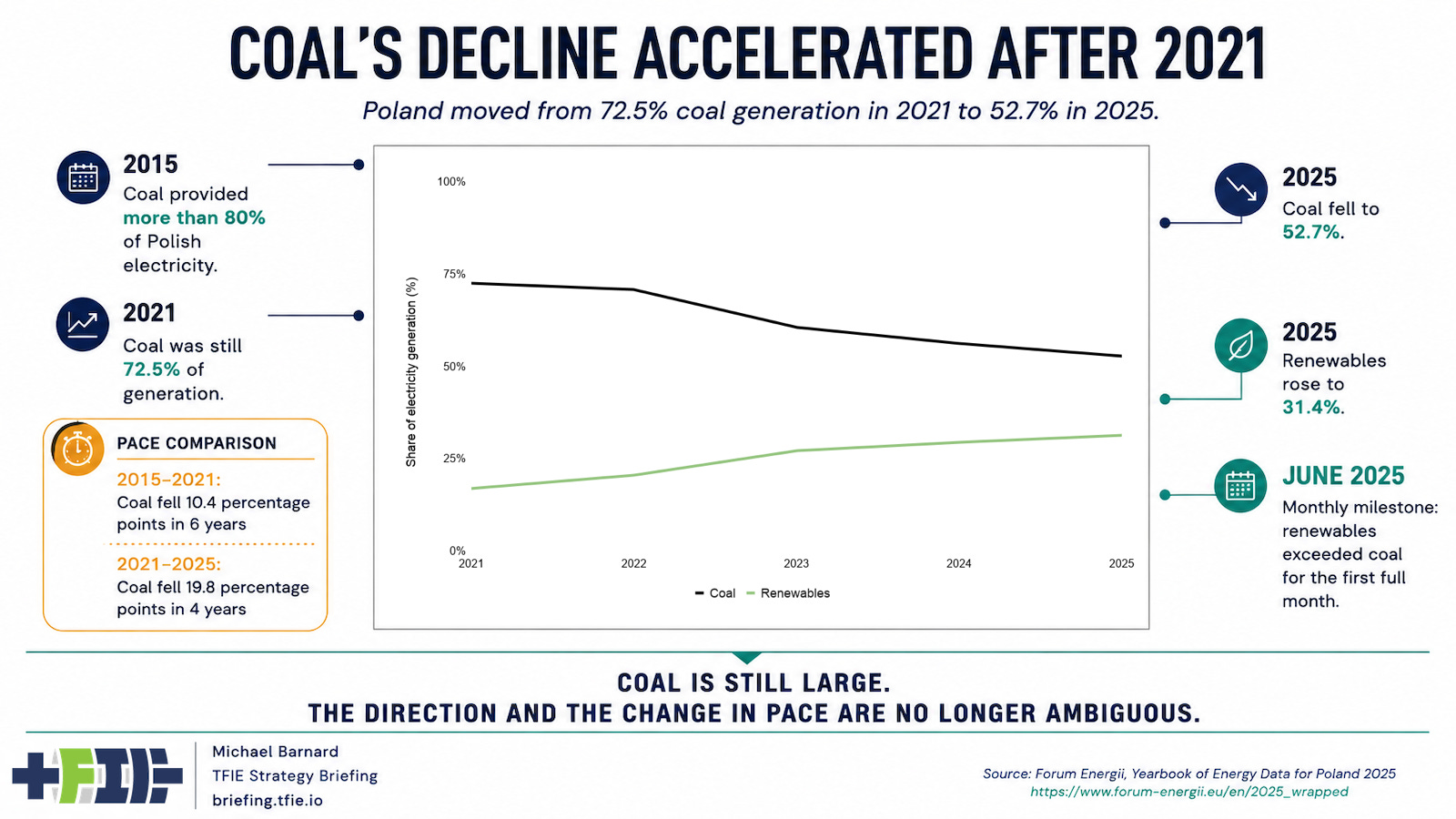
What has changed most since that earlier article is the slope. Coal supplied more than 80% of Polish electricity in 2015. By 2021 it was still at 72.5%, a decline of 10.4 percentage points over six years. In the next four years it lost another 19.8 percentage points, reaching 52.7% in 2025. Coal supplied less than half of Polish generation in five separate months during the year, and in June renewables produced more electricity than coal over a full month for the first time. This is no longer a slow diversification story measured over several decades. Most of the recent change has occurred in a handful of years.
The monthly numbers also show why declaring victory would be premature. In May 2026, hard coal still supplied 30% of electricity entering Poland’s power system and hard coal plus lignite supplied nearly half. Solar, meanwhile, supplied a remarkable 21% for the month and wind another 11%. Battery storage capacity reported to Poland’s Energy Market Agency had passed 1 GW. This is what an electricity system in the middle of a transition looks like: renewables can dominate particular hours and become major sources over whole months while coal remains materially important when weather, demand and system conditions change.
That leads to the more interesting Polish coal story now. Coal generation is falling faster than Poland can stop relying on coal capacity. Annual electricity generation measures energy, in MWh or TWh. Power-system adequacy asks a different question: whether enough dependable MW are available during the difficult hours when demand is high, wind is weak, solar is absent, imports are constrained or several things go wrong at once. A coal plant can therefore run fewer hours every year, lose market share and become increasingly uneconomic as an energy producer while still being considered useful insurance against those stress periods.
Poland’s capacity market makes that distinction unusually visible. In September 2025, the supplementary auction for the 2026 delivery year contracted 7.58 GW of capacity obligations. The important detail is not that all 7.58 GW was coal, because it was not reported that way. It is that plants emitting more than 550 kg of CO₂ per MWh were allowed to participate under a special derogation. Similar supplementary auctions are planned for 2027 and 2028, and the European Commission’s exemption allowing this high-emitting capacity to receive support runs only through December 31, 2028.
That can look contradictory if the only metric being watched is annual coal generation. Poland is adding renewables quickly enough to push coal down the merit order, then paying to keep some high-emitting capacity available because the rest of the system is not yet capable of replacing all of its reliability function. Those are not opposite policies so much as different stages of the same transition. The energy transition has run ahead of the capacity transition.
Poland is already seeing what has to come next. Renewable generation grew enough in 2025 that 1.4 TWh was curtailed, twice the 2024 amount. Almost all of that curtailment was attributed to balancing rather than physical grid congestion. During many sunny periods, Poland now has more low-marginal-cost generation than its relatively inflexible power system can conveniently absorb. At other times, it still wants coal plants standing by. Building another solar farm solves the first problem only if the electricity can be shifted, exported or turned into useful demand, and it does not by itself solve the second.
This is why transmission, interconnection, batteries, flexible demand, district heating, smart EV charging and other forms of load shifting increasingly matter as much as another tranche of generation capacity. Poland’s old coal fleet was built to be the electricity system. The replacement is a mesh of generation, grids, storage and responsive demand. That replacement can use much less fuel, but it requires more coordination across the system.
The physical transition is becoming harder to miss. On July 10, 2026, Poland’s first offshore wind farm, Baltic Power, delivered its first electricity to the grid. At that point 54 of its 76 turbines had been erected. When fully commissioned, the project will provide about 1.2 GW, producing roughly 4 TWh a year, equivalent to around 3% of current Polish electricity demand. Offshore wind is moving in the same direction as the already much larger solar buildout: technologies that were peripheral to the Polish system a few years ago are becoming material pieces of it.
The near-term outlook no longer requires heroic assumptions. The International Energy Agency now expects Polish renewable generation to grow about 13% annually through 2030, overtaking coal on an annual basis in 2028 and reaching about 53% of generation by 2030. Over the same period it expects coal generation to fall around 11% a year. Gas is forecast to grow, not disappear, which reinforces the point that Poland’s electricity decarbonization is progressing rapidly without yet being complete or entirely clean.
There is a useful denominator for watching Poland from here. Do not track only the percentage of electricity generated from coal. Track that alongside the amount of coal capacity the system still believes it needs during its hardest hours. The first number is already falling very quickly. The second will tell us whether grids, storage, flexible loads, interconnection and replacement generation are arriving fast enough to let the plants themselves disappear.
Poland has therefore moved into a more difficult and more interesting stage than the one I described in May 2025. It no longer needs to demonstrate that wind and solar can take large quantities of generation away from coal. They already are. The test now is whether Poland can build enough flexibility around them that coal stops being valuable even as insurance.
Getting coal out of the energy mix comes first. Getting coal out of the power system is the harder second act.
For more system-level analysis of grids, generation and the energy transition, subscribe to TFIE Strategy Briefing.