

In May, I wrote about what happened after Poland heavily subsidized hydrogen buses. Cities discovered that grants covering much or all of the vehicle cost did not produce cheap transportation. They still had to procure hydrogen, secure refuelling infrastructure and absorb the risks of depending on a specialized fuel supply chain. By April 2026, Poland had 153 hydrogen buses registered, 140 in service and another 107 contracted, enough deployment to move the discussion beyond demonstrations and pilot projects. The results documented by CEE Bankwatch included high delivered fuel costs, failed tenders, station losses, fuel-quality problems and municipalities switching planned hydrogen purchases to battery-electric buses.
That assessment mostly looked at the transit-agency side of the market. Poland’s hydrogen strategy had a broader industrial-policy logic. Subsidized buses would create hydrogen demand, demand would support refuelling stations, stations would help justify hydrogen production, and production would support a domestic hydrogen industry. The experience of Polenergia shows what happened on the supply side. Poland’s largest private energy group spent several years developing renewable-hydrogen projects, secured technology partners and public support, and in one case won a 15-year municipal fuel tender. It nevertheless concluded that hydrogen no longer justified substantial additional investment and began withdrawing from the sector.
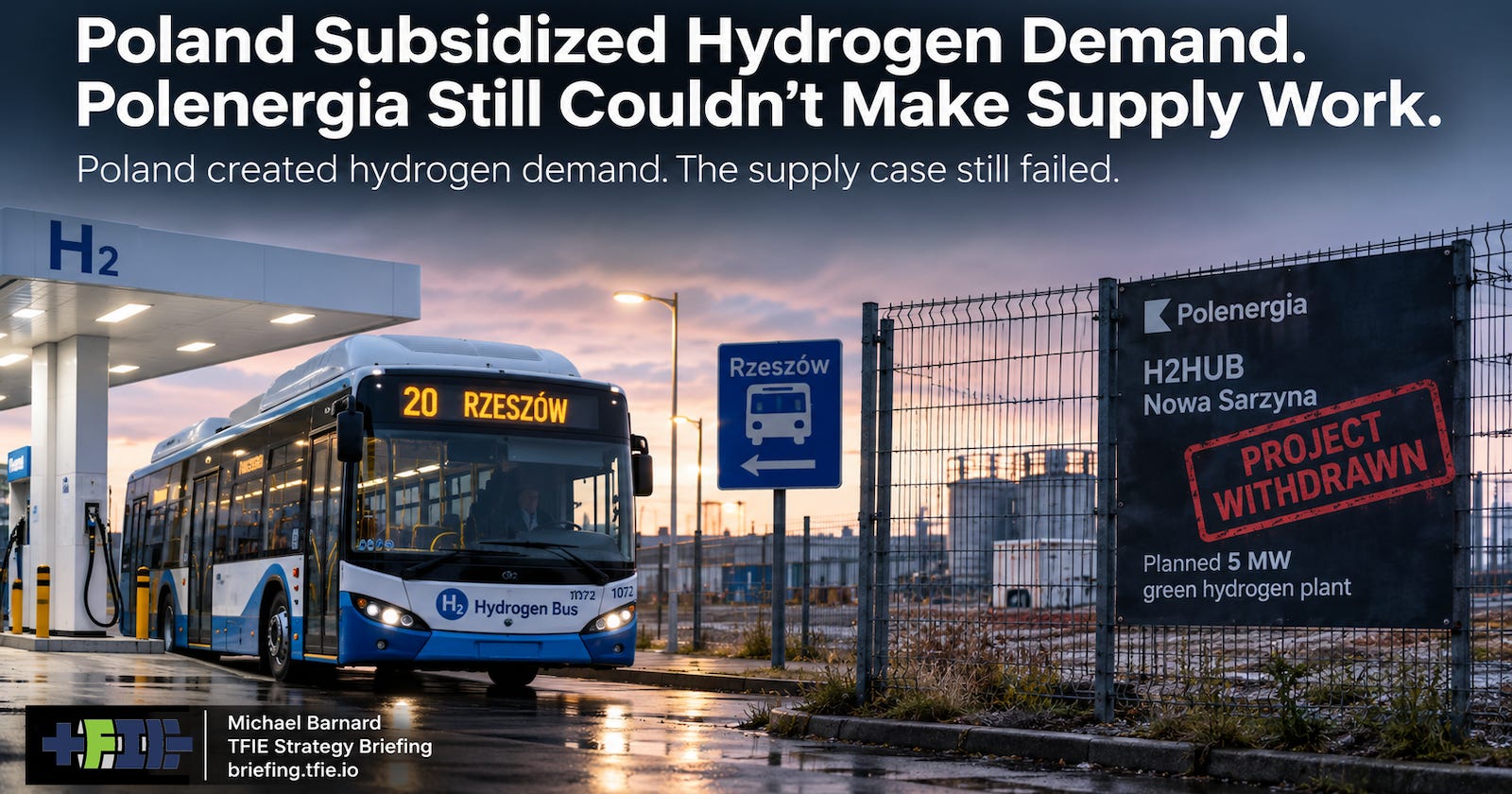
The most useful case is H2HUB Nowa Sarzyna, in southeastern Poland. Polenergia planned a 5 MW renewable-hydrogen installation capable of producing roughly 500 tonnes annually, together with distribution and refuelling infrastructure. It contracted Norwegian electrolyser manufacturer Hystar to supply and commission the plant, and the International Finance Corporation agreed to support development spending and part of the electrolyser purchase cost. Poland’s environmental fund separately offered support for hydrogen filling stations at Nowa Sarzyna and the Rzeszów bus depot. By October 2024, Polenergia had a building permit and all eight Hystar electrolyser stacks had completed factory acceptance testing. The project had therefore progressed substantially beyond the memoranda, feasibility studies and future production targets that make up much of Europe’s hydrogen pipeline.
It also had something many hydrogen projects lack: an identified long-term customer. MPK Rzeszów was procuring hydrogen for 20 fuel-cell buses, and in October 2024 Polenergia won the tender. The proposed supply agreement was worth about PLN120 million and would have run for 180 months, giving the project a 15-year municipal offtaker. The quantities were meaningful without being sufficient to absorb the plant’s entire production, making Rzeszów the sort of anchor customer around which additional transport or industrial demand could theoretically develop. This was close to the market-development sequence Poland’s hydrogen strategy envisioned: public procurement created durable demand, an established energy company built local renewable supply, and dedicated infrastructure connected the two.
Polenergia nevertheless decided in January 2025 that it could not conclude the Rzeszów agreement. Its disclosure cited legal issues associated with the tender as well as the risk that it would not be able to deliver hydrogen on schedule. The decision came while the company was already reassessing its hydrogen strategy. Its 2025–2030 corporate strategy subsequently called for a gradual withdrawal from hydrogen transportation, a subsidized hydrogen-storage research project at Nowa Sarzyna was discontinued, and the H2HUB investment was impaired. Later financial disclosures cited the development of the green-hydrogen market, the project’s investment-risk profile and limited possibilities for obtaining financing. The important point is not that one tender collapsed, but that an established energy company looking at the complete investment case decided that the project no longer met its requirements despite having progressed unusually far toward operation.
Polenergia’s much larger H2Silesia project makes the wider strategic shift clearer. The proposed 105 MW plant was intended to produce around 13,000 tonnes of renewable hydrogen annually for industrial and transport customers. It qualified under the European Hy2Infra programme for a state-aid ceiling of €142.77 million, and in June 2025 Poland’s Bank Gospodarstwa Krajowego recommended PLN618.3 million in non-repayable support under the National Recovery and Resilience Plan. Even with that prospective subsidy, Polenergia continued to make investment conditional on securing hydrogen sales contracts, acceptable project economics, financing and final corporate approval. After Polenergia sought changes intended to reflect current market conditions and its revised strategy, BGK concluded that the alterations could not be accommodated within the funding arrangement. The grant agreement was not signed, H2Silesia was impaired and subsequent company reporting listed the project as abandoned.
The reasons Polenergia gave shareholders are more useful than another theoretical comparison of electrolyser and battery efficiency. In its responses to shareholder questions, it identified rapid improvements in battery vehicles and growing competition from Chinese manufacturers as reducing the attractiveness of hydrogen vehicles in low-emission transport. It also pointed to slow development of the regulatory mechanisms expected to support renewable hydrogen and to customers delaying purchasing decisions. Polenergia was not retreating from the energy transition generally. Its strategy directs substantial capital toward offshore and onshore wind and other electricity assets where revenues can be secured through mechanisms such as power purchase agreements and contracts for difference. Hydrogen was being asked to compete internally for capital against technologies with clearer demand, simpler infrastructure and more bankable revenue streams, and it lost that competition.
Rzeszów then had to deal with the consequences from the other end of the supply chain. Its 20 hydrogen buses were still arriving, but the prospective local renewable-hydrogen supplier was gone. A subsequent fuel procurement attracted a single offer from PAK-PCE Stacje H2, part of the ZE PAK/Polsat Plus hydrogen business. The contract was worth about PLN9.64 million for an estimated 117 tonnes of hydrogen through the end of 2027, above the city’s initial budget, with the first buses supplied through containerized refuelling infrastructure while permanent facilities are developed. Instead of creating enough predictable demand to bring competitive local production into operation, Rzeszów became a relatively small captive hydrogen customer dependent on an external supplier and dedicated logistics.
That outcome matters because Poland has not lacked either hydrogen policy or public funding. The country subsidized hydrogen buses to establish demand, supported refuelling infrastructure, funded electrolyser projects and offered substantial grants to larger renewable-hydrogen developments. The Nowa Sarzyna project added an established energy company, a contracted electrolyser supplier, international financial involvement, permitting and a 15-year municipal customer. Those conditions addressed many of the explanations usually offered for why green-hydrogen projects fail to reach final investment decisions. They still did not create an investment case attractive enough for Polenergia to continue.
This does not imply that renewable hydrogen has no future in Poland. Poland already consumes large quantities of fossil-derived hydrogen in refining, chemicals and other industrial processes, and replacing that existing hydrogen with progressively lower-carbon supply remains a substantial decarbonization task. Those consumers also provide large, concentrated demand that does not first have to be created through subsidies for new end-use technologies. Urban buses are different because a mature direct-electric alternative already exists. My May assessment argued that creating additional hydrogen demand in public transport before decarbonizing Poland’s existing industrial hydrogen consumption was poor sequencing. Polenergia’s withdrawal strengthens that argument by showing that the hoped-for supply response was not simply waiting for municipalities to buy enough buses.
The original Polish industrial-policy proposition was that subsidized transport demand could help bootstrap a competitive low-carbon hydrogen ecosystem. The bus programme did create customers that require hydrogen for the next decade or more, but Polenergia’s experience shows that creating demand is not the same thing as creating economical supply. Even with substantial public support and a long-duration customer, prospective local production could remain difficult to finance and unattractive relative to competing investments. Poland’s hydrogen bus experience therefore now provides evidence from both sides of the market: municipalities discovered that subsidized vehicles could leave them with expensive and fragile fuel supply, while a prospective supplier discovered that subsidized demand did not necessarily make producing that fuel an attractive business.
If decision-grade assessments of transport technologies, infrastructure and industrial policy are useful to your work, subscribe to TFIE Strategy Briefing. Paid subscribers get the deeper evidence, scorecards and procurement analysis behind the public arguments.