

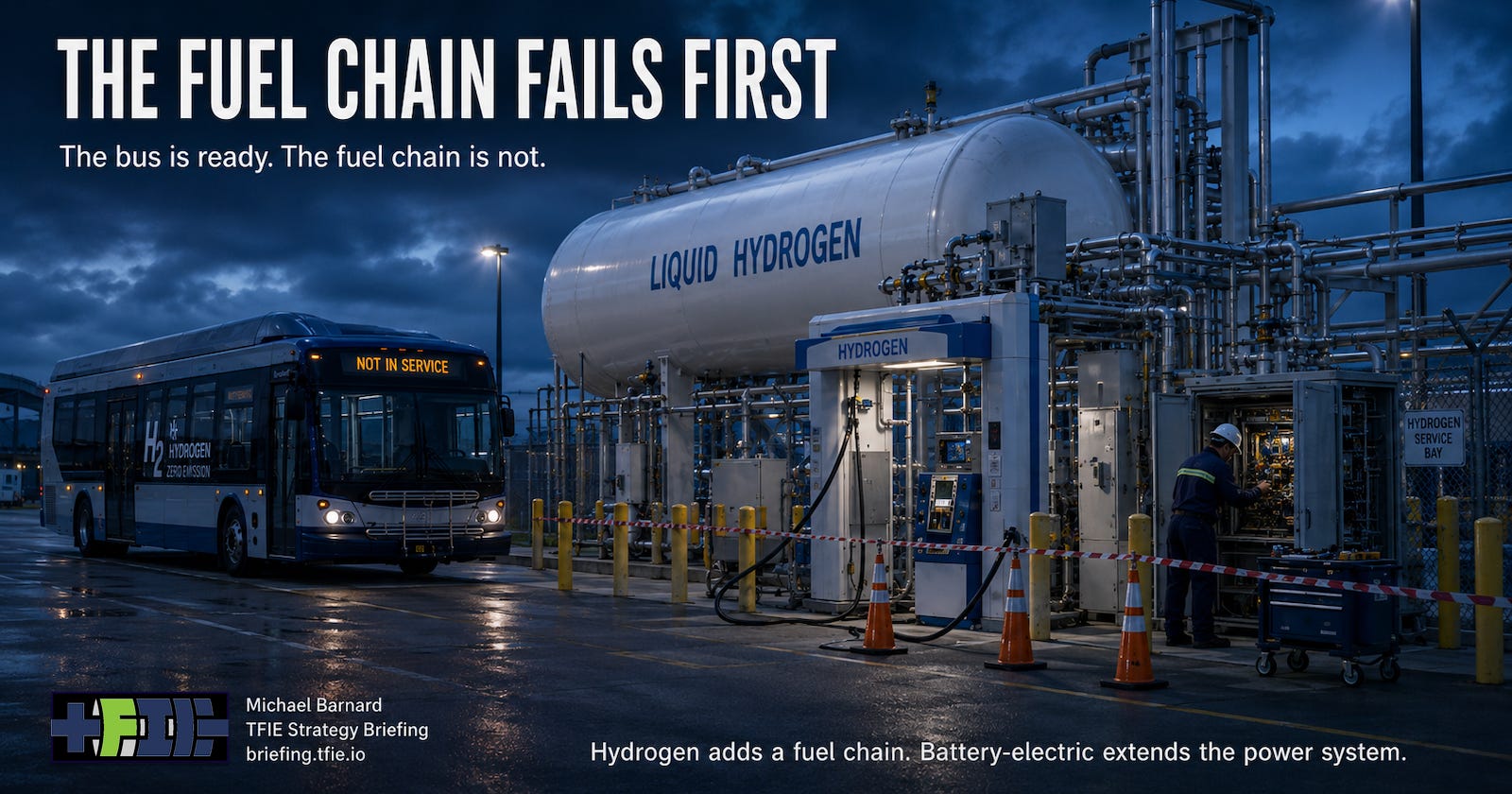
Clean Energy has won a $27.6 million contract to build a second hydrogen station for the Orange County Transportation Authority as OCTA expands its fuel-cell bus fleet from 10 buses toward 50. The press-release reading is straightforward: a growing zero-emission fleet needs more fuel capacity. But OCTA already opened a substantial hydrogen station at its Santa Ana base in 2020, sized to fuel roughly 40 to 50 buses per day. The total cost for the various refueling systems has risen to $108 million, well over $2 million per bus.
That first station did not simply wear out. OCTA owned much of the installation, but Air Products owned the leased 18,000-gallon liquid-hydrogen tank and vaporizers. After the parties failed to reach a new commercial agreement, Air Products removed that equipment in January 2026 and the station became unusable. OCTA is now planning a roughly $19 million replacement and capacity expansion at Santa Ana while separately paying Clean Energy for the new Garden Grove station.
The operating consequences were already visible before the equipment was physically removed. OCTA’s ten fuel-cell buses traveled 270,462 miles in 2024 and only 14,232 miles in 2025, a decline of almost 95%, amid hydrogen fueling problems and reliance on off-site fueling. The agency sent buses to a commercial Shell station near Long Beach and moved toward temporary mobile fueling while trying to restore depot capability.
OCTA also operates battery-electric buses, which gives the case an unusually useful internal comparator. Its chargers have had reliability problems too, with OCTA reporting equipment availability around 80%, but the agency also reported no lost bus deployments because charging infrastructure was unavailable. The charging infrastructure also cost a fraction of the hydrogen refueling infrastructure, about $6 million. The hydrogen buses faced a different exposure because they depended on a dedicated fuel chain with few substitutes when a storage, supply or contracting link failed.
That is the Achilles heel of hydrogen for transit. A transit agency needs hydrogen that is affordable at the nozzle, genuinely low-carbon across its production and delivery chain, and reliably available every day for buses expected to operate for 12 to 15 years. Hydrogen bus programs keep struggling to secure all three conditions at once.
Low-carbon hydrogen starts with low-carbon electricity, but electrolysis consumes far more electricity than putting that electricity directly into a battery bus. The resulting hydrogen still has to be compressed or liquefied, transported or produced on site, stored, temperature-managed, dispensed and maintained to demanding purity and safety standards. Centralized production can improve electrolyzer utilization but adds logistics. On-site production reduces some logistics while adding electrolyzers, compression, storage and often poor utilization of expensive equipment. Those steps remain in the delivered fuel cost regardless of who owns them or which grant paid for them.
The Garden Grove award does not eliminate that exposure. The $27.6 million figure is not simply the construction price of a station. It bundles design-build work, facility modifications, fuel supply and 18 months of operations, maintenance and training. OCTA’s procurement documents also specify that at least 33.3% of the hydrogen supplied during commissioning and training must come from renewable sources. They do not establish that OCTA has secured 100% renewable hydrogen at an affordable long-term delivered price for the fleet’s operating life.
Orange County is not an exceptional case. SunLine Transit in California has spent a quarter century trying to make hydrogen transit work and has cycled through early electrolysis, reformers, a large PEM electrolyzer and, most recently, a truck-fed liquid-hydrogen station. Major refueling-system expenditures across those generations add up to about $27 million in 2026 dollars for a fleet of roughly 31 to 32 hydrogen buses. Compressor failures, station outages, delivered backup hydrogen and repeated rebuilding persisted despite exceptional institutional experience with the technology.
Poland provides the same signal under very different market and policy conditions. By April 2026 it had 153 hydrogen buses registered, supported by more than €120 million in grants for buses and refueling infrastructure, so this was no longer a collection of tiny pilots. Cities then encountered high delivered hydrogen prices, sparse fueling infrastructure, unprofitable station operations and fuel-contamination events that grounded buses. Several municipalities redirected planned hydrogen procurements toward battery-electric buses as the operating economics became clearer.
Taken together, SunLine and Poland make it difficult to explain OCTA as one bad vendor relationship. Hydrogen transit repeatedly turns a bus purchase into a long-duration dependency on specialized fuel production, storage, transport, dispensing, maintenance and counterparties. Battery-electric buses also need infrastructure, but their depots connect to an electricity system that already serves every city and is expanding for buildings, industry and vehicles. Hydrogen requires transit agencies to establish and sustain a second energy-delivery system for a comparatively small fleet.
Public subsidies can hide that difference at the point of purchase. OCTA’s program, like SunLine’s and many European hydrogen bus programs, has been supported heavily by government funding. Grants can pay for expensive buses and stations, but they cannot remove conversion losses, supply contracts, specialized maintenance or equipment replacement cycles. Once the buses are purchased, another station or another subsidy can become defensible simply because abandoning the existing assets would crystallize the earlier loss.
That dynamic deserves more attention in transit procurement. More buses improve station utilization, while more station capacity protects the bus investment, allowing each successive decision to reinforce the previous one. The relevant comparison is not whether the next hydrogen project can win grant funding. It is whether the entire fuel system can deliver low-carbon passenger-kilometers more cheaply and reliably than battery-electric buses over the fleet’s life.
OCTA’s response is now additional redundancy: rebuild Santa Ana, add Garden Grove and use temporary fueling in between. For an agency already committed to 50 hydrogen buses, that is understandable operational risk management. It also demonstrates how much infrastructure has to sit behind a supposedly simple advantage such as fast refueling.
Transit procurement should treat hydrogen supply as part of the drivetrain rather than as a separate facilities line item. An agency that cannot show how affordable, genuinely green hydrogen will reach its depot reliably for the full service life of the buses has not finished the propulsion-system procurement. OCTA’s experience is larger than one six-year-old station becoming unusable. The specialized fuel chain behind hydrogen buses keeps proving to be the weakest part of the system.
Transit procurement reality lives in operating costs, infrastructure uptime and service delivered, not grant-funded purchase orders. Subscribe to TFIE Strategy Briefing for more evidence-led analysis of what survives contact with operations.