

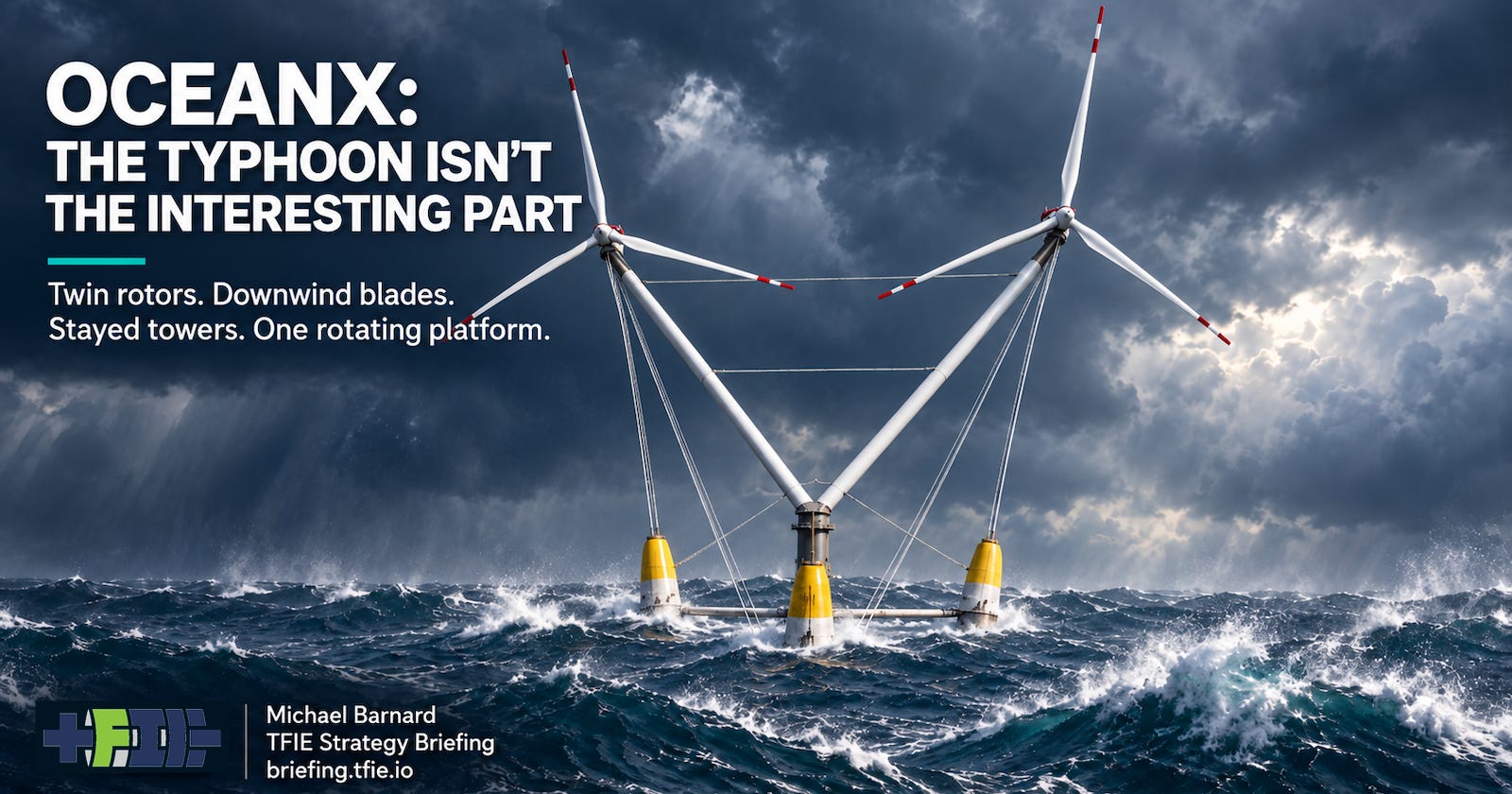
Landon Frigault, a Sustainable Energy Engineering student at Simon Fraser University, dropped an OceanX story into my LinkedIn messages over the weekend. A Chinese floating wind turbine had reportedly gone through a severe typhoon and kept spinning, which was enough to make me open the link. I expected another instance of China building a wind turbine at a scale that would have sounded implausible a decade ago, but the machine itself quickly became more interesting than the weather story. OceanX carries two turbines on one floating structure, and both rotors sit downwind of their supports.
Both choices were familiar to me from work I had done years ago. I had worked through the multi-rotor question in an old Quora answer, looking at why vertically stacking smaller rotors on a mast generally sacrifices swept area and puts more of the remaining rotor area into weaker wind closer to the ground, while putting one rotor behind another introduces wake losses, turbulent inflow and ugly cyclic loading. Modern three-bladed horizontal-axis turbines had converged on their familiar form for good engineering reasons, and most arrangements involving extra rotors looked worse after swept area, wind shear, wakes, structure and maintenance were included.
Downwind turbines had their own history. They offer some attractive characteristics, including natural alignment tendencies and more freedom for blades to deflect away from the support, but they historically paid for them every time a blade crossed the tower wake. The abrupt velocity deficit and turbulence behind the tower periodically unload the blade, contributing cyclic structural loading and, on some machines, the characteristic low-frequency thump that helped make downwind designs unpopular.
OceanX combines those two design choices on a 16.6 MW floating turbine, but it does so in configurations that differ markedly from the ones I had been considering years ago. The two 182 metre rotors sit side by side rather than one above or behind the other. Their supports are extraordinarily slender compared with ordinary wind-turbine towers and are held within a network of substantial pretensioned stays. The complete floating structure turns relative to its mooring system, keeping the rotors, towers and stays in approximately the same relationship to the wind as direction changes. Mingyang’s technical paper on OceanX makes clear that these are not independent curiosities bolted onto a conventional floater. They form a coupled structural and aerodynamic design.
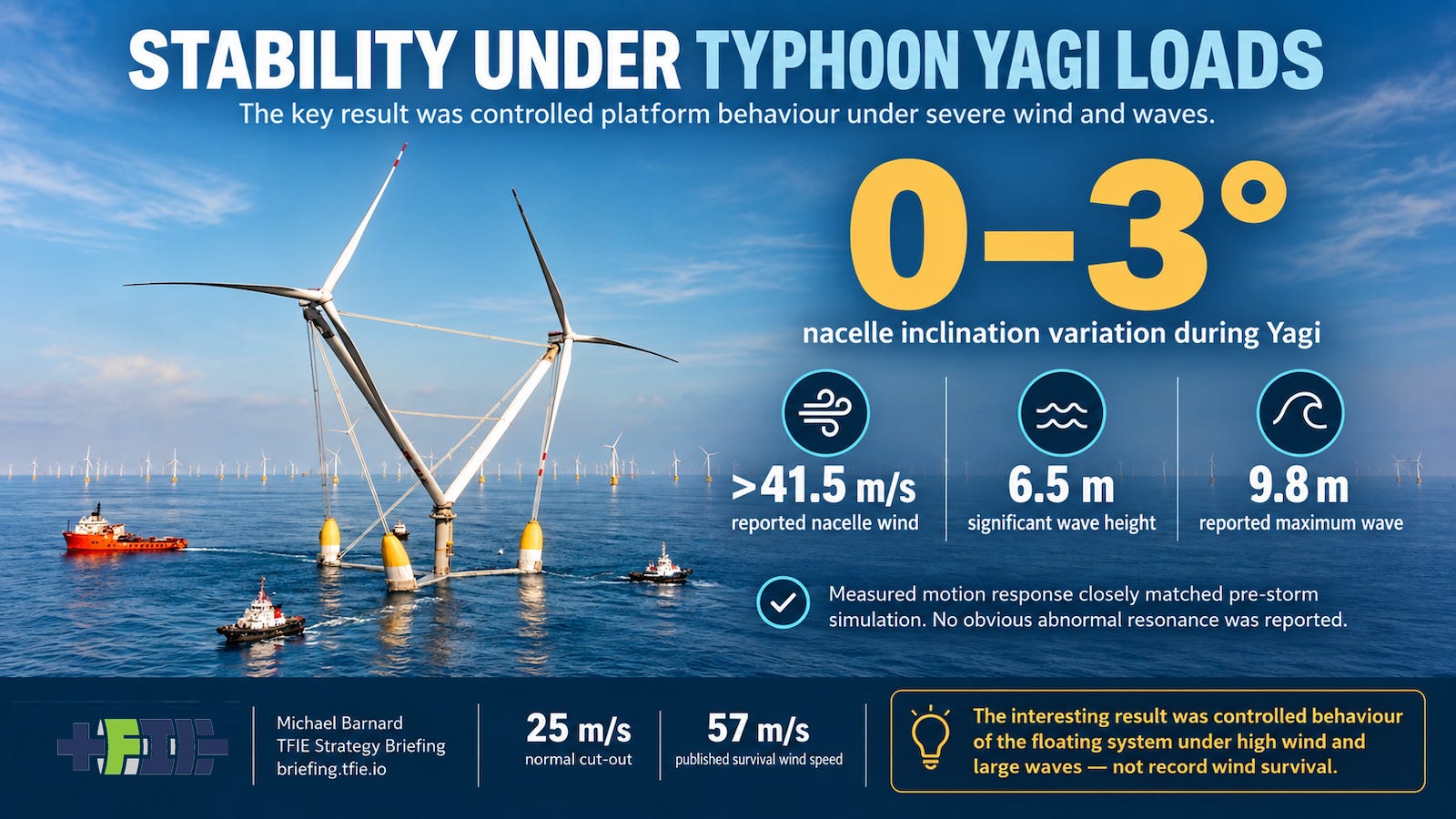
The typhoon claim itself turned out to be both less extraordinary and more useful than the headlines suggested. OceanX reached its Yangjiang site in August 2024 and Super Typhoon Yagi arrived in September. The turbine did not achieve grid connection until December 11, 2024, so descriptions implying that it continued feeding electricity into the grid throughout Yagi are chronologically impossible. Whether its rotors continued turning unloaded at particular points is a different question. The instrumented storm response is much more valuable. Mingyang reports nacelle wind above 41.5 metres per second, significant wave height of 6.5 metres, a maximum wave of 9.8 metres and nacelle inclination varying by only about zero to three degrees. Afterward, its engineers compared measured floating-body responses with simulations prepared before the storm and reported close agreement, no obvious abnormal resonance, closely matching upstream and downstream float drafts, and no obvious change in platform attitude or draft.
OceanX’s published normal cut-out wind speed is 25 metres per second and its survival specification is 57 metres per second, so Yagi did not expose the machine to a wind speed beyond what a typhoon-rated offshore turbine is supposed to survive. The reported wind was nevertheless far beyond normal generating conditions. Dynamic pressure scales with the square of velocity, making the ambient pressure associated with 41.5 metres per second roughly 2.8 times that at 25 metres per second before blade pitching and other load-reduction measures are considered. At the same time, the platform was responding to a 6.5 metre significant sea and individual waves approaching ten metres. A floating wind turbine has surge, sway, heave, roll, pitch and yaw available to it before the flexibility of towers, blades and mooring lines is included, and OceanX adds two widely separated rotors, a large stayed V structure and a rotating mooring connection. In that context, the roughly zero-to-three-degree reported nacelle inclination response is considerably more informative than the category attached to the storm.
The storm data made the rest of the machine worth taking seriously without resolving the two design choices that had initially made me skeptical. Two turbines still mean two nacelles, two drivetrains, two hubs and six blades. Downwind rotors still pass repeatedly through disturbed air created by the structures ahead of them. The thin towers and stays may reduce the tower-shadow problem enough to alter lifetime economics, or they may shift structural cost and fatigue into components that are less obvious in photographs. Whole-platform yaw eliminates conventional nacelle yaw systems but places more importance on a rotating connection below the waterline. My assessment therefore started to diverge: the severe-weather response looked better the more closely I examined it, the downwind arrangement became more technically interesting, and I remained unconvinced that two rotors were necessary.
OceanX does not overturn most of the objections I had made years ago about multi-rotor or downwind machines. Its designers have instead changed many of the conditions that created those objections. The rotors are beside one another instead of stacked or tandem. The stays may allow supports slender enough to greatly reduce the wake that historically penalized downwind machines. The complete structure weather-vanes rather than asking two nacelles to yaw independently. Almost all of those potential advantages, however, could also exist with one larger rotor. Following the load path from blades through towers and stays into the floating platform and its moorings made me substantially more interested in downwind floating wind, while leaving the case for two rotors unresolved.
