

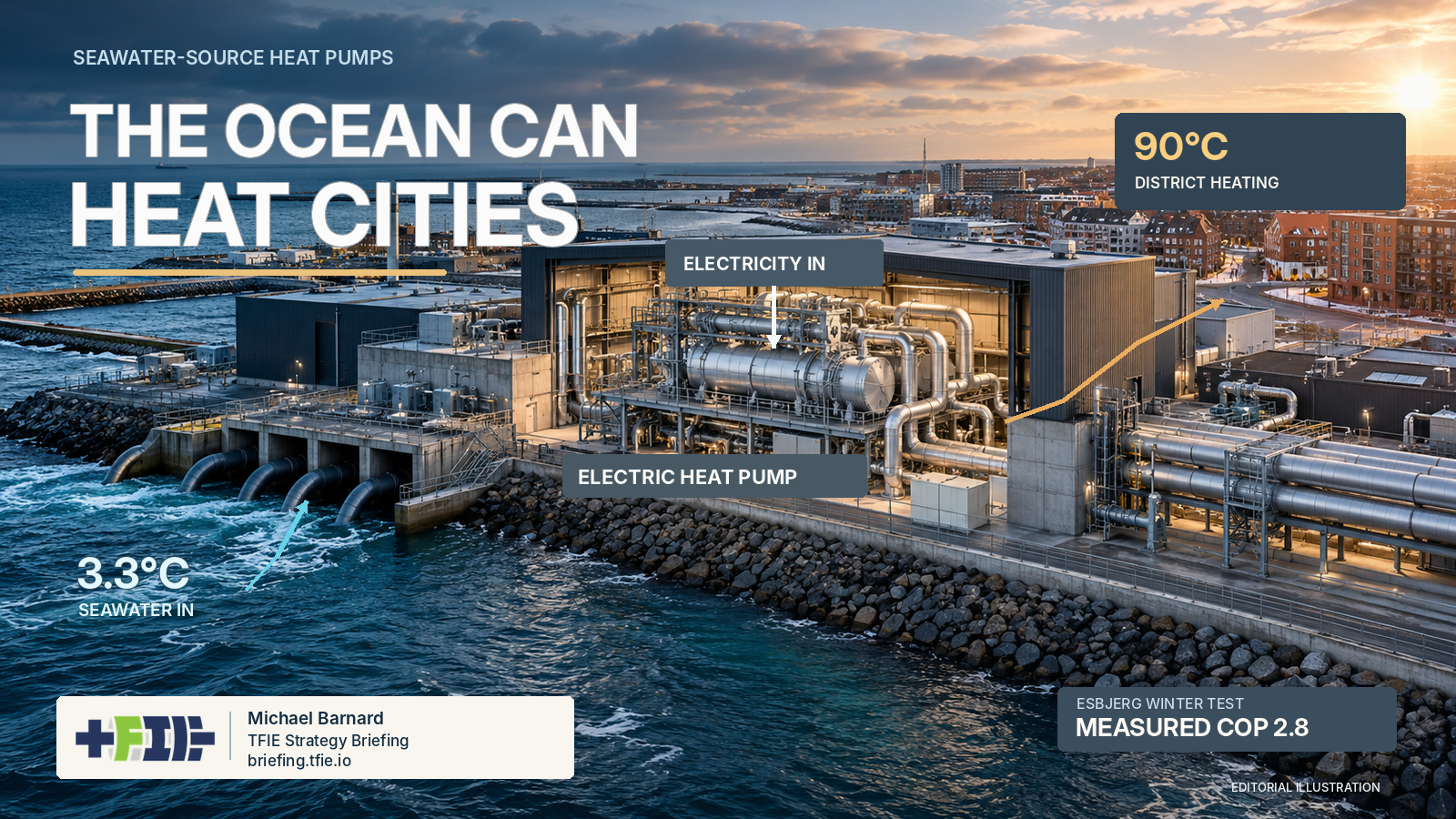
The North Sea is not somewhere most people would look for heating in winter. Yet in Esbjerg, Denmark, seawater at just 3.3°C is being used to deliver district heating water at 90°C. The city has installed enormous electric heat pumps that extract thermal energy from the sea, upgrade it to useful temperatures and distribute it to buildings. It is an established way to replace fossil fuel combustion with electricity and environmental heat.
The Esbjerg installation, which began delivering heat in late 2024, has a nominal capacity of 70 MW of heat. It is part of a broader replacement for the city’s retired coal-fired combined heat and power plant. What makes the project interesting isn’t its size alone, but the operating data reported in May 2025. During a two-hour test, the two heat pumps consumed 19.9 MW of electricity and delivered 55.2 MW of useful heat. The coefficient of performance, or COP, was 2.8. By subtraction, the remaining 35.3 MW of heat came from the seawater, which cooled from 3.3°C to 1.2°C as it passed through the system.
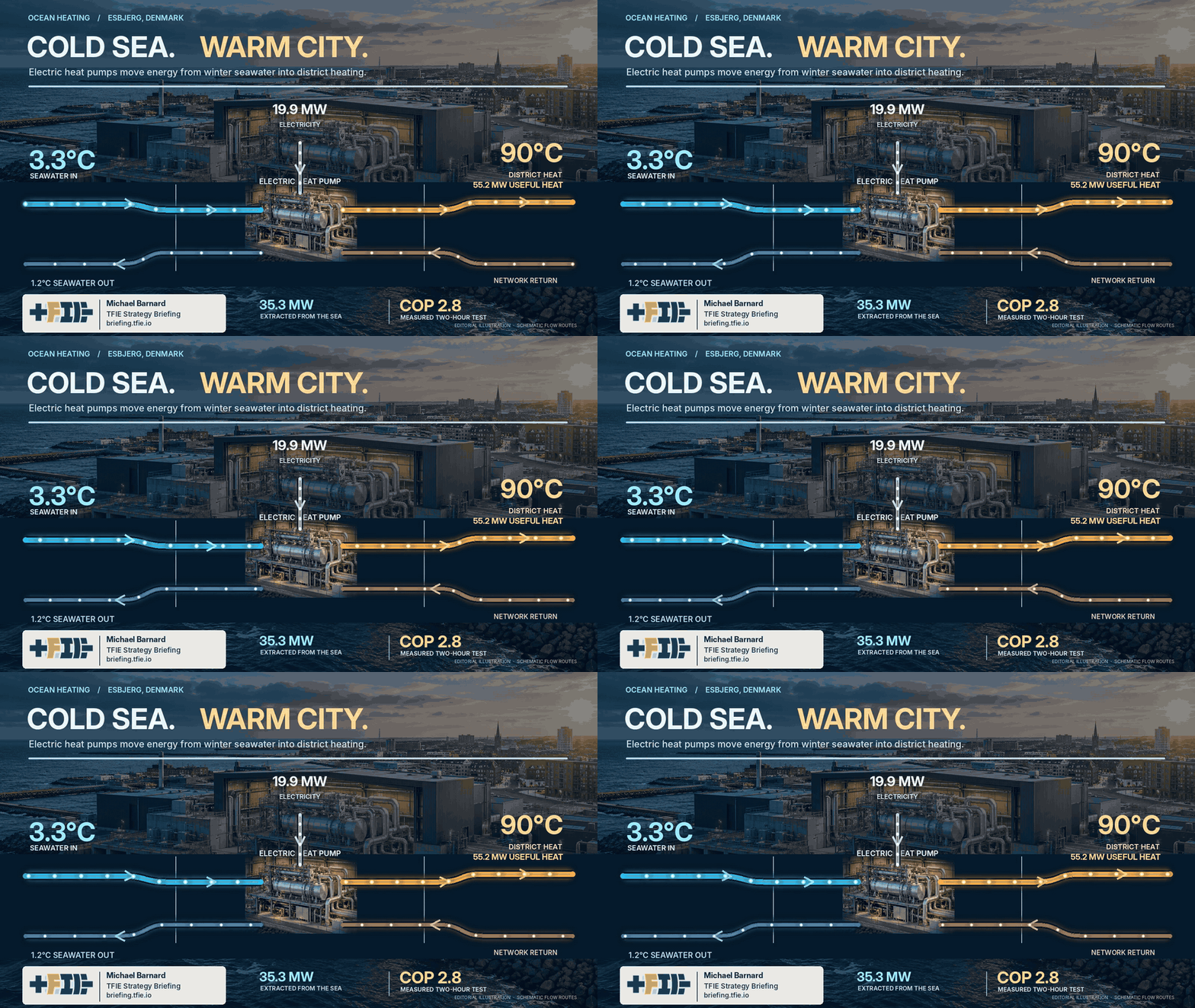
This sounds counterintuitive only because we tend to think of heat as something that must come from a hot source. Heat pumps don’t work that way. A refrigerant absorbs heat from water that is warmer than the refrigerant itself. An electrically driven compressor then raises the refrigerant’s temperature so that it can deliver useful heat to a building or district heating network. Esbjerg uses CO₂ as its refrigerant, operating in a high-pressure cycle designed for industrial-scale heating. The process is well-understood refrigeration engineering, running in the direction needed for heating.
The resulting efficiency matters. At a COP of 2.8, resistance heating would require almost three times as much electricity for the same heat output. At an illustrative electricity price of €100/MWh, the heat pump’s compressor electricity would cost about €36/MWh of heat, before seawater pumping, maintenance, capital recovery and distribution. Even at the demanding 90°C output temperature of an older district heating network, that is a useful multiplier. Lower-temperature heating networks can improve the economics further by reducing the temperature lift required.
The rest of this Briefing follows the operating history from Monaco and Stockholm to Horseshoe Bay, then examines the costs, cold-water limits and grid benefits. Subscribe for free to continue.