

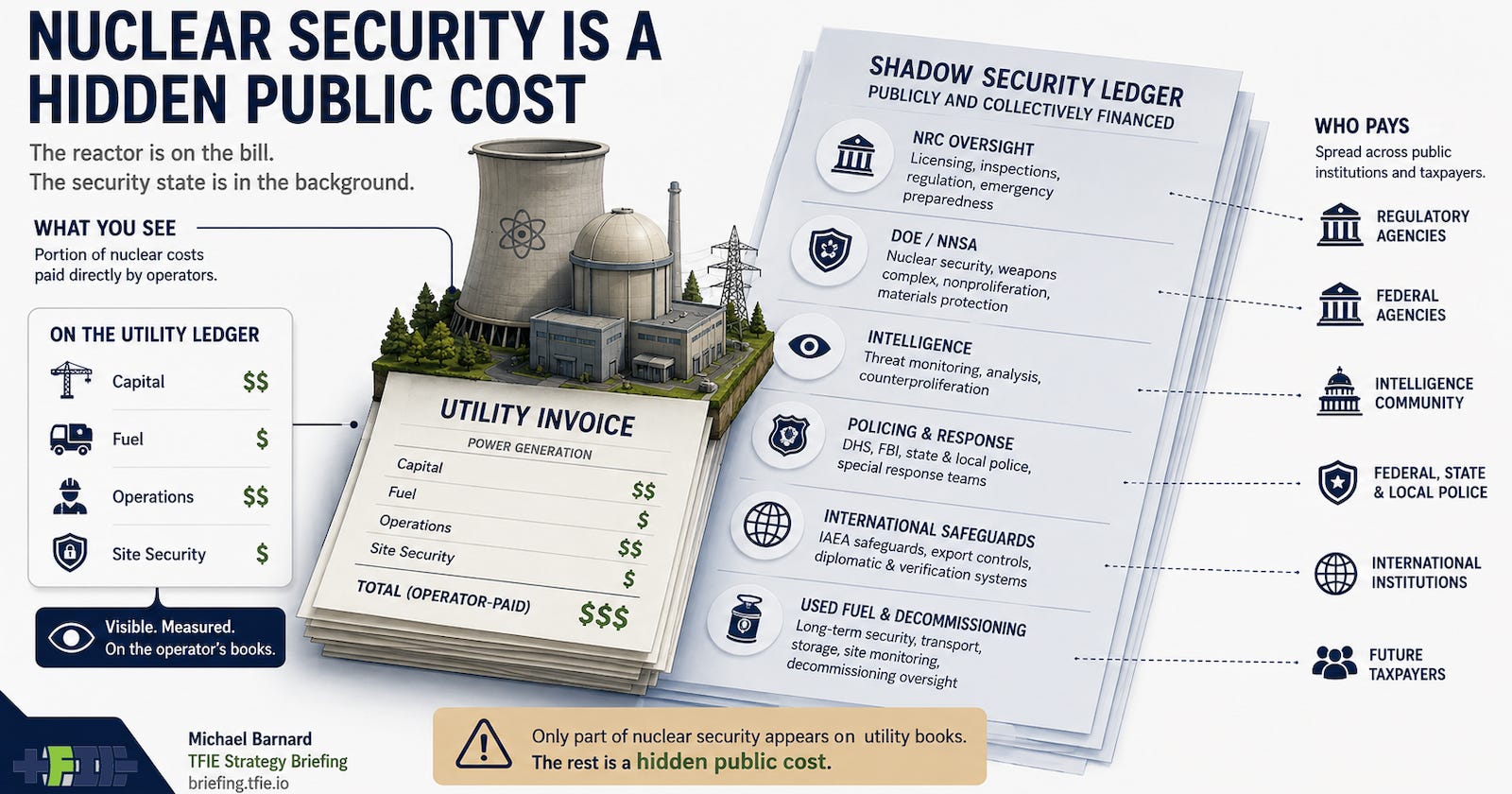
Nuclear power has an accounting problem that rarely appears in clean-energy comparisons. The industry requires overlapping layers of security across fuel supply chains, international safeguards, generation sites, used fuel, waste management and long decommissioning periods. Operators pay some of those costs directly. Much of the rest is spread across public agencies, regulatory systems, policing, intelligence and security institutions.
That was the core argument of my original CleanTechnica analysis in 2021. The article estimated that nuclear security costs in the United States were on the order of $50 million per reactor per year, with roughly half or less paid directly by operators. The resulting screening estimate was about $4 billion per year in uncounted public support for the U.S. nuclear fleet, in addition to direct tax preferences. That number should not be treated as a consolidated federal invoice. It was, and remains, an attempt to size a cost category that is otherwise scattered across too many budget lines to see clearly.
The need for that framing has not gone away. The numbers have moved, but the structure remains. As of March 2026, the United States had 96 operating commercial reactors at 57 nuclear power plants in 28 states. The NRC’s FY2027 budget request was $892 million with 2,606 full-time-equivalent staff. NRC fee recovery rules have also shifted: the Nuclear Energy Innovation and Modernization Act now requires the NRC to recover, to the maximum extent practicable, approximately 100% of its annual budget authority, excluding specific categories. The National Nuclear Security Administration, a semiautonomous DOE agency responsible for nuclear warheads, naval reactors and nonproliferation, has also grown materially, with an FY2026 request of about $30 billion.
