

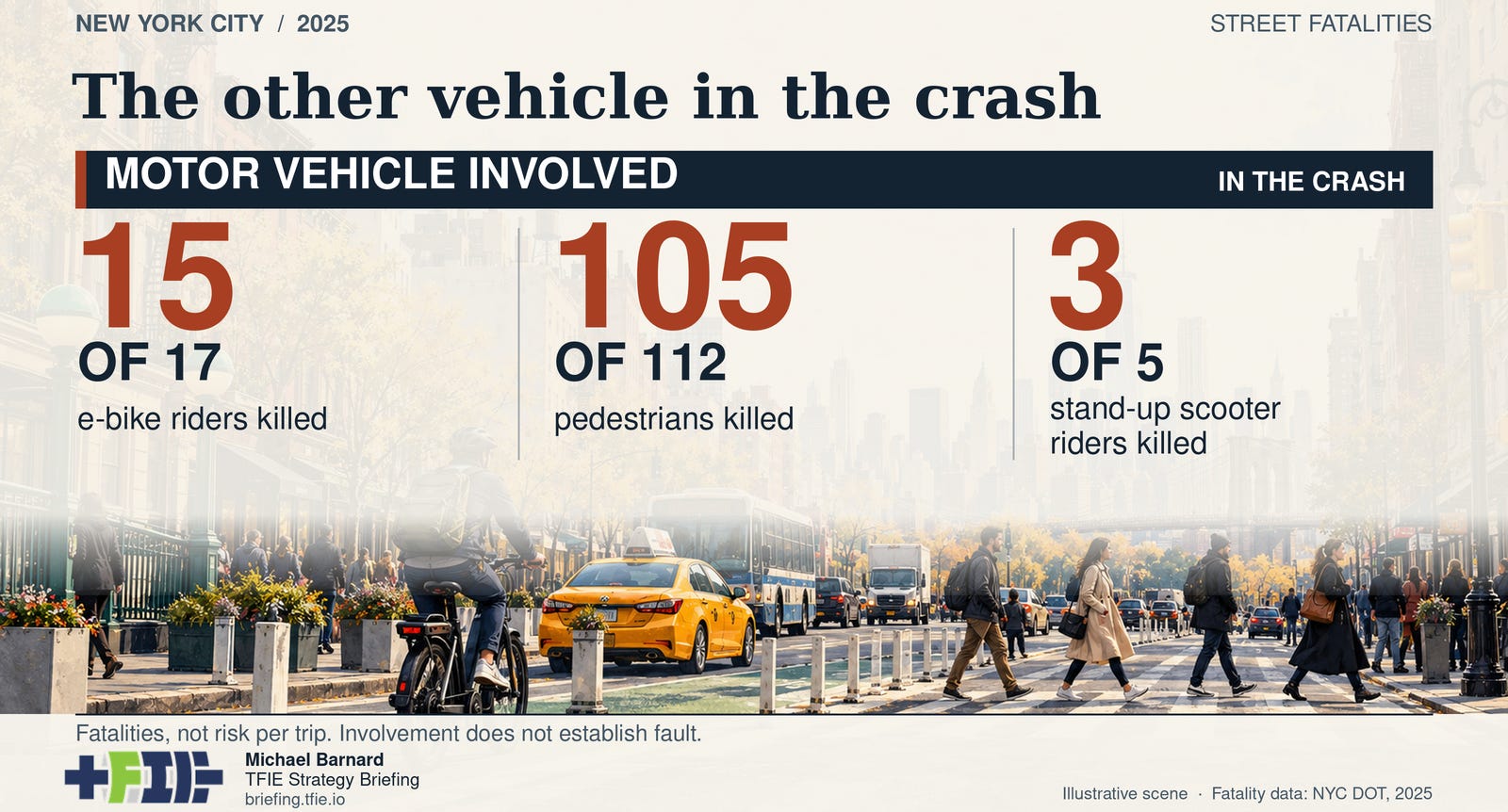
A recent New York Times newsletter says fatal crashes involving e-bikes and electric scooters in New York City have reached a record high this year. “Record” is a compelling headline word, especially when the vehicles are relatively new. But it directs attention to what the victim was riding and away from what else was involved. The most recent complete-year NYC DOT crash report records 17 people killed while riding e-bikes in 2025. Fifteen died in crashes involving a motor vehicle. Of five people killed while riding stand-up scooters, three died in motor vehicle crashes. Those numbers do not assign fault to a driver in every case. They do mean that “e-bike deaths” and “scooter deaths” are often also deaths in collisions with much heavier vehicles.
For pedestrians, the imbalance is starker. The city recorded 112 pedestrian deaths in 2025, 105 in crashes involving motor vehicles. A comptroller analysis of 2020–23 found motor vehicles involved in 434 of 449 pedestrian deaths, while e-bikes and stand-up scooters were involved in six. Scooters on sidewalks and reckless e-bike riding are real problems, including injuries that a fatality count misses. But a run of stories that makes electric two-wheelers the face of pedestrian danger gives readers a distorted view of what kills people on New York’s streets.
Small annual totals make the rhetoric of records particularly volatile. One more stand-up scooter rider death on top of the five in 2025 would raise that count by 20 percent. At the same time, electric Citi Bike trips exceeded 29 million in 2024, before counting any privately owned e-bikes or scooters. More riding can produce a higher death count without proving that a given ride has become more dangerous. The city should investigate every death and the fast machines involved in many of them; readers should also be told that millions of ordinary journeys sit behind these small fatality totals.
Some of those machines are plainly a safety concern. In an August 2026 enforcement announcement, the city said that 45 e-bike rider deaths from 2017 through 2025, 54 percent of the total, involved devices capable of exceeding 25 mph. Fourteen stand-up scooter rider deaths, 52 percent, involved devices capable of exceeding 20 mph. Capability is not proof of the speed at impact or the cause of each crash, but the prevalence of prohibited fast devices makes enforcement against their sellers and dangerous operation a sensible response. It does not remove the need to protect riders of legal devices from cars and trucks.
In New York’s East Bronx scooter pilot, riders named cars, car-share and ride-hail among the trips they would otherwise have taken. A 48-city travel-diary study estimated a median reduction of about 0.15 car miles per shared scooter trip and 0.25 per bike-share trip, including e-bikes. Even a fraction of a car mile matters when trips number in the millions. Some replace walking or transit, so it would be wrong to credit every electric ride with removing a car. There is nonetheless good evidence that these services displace some driving.
A car trip replaced by an e-bike or scooter no longer burns gasoline or produces tailpipe emissions along that route; the electric trip uses far less energy. New York’s Department of Environmental Protection estimates that motor vehicles account for about 28 percent of local nitrogen oxide emissions and 11 percent of local fine particulate emissions. Traffic pollution is a health issue as well as a carbon issue: the city health department estimates that traffic-related fine particles contribute to roughly 320 premature deaths annually. Electric bikes will not erase that burden, and shared scooters have manufacturing and fleet-service impacts, but replacing combustion-vehicle miles means lower emissions and cleaner air for the people breathing beside those streets.
The same substitution changes what a street sounds like. An electric bike or stand-up scooter has no idling engine or exhaust note, and a replaced car or gasoline moped is one less source of engine noise. New York’s noise rules address the health and quality-of-life effects of loud engines and mufflers. Tires, horns and the rest of traffic do not vanish because someone chooses an e-bike; the benefit comes when enough motor vehicle trips are actually avoided. It is still a benefit rarely mentioned in an account of what these devices cost the city.
They also buy time and support work. A study following Citi Bike’s launch found lower bus ridership on routes exposed to bike share than on comparison routes. It predates the electric fleet and does not measure today’s busiest-hour crowding, but it shows that a bike can substitute for a bus when that is the faster or more convenient choice. For delivery workers, the device is a means of earning a living. An NYU study of New York couriers found certified e-bikes competitive on five-year ownership costs and documented the importance of charging and battery access to workers’ choices. In freight delivery, the city’s microhub pilot replaced more than 3,000 truck trips in its first year by transferring goods to handcarts, cargo bikes and small electric vehicles. Cargo bikes did only part of that work, but the result shows why smaller vehicles have economic value in a dense city: they can deliver goods without sending a truck down every block.
“It bleeds, it leads” is a poor accounting system for transport. Fatal crashes deserve investigation, and dangerous riders, illegal fast devices and sidewalk conflicts deserve a response. The next record-high headline should also name the motor vehicles involved, distinguish riders from pedestrians, and put the fatalities beside the scale and value of electric travel. New York can reduce the harms from e-bikes and scooters while making streets safer from the vehicles implicated in most of its rider and pedestrian deaths. Cleaner air, quieter streets, less driving and useful work belong in that story too.
Subscribe to TFIE Strategy Briefing for more transport analysis.
Some insight on this: I was on a community board that has been agitating around this issue - the anti-ebike crowd simply does not care about things like evidence, data, alternative options, or historical examples. The board resovled to support (against my vote) a measure that would impose much stricter license/registration/insurance requirements than exist for comparably powerful gas mopeds. The backlash is best understood as a cynical attempt to cater to elderly reactionaries - show a loud minority that their voices are the ones that matter, rather than those of the (largely nonwhite immigrant) riders