

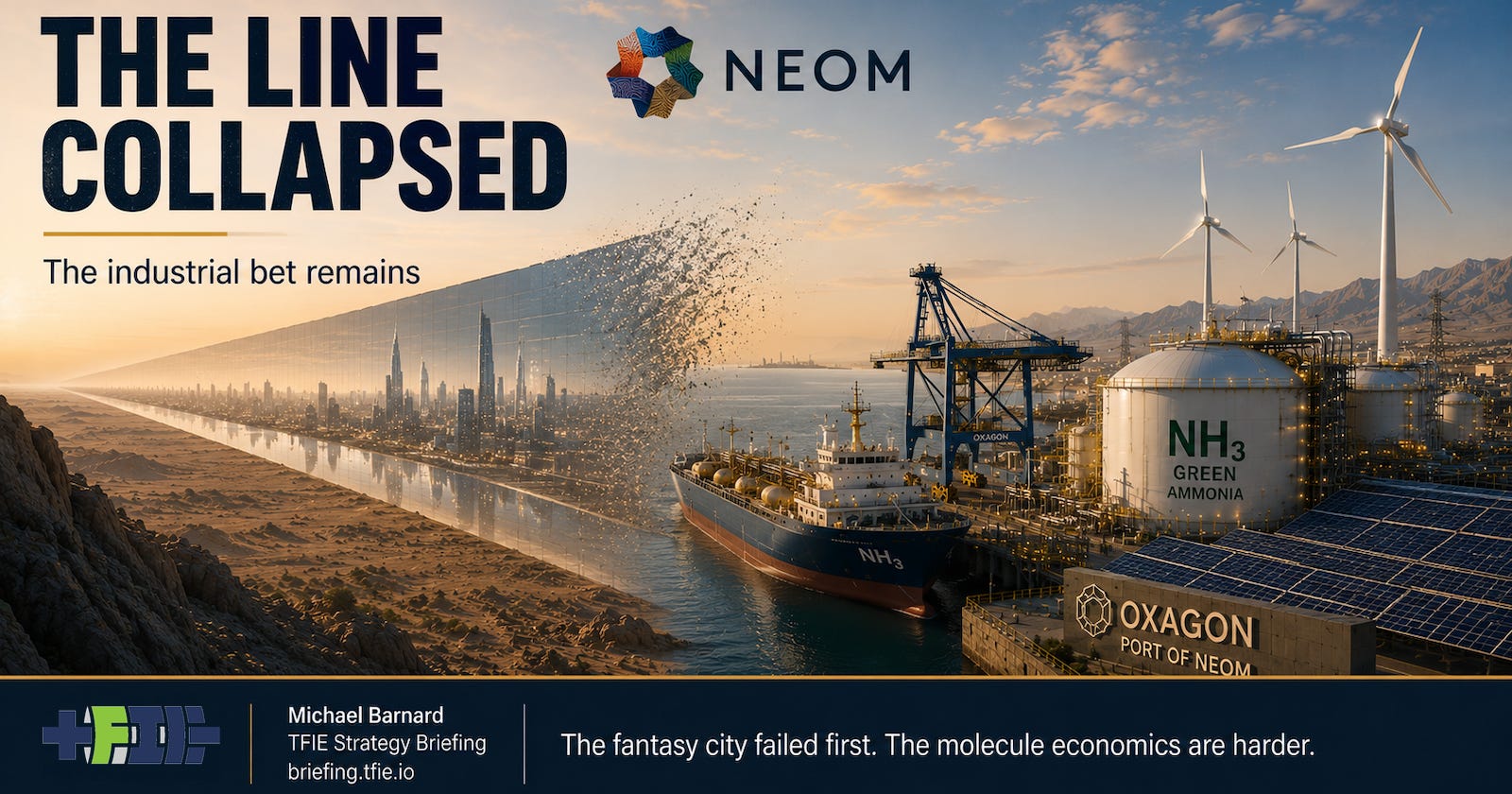
The Line was never a city. It was a claim about a city, and that distinction matters now that the claim is retreating into the usual megaproject vocabulary of phasing, redesign, reprioritization and post-2030 sequencing.
Cities are networks of jobs, freight, schools, sewage, delivery bays, maintenance depots, small businesses, social friction, mobility choices, power systems, water systems and decades of adaptation. They thicken, sprawl, accrete and fail in useful ways, which is one of the reasons they work at all. They are not 170 km mirrored corridors with a promotional video, a population target and a promise that everyone’s daily life will somehow fit into an architectural extrusion.
That was always the problem with The Line. The official claims were about car-free living, 5-minute access to daily needs, high-speed transit across an impossibly long urban form and a 9 million person future inside a mirrored wall. The actual test was whether the thing worked as a city, and on that test it was never close. It was not a little bit short of the mark. It was standing in a different desert waving at the mark through heat shimmer.
That is why I expected it to fail from the first time I saw it. Not because of any privileged insight into Saudi budgeting, construction sequencing, or the internal mood of the Public Investment Fund. That is why I expected it to fail from the first time I saw it. I’ve been studying how cities actually work since reading Jane Jacobs in the late 1980s, and The Line was detached from every leading practice of urban planning and development from the moment it was conceived.
The quiet retreat is now visible. Semafor reported that NEOM had delayed further work on The Line until after 2030 while redesign work and funding were reconsidered. Population projections have shifted from 9 million, to 300,000 to 100,000. Reuters reported that Saudi Arabia’s Public Investment Fund was reworking its 2026 to 2030 strategy, scaling back or reconfiguring expensive megaprojects and shifting emphasis toward industry, minerals, artificial intelligence, tourism, renewable energy, green hydrogen, solar, wind and data centers. The point is not that no structure called The Line will ever be built. Saudi Arabia may build fragments, demonstration sections, symbolic districts or renamed phases for years. The point is that the original claim set has collapsed. The scale, timing, population, financing logic and urban-function narrative no longer hang together.
That is how megaproject failure often arrives. Not as a dramatic cancellation, but as phasing, redesign, reprioritization, new strategic context and a long walk through euphemism. The original claim is not formally abandoned. It is moved far enough into the future that it stops being an operational commitment. The useful question now is what survives after the most theatrical part of NEOM is pushed offstage, because the answer appears to be ports, power, industrial land, data centers, utilities, logistics and export molecules. That is much less exciting than a mirrored linear city, but much closer to recognizable economic development. It can still be overbuilt, gold-plated, poorly sequenced or politically protected, but at least it belongs to a category where conventional analysis works.
That is why Oxagon matters. It is NEOM’s industrial and port-facing region, positioned around manufacturing, logistics, data infrastructure, renewable energy and the NEOM Green Hydrogen Company project. Strip away the branding and the core model is straightforward enough: build a Red Sea industrial zone with a port, large power supply, green ammonia export capacity and energy-hungry digital infrastructure. That does not make it a good investment. It makes it analysable. The Line could be rejected at the concept level because the urban form was nonsensical. Oxagon requires a more adult test: what is real, what is expensive, who is contracted, who is exposed, and what final markets can absorb the output.
The green hydrogen and ammonia project is the center of that test. NEOM Green Hydrogen Company reached financial close on an $8.4 billion project with $6.1 billion of non-recourse financing. It is an equal joint venture of ACWA Power, Air Products and NEOM. The stated plan is up to 4 GW of wind and solar, up to 600 tons per day of hydrogen, and up to 1.2 million tons per year of green ammonia for export. Air Products has the exclusive 30-year offtake for the green ammonia. That is not a rendering. It is a large industrial project with serious partners, financing, construction progress and a product category the world already uses. Hydrogen converted to ammonia for export is not in the same analytical category as The Line. It deserves a sharper assessment because real projects can still fail economically, and because surviving NEOM pieces will be used to argue that the original vision was merely being refined rather than cut back.
The key question is not whether the plant produces a first cargo. It is whether the full chain can deliver certified green ammonia, or hydrogen cracked back from ammonia, at prices that real buyers will pay repeatedly and that still leave acceptable returns for the parties carrying the capital and commercial risk. The attraction of Saudi green hydrogen is obvious. Saudi Arabia has excellent solar resources, good wind resources in selected areas, state-backed industrial coordination and the ability to create large sites with fewer local constraints than most democracies. Start a spreadsheet with very cheap renewable electricity, add a very large electrolyser complex, convert the hydrogen to ammonia and send the molecule to Europe or Asia. The story wrote itself during the hydrogen bubble.
Unfortunately, the spreadsheet does not end at the busbar. Electrolysers, water systems, hydrogen handling, nitrogen supply, ammonia synthesis, storage, port loading, shipping, certification, downstream marketing and, in some cases, ammonia cracking all have to be paid for. Every conversion step adds capital, losses, operating complexity, maintenance requirements and contract exposure. This is the same whole-system problem that has appeared repeatedly in the hydrogen economy. The impressive numerator is usually a project announcement, capacity target, framework agreement, pilot, grant or cost claim from one segment of the chain. The real comparison is the delivered service. In hydrogen buses, a station opening is not station utilization, a fuel-cell bus delivery is not reliable fleet service, and a grant is not durable demand. The same discipline applies here. A green ammonia plant is not the same thing as a green ammonia market.
That matters because ammonia is not a luxury product. In fertilizer, it sits inside the nitrogen chain that eventually has to make sense to farmers and food systems. In refining and chemicals, it has to compete with existing hydrogen and ammonia supply under emerging carbon rules. In shipping, it has to compete with batteries, shore power, route optimization, efficiency, biofuels, methanol and the structural decline of some fossil cargoes. In power generation, it has to compete with renewables, storage, transmission, demand flexibility and the fact that turning electricity into ammonia so it can be burned back into electricity is rarely a sign that a power system is thinking clearly.
That is where Air Products becomes the interesting part of the story. The simple public version is that NEOM Green Hydrogen Company produces green ammonia and Air Products takes it. That is true as far as it goes, but it leaves out the commercial muddiness that matters most for the risk assessment. Air Products is not merely an unrelated buyer signing a standard third-party offtake. It is an equity partner in NEOM Green Hydrogen Company (NGHC), the primary engineering, procurement and construction (EPC) contractor and system integrator, the exclusive offtaker, and, according to Air Products’ SEC disclosures, the party for which the facility will produce green ammonia under a long-term take-if-tendered agreement. That puts Air Products both inside the project and downstream of it.
That structure can reduce interface risk because a serious industrial firm is deeply involved in construction, integration and commercialization. It also creates ambiguity. Air Products can earn EPC margin, hold equity exposure, take the product under the offtake, develop downstream logistics, crack some ammonia back into hydrogen and try to resell the molecule into refineries, fertilizer, industrial nitrogen, maritime experiments or whatever remains of the hydrogen mobility story. That is enough for the public point. The offtake helps make the project bankable. It does not by itself prove that final buyers exist at the required price.
Below the paywall is the professional layer: the outside-view cost test, the Air Products risk map, the offtake-quality assessment, the green-ammonia market filter, update triggers, decision implications and the final scorecard I’ll use to judge whether Oxagon’s green ammonia pathway is scaling, niche-valid, stalled or merely converting sovereign ambition into expensive molecules.
