

The Financial Times supplied an interesting prompt this week. Short sellers have made an estimated $2.1B betting against Oklo, NuScale and Nano Nuclear, while $30.3B of their combined market value has disappeared since the three small modular reactor developers peaked in October 2025. The FT describes the rise and collapse as a hype cycle. I have been writing for years that the underlying SMR economics did not support the story investors were being sold, so the obvious question was how much money investors might have saved by treating that analysis as investment diligence rather than merely an argument about energy technology.
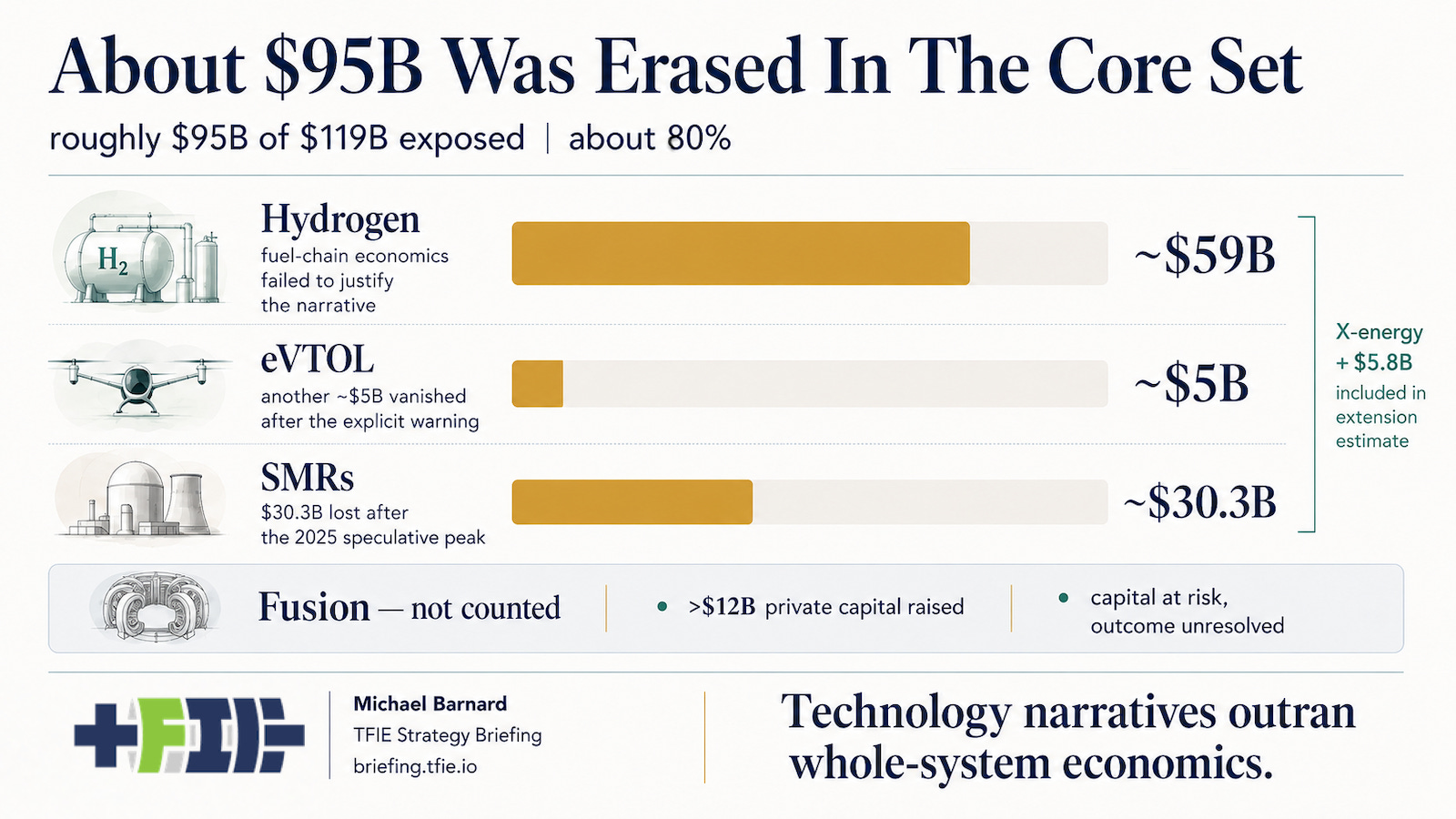
I went back through my published work on hydrogen, electric air taxis and SMRs, matched the dates of substantive warnings against subsequent valuations, and tried to make the calculation hostile to my own thesis. The result is about $95B of shareholder value subsequently erased from roughly $119B that remained exposed in the core set, close to 80%. Include X-energy, which listed years after my SMR economic critique was public and has since lost another $5.8B from its post-IPO surge, and the broader tally reaches roughly $100B.
That needs an immediate caveat. $100B of lost market capitalization is not $100B of cash physically fed into companies and burned, nor could every shareholder have sold simultaneously at the reference valuations. Markets do not work that way. The useful counterfactual is at the individual investor level: someone considering or holding these investments could read the analysis, decide that the system economics did not justify the valuation, and keep the money somewhere else. Avoiding a 70%, 90% or 100% loss preserves capital just as surely as picking another stock that rises.
The calculation also refuses some tempting numbers. Nikola briefly approached a $30B valuation in 2020, but I am not claiming that entire collapse. My broad warning that the “hydrogen economy” was mostly hype was published December 23, 2020, after Nikola’s great speculative peak. Nikola ended 2020 worth about $5.9B, so that is the useful starting point for this exercise. It later filed for bankruptcy with its equity worth only tens of millions. Counting the earlier peak would produce a much better marketing number and a much worse analysis.
Hydrogen is still the largest part of the bill. After that December 2020 assessment was public, the hydrogen enthusiasm cycle carried Plug Power to around a $40B valuation, Ballard Power above $10B and FuelCell Energy to roughly $7B. Their combined market value today is only around $6B. Add the roughly $5.9B of Nikola value that still existed at the end of 2020 and the hydrogen portion of the exercise accounts for approximately $59B of subsequent shareholder-value destruction. The original argument did not depend on anticipating interest rates or investor sentiment. It was about delivered hydrogen cost, conversion losses, infrastructure, utilization and competition from direct electrification. Those problems subsequently became commercial problems.
The financial mechanism became even clearer with time. In March 2026 I described the sector’s recapitalization cycle: investor enthusiasm sends the limited set of listed hydrogen stocks upward, the companies issue equity or convertible securities into the enthusiasm, the anticipated profitable markets fail to arrive at the expected scale, cash disappears, valuations fall, and management waits for the next policy or technology narrative. Plug Power’s accumulated deficit has passed $8B, Ballard’s exceeds $2B and FuelCell Energy’s is around $1.8B. This is not a young industry encountering the ordinary losses of commercialization. Some of these companies have been repeating versions of the cycle for decades.
The eVTOL case provides an unusually clean dated receipt because I wrote the investment conclusion explicitly. On November 24, 2021, I calculated that the publicly traded urban-air-mobility pure plays had already fallen from $27.92B at their peaks to $11.82B. I called the sector vastly overvalued and told investors in the companies to “cut your losses”. I do not count the $16.1B that had already disappeared when I wrote that. Four months later I checked again and found that cumulative destruction had risen to about $21B. Another $5B had disappeared after the warning, roughly 42% of the remaining $11.82B in only a few months.
SMRs close the loop. In 2021 I argued that small modular reactors were mostly bad policy because making reactors smaller surrendered economies of vertical scale while assuming manufacturing economies that did not yet exist. In 2023, after NuScale’s UAMPS project collapsed, I wrote explicitly about the investment and SPAC dynamics behind SMR enthusiasm. More recently I tested the proposition that serial production would rescue costs and found that even generous Wright’s Law assumptions do not rescue the economics. Then came the 2025 AI-and-nuclear stock mania. Oklo, NuScale and Nano Nuclear subsequently lost $30.3B from their October peaks. X-energy, which listed in April 2026, has lost another $5.8B since its initial surge.
There is a common analytical error underneath all three categories. Investors tend to value the interesting component and assume away the expensive system around it. A fuel cell works, but a hydrogen transportation business also needs hydrogen production, compression or liquefaction, distribution, storage, refueling infrastructure, high utilization and a delivered cost that beats batteries. An eVTOL can fly, but a profitable air-taxi system also needs certification, low maintenance, high aircraft utilization, vertiports, acceptable noise and downwash, airspace integration and enough wealthy passengers making trips that existing helicopters, cars and transit do not already serve better. An SMR can sustain fission, but the investable product also includes licensing, fuel, factories, construction, security, financing, waste management, repeat orders and electricity cheap enough to compete with the alternatives.
That distinction between a component and a system has been the useful investment signal. None of the original warnings required knowing whether Plug Power would peak in January 2021, whether eVTOL SPACs would crack before certification, or whether AI enthusiasm would send Oklo toward a spectacular valuation before investors rediscovered reactor timelines and capital requirements. They required asking whether the entire product could become competitive, repeatable and financeable. When the answer depended on several difficult things becoming cheap, abundant and easy at the same time, the valuation deserved a much higher discount than the market was applying.
Market capitalization is still only one measure, so I ran a second test. Across the companies where the filings allowed a reasonably comparable reconstruction, at least $11.5B of operating cash was consumed after the relevant warnings, before counting several billion more spent on factories, equipment, facilities and infrastructure. Adding only readily identifiable physical-capital expenditures puts the conservative floor around $14.5B of cash consumed or deployed. Not all of that physical capital is worthless, and some assets will retain salvage or alternative-use value. But the gap between the roughly $100B market repricing and the smaller cash figure is useful: investors first paid extraordinary prices for expectations, then companies converted part of those expectations into actual cash and spent it pursuing the business cases.
Fusion is deliberately absent from that ~$100B calculation. I wrote in 2021 that fusion power had once again receded into the future, focusing not on whether fusion reactions could be produced but on whether whole facilities could ever deliver competitive net electricity. In 2024 I included fusion among the questionable capital allocations in my review of Breakthrough Energy Ventures. Commercial fusion companies had raised more than $11.5B in private capital by mid-2026, before Commonwealth Fusion Systems added another $1B in July. Helion has raised about $1.5B and was valued at $15.5B in its latest financing.
I am counting none of that as capital destroyed. Those investors may eventually make excellent returns, lose most of their money, or spend another decade discovering which. Most of the major fusion companies are private, their latest financing rounds generally imply rising rather than collapsing valuations, and there is no liquid-market repricing that permits the same calculation available for Plug Power, Joby or Oklo. More than $12B of private fusion investment belongs in a different column today: capital at risk, outcome unresolved. If it eventually produces competitive electricity, the investment thesis will have been vindicated. If it does not, there will be another dated set of receipts to examine.
That exclusion matters because this is not an exercise in collecting technologies I dislike and calling their funding losses. Fusion is a technology I have been publicly skeptical of for years, billions remain invested at high private valuations, and I am refusing to count them because the evidence does not yet support the claim. NuScale provides another version of the same lesson. After its UAMPS project failed and I wrote in November 2023 that its SMR proposition remained economically weak, its shares subsequently went through another enormous speculative rise. Anyone using my analysis as an instruction to maintain an unhedged short position would have discovered that weak long-run economics and short-run stock prices are different things.
The more useful investment interpretation is simpler. An investor does not have to predict the top of a bubble to benefit from recognizing that the story underneath it is weak. There is no requirement to short the company, trade options or identify the exact month reality will catch up. Declining to put capital into a business whose economics require unrealistic system assumptions is an investment decision. Keeping $100 that would otherwise become $20 leaves $80 available for the next decision.
That is why this exercise is more interesting to me than an “I told you so” scorecard. Hydrogen, eVTOL, SMR and fusion companies are very different technically. The repeated analytical question sits upstream of the technologies themselves: does the entire system survive contact with physics, infrastructure, realistic competitors, financing and repeatable commercial demand? Investors repeatedly paid very large sums before answering that question. Roughly $100B in subsequent public-market destruction, another $14.5B or more of real capital consumed or deployed, and more than $12B currently at risk in private fusion companies suggest that the question is financially consequential.
Subscribe to TFIE Strategy Briefing for the deeper professional layer: denominator checks, capital filters, comparator cases and decision context for technology and infrastructure bets before narrative momentum becomes an expensive position.