
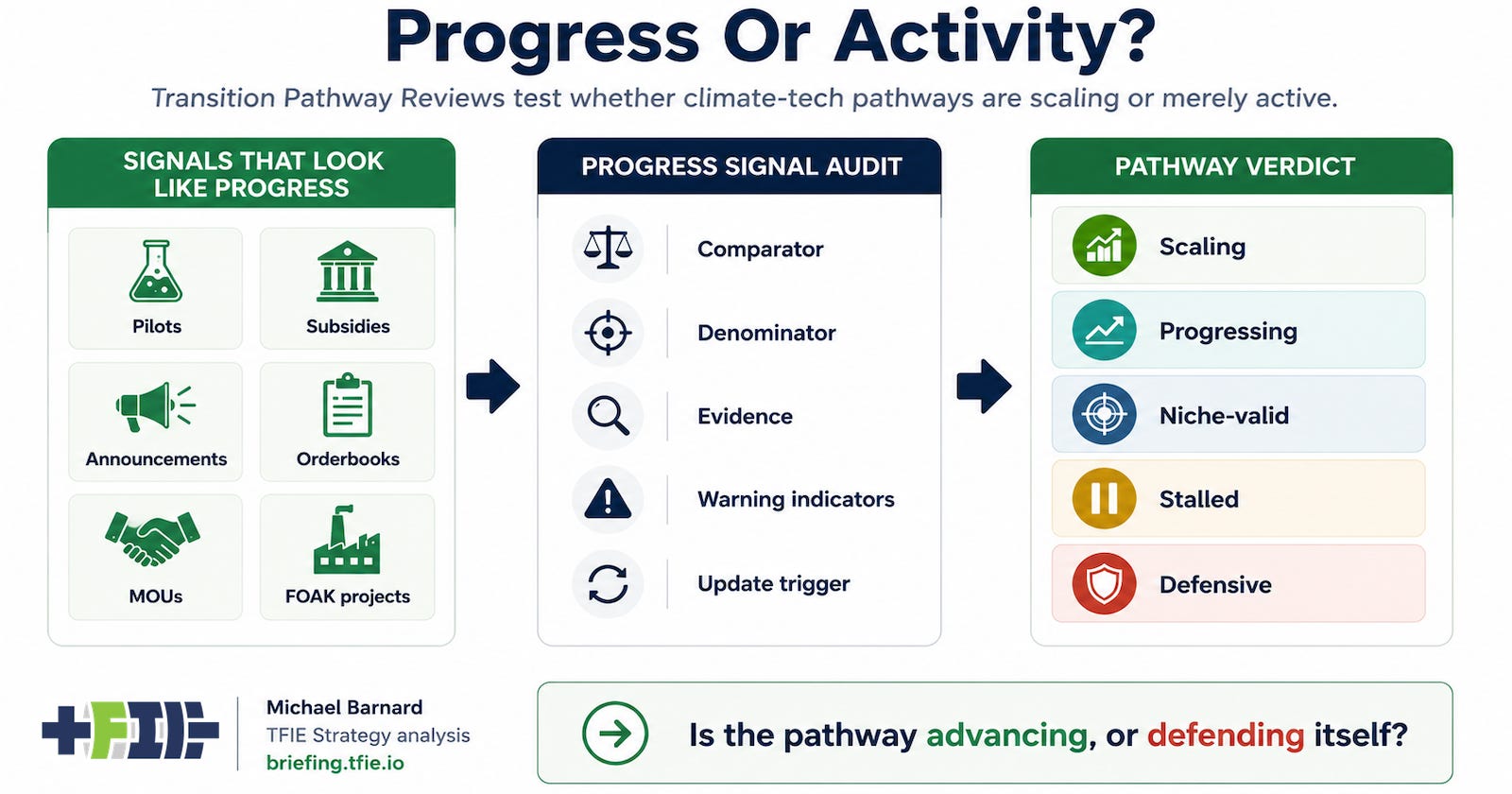
Energy transition claims are easy to make. Pilots are announced, grants are awarded, memoranda are signed, first-of-a-kind projects are celebrated, and orderbooks are waved around as proof that a market has arrived. Sometimes that activity is genuine progress. Quite often, sadly, it is just activity with a better press release.
TFIE Strategy Briefing reviews decarbonization pathways by asking whether they are becoming durable parts of the energy, industrial, transportation, or infrastructure system, or whether they are mostly producing signals that look like progress to people who want them to be progress. The work is not to reward novelty, defend yesterday’s conclusions, or confuse motion with direction. It is to test whether a pathway improves affordability, security, resilience, emissions, and scale against credible alternatives that are also improving.
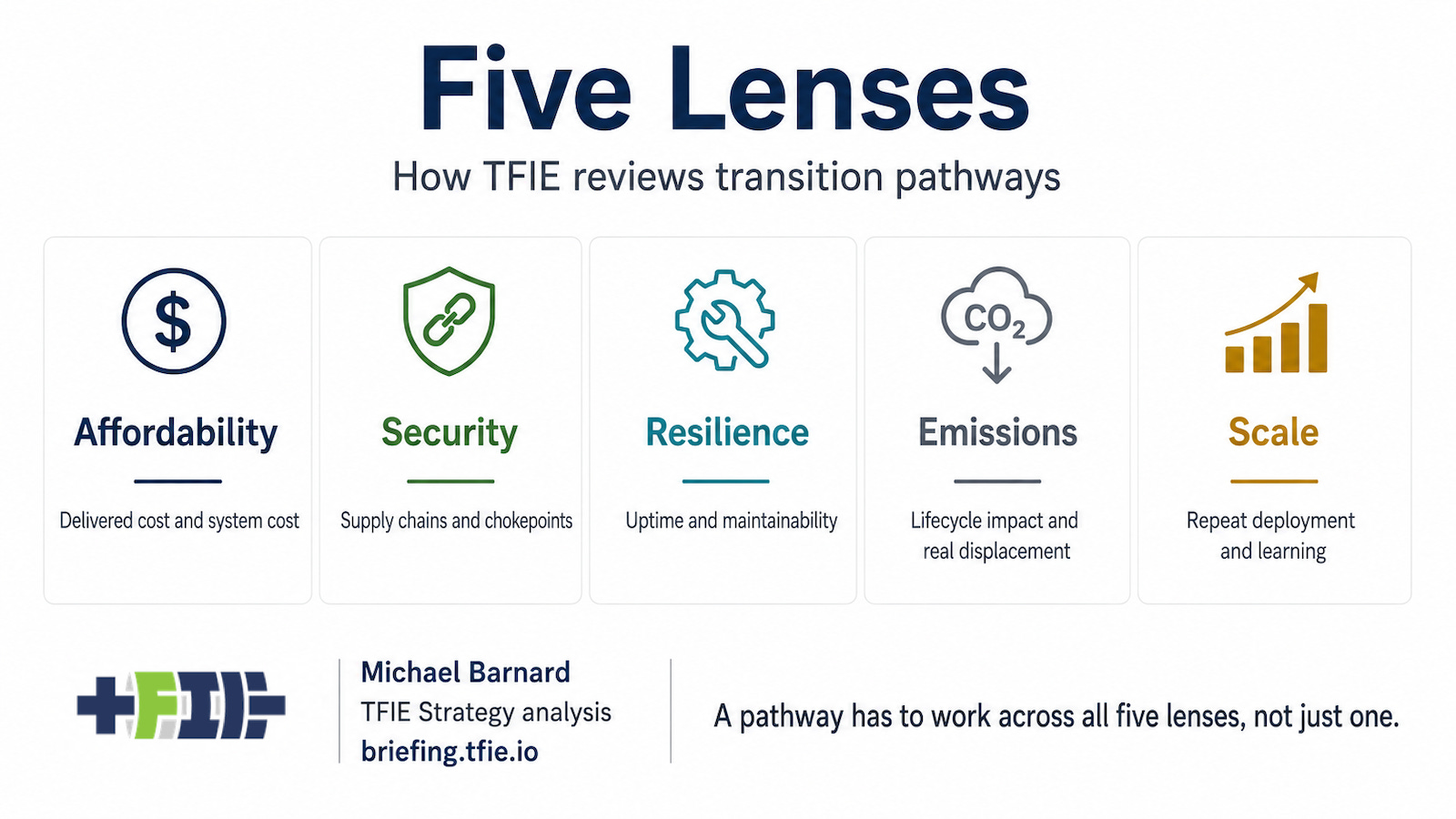
The Five Lenses
Every pathway review starts with five system questions. Affordability asks whether the pathway can deliver useful service at competitive cost, including infrastructure, maintenance, utilization, financing, and system integration. Security asks whether it improves supply-chain strength, fuel security, operational independence, and exposure to geopolitical or commodity chokepoints. Resilience asks whether it can operate reliably under real-world conditions, recover from disruption, and avoid brittle dependence on rare skills, fragile supply chains, or narrow operating windows.
Emissions asks whether the pathway delivers real lifecycle reductions, not just local displacement, accounting tricks, or emissions moved upstream where they are easier to ignore. Scale asks whether the pathway can repeat, standardize, learn, and deploy beyond isolated pilots, protected niches, or subsidy-shaped demonstrations. A pathway does not have to be perfect across all five lenses. Few are. But a serious pathway has to improve the system more than the alternatives it claims to beat.
The Questions Every Review Asks
A TFIE Transition Pathway Review asks five basic questions. What is being claimed? What is being counted as progress? What must this pathway beat? What evidence would show market formation? What evidence would change the verdict? These are not especially exotic questions, which is part of the point. A lot of climate-tech storytelling gets much less impressive when it is asked to pass through ordinary filters.
A pilot is not a market. An announcement is not deployment. An orderbook is not necessarily demand. A subsidy can support early learning, but it can also hide weak economics. A first-of-a-kind project can show that engineering is advancing, or it can show that the pathway still cannot attract normal commercial risk. The work is in separating useful evidence from activity that merely looks like progress.
Comparators Matter
No pathway gets reviewed in isolation. Hydrogen buses are judged against battery-electric buses. Small modular reactors are judged against renewables, storage, grids, large nuclear, gas backup, delivery timelines, fuel constraints, and actual buyers. Methanol shipping is judged against batteries, biofuels, ammonia, conventional marine fuels, operational constraints, and the sectors competing for the same molecules.
That matters because alternatives are not standing still. Batteries improve. Grid technologies improve. Heat pumps improve. Transmission expands. Demand flexibility becomes more valuable. Established systems learn, standardize, and get cheaper. A pathway is not judged against yesterday’s baseline, or against a conveniently weak version of the thing it hopes to displace. It is judged against the denominator that matters now.
Evidence Beats Narrative
Useful evidence includes repeat deployment, falling delivered cost, higher utilization, better reliability, design convergence, private capital at risk, lower subsidy intensity, stronger operating data, and clearer advantage over competitors. Warning signs include repeated pilots, rising costs, schedule slippage, shifting use cases, grant dependence, missing operating data, narrowing markets, weak utilization, strategic rebranding, and claims that move from commercial value to national necessity.
That distinction matters. A pathway can be technically real and still fail as a system solution. It can work in a protected niche and still be a poor answer for the broader market. It can attract public money and still repel normal commercial risk. TFIE Strategy Briefing is interested in what survives after the storytelling gets stripped away.
Pathway Verdicts
TFIE uses qualitative verdicts, not fake precision. Scaling means repeat deployment, improving economics or performance, and adoption beyond isolated pilots. Progressing means credible evidence of improvement, while scale, cost, delivery, or market formation remains incomplete. Niche-valid means the pathway works in constrained conditions, but broader claims remain weak or unsupported.
Stalled means activity continues, but durable evidence of market formation or system value is missing. Defensive means the pathway survives mainly through shifting claims, subsidies, special pleading, narrative retreat, or weak evidence substituted for operating performance. Confidence and evidence quality are tracked separately, because a high-confidence niche verdict is much more useful than a low-confidence claim of scale.
Scorecards Make The Method Usable
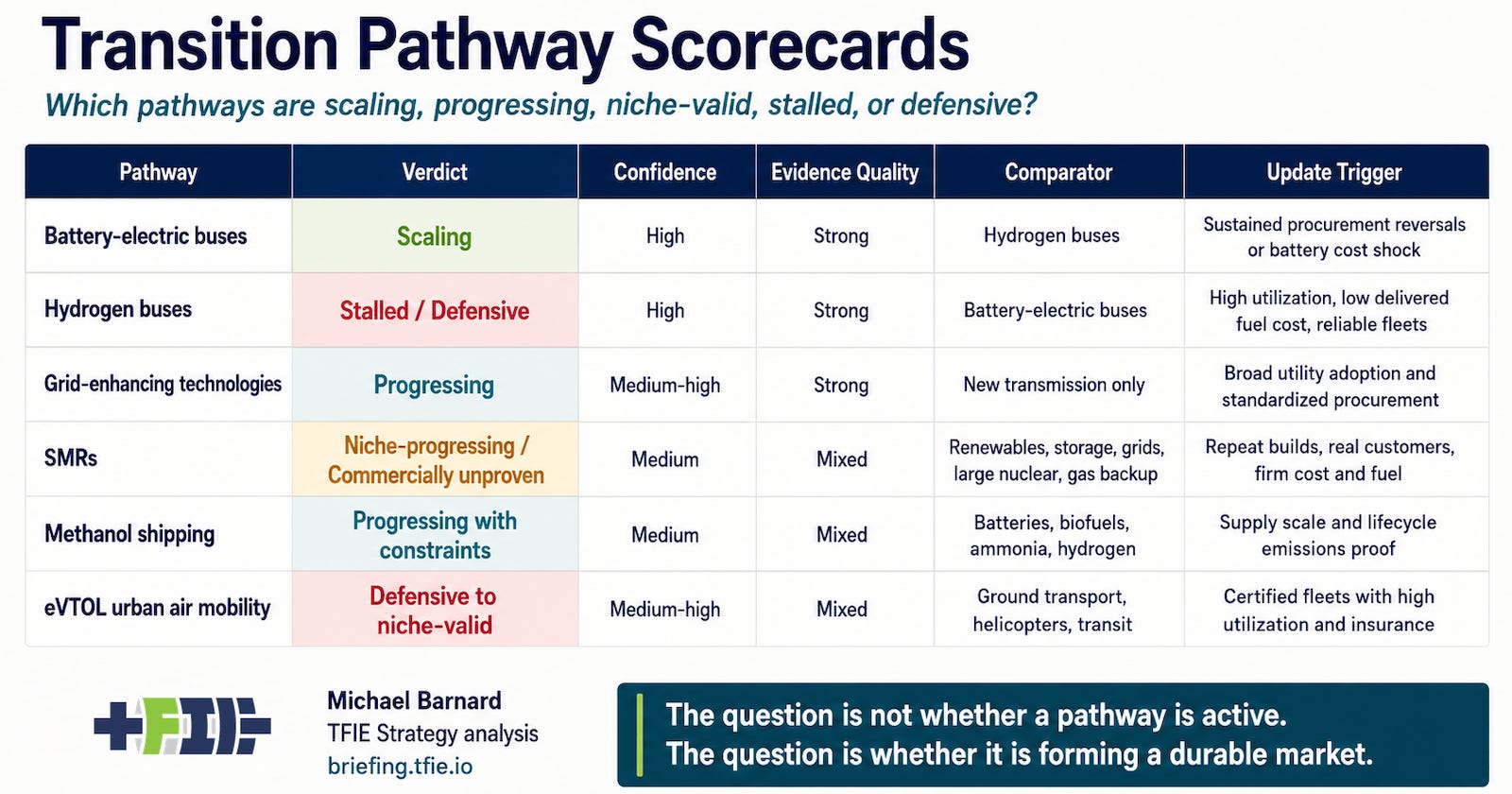
Transition Pathway Scorecards are the professional layer behind TFIE Strategy Briefing. The public work carries the argument; the scorecards make the evidence, comparators, warning signs, confidence level, and update triggers explicit. The public work carries the argument. It explains the pathway, the evidence, the comparator, and the verdict in plain language. The paid scorecards add the professional layer behind that argument: evidence notes, denominator checks, progress signals, warning indicators, confidence, evidence quality, source context, update triggers, and decision implications.
A scorecard tracks the pathway, the current verdict, the strength of the evidence, the comparator that matters, what is improving, what is weakening, and what would change the view. That last part is important. Every serious verdict needs an update trigger. If a conclusion cannot say what would change it, it is probably not analysis. It is identity maintenance with a spreadsheet.
Updates Are Part Of The Method
Some conclusions reverse. Some narrow. Some remain intact, but with a corrected denominator, a better comparator, a mechanism update, or a lower confidence level. That is not a failure of the method. It is the method working. The useful answer is not to defend an old claim because it was once published. The useful answer is to correct the denominator, update the evidence, and carry forward the stronger argument.
TFIE Strategy Briefing is built around that discipline. I don’t claim to be right, I just claim to be less wrong than most. That requires being willing to change specific numbers, narrow claims, retire weak arguments, and keep the parts that survive contact with better evidence.
What Paid Subscribers Get
Free posts are meant to stand on their own. They carry the public argument for readers who want clear, evidence-based decarbonization analysis without a professional workflow attached. Paid subscribers get the structured professional layer: scorecards, evidence notes, denominator checks, update triggers, position updates, and decision-grade context for strategy, procurement, policy, investment, and infrastructure decisions.
That layer is built for people working around energy, industry, transportation, infrastructure, climate-tech capital allocation, public procurement, and decarbonization strategy. The casual question is whether a pathway sounds plausible. The professional question is whether it is becoming durable enough to matter, cheap enough to scale, and strong enough to beat the alternatives. That is what the scorecards are for.