

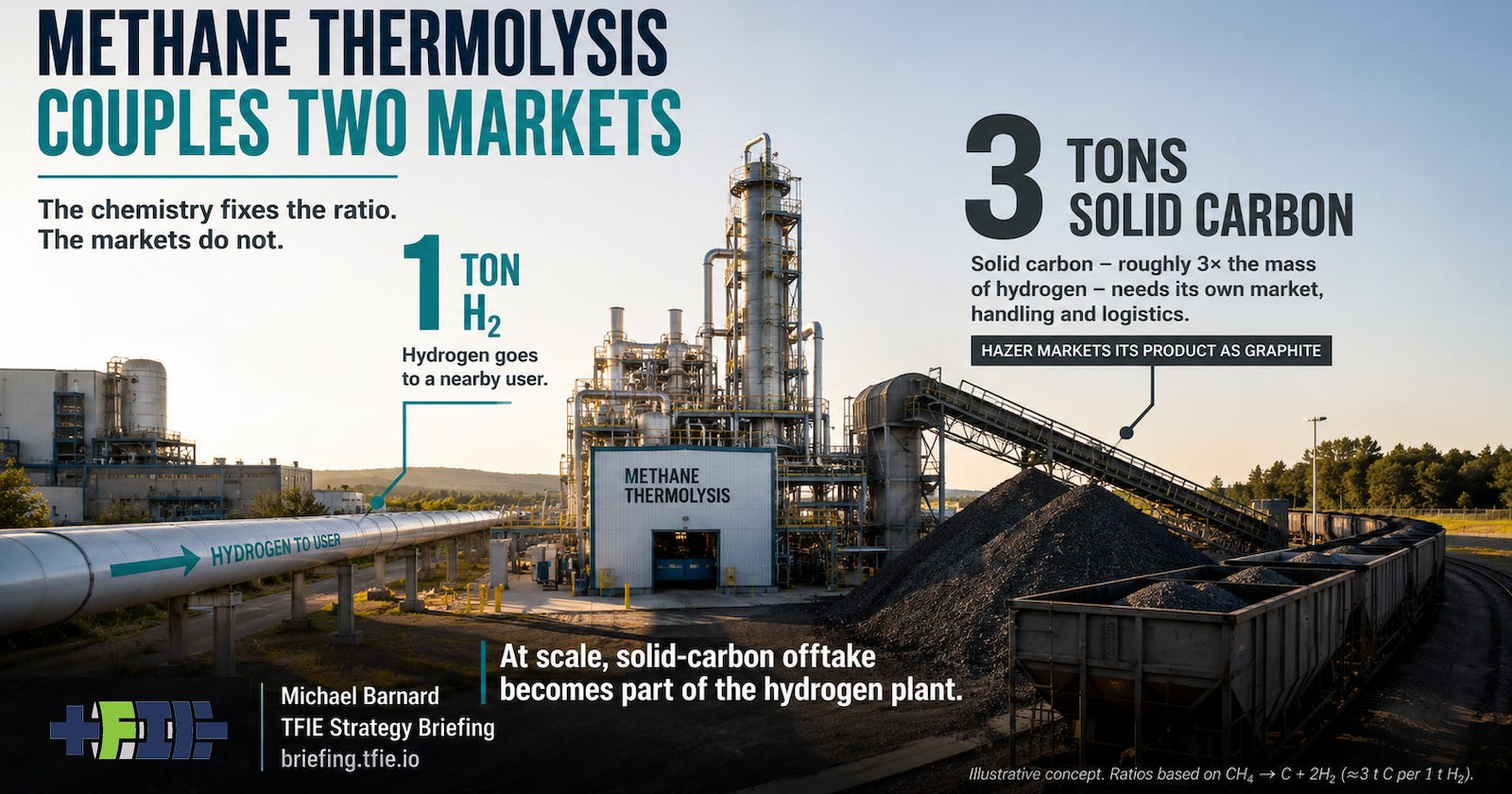
Methane thermolysis, commonly called methane pyrolysis, has an attractive proposition for lower-carbon hydrogen. Split methane without oxidizing its carbon and the outputs are hydrogen and solid carbon instead of hydrogen and CO₂. Hazer Group is now providing a useful test of what that chemistry means at industrial scale. The Australian developer and KBR recently signed a paid study with a large Japanese power utility examining plants producing 30,000 and 300,000 tons of hydrogen a year. The larger configuration is only a pre-feasibility study, not a project decision, but at that scale one characteristic of methane thermolysis becomes impossible to treat as a footnote: roughly every ton of hydrogen brings three tons of solid carbon with it.
That ratio is not peculiar to Hazer. It follows from the chemistry of methane thermolysis itself. Methane is CH₄. Splitting it into its constituent elements produces hydrogen and carbon, and the mass balance is about three tons of carbon for every ton of hydrogen. Hazer’s particular process produces a graphitic carbon that the company is developing as a commercial product, which is a meaningful distinction from generic carbon black or amorphous carbon. But at the chemistry level the important point is simpler. A 300,000-ton-per-year methane-thermolysis hydrogen plant creates roughly 900,000 tons of solid carbon every year, about 2,500 tons every day.
That is also why methane thermolysis deserves more serious consideration than many hydrogen propositions. It does not create a concentrated process CO₂ stream that then requires capture, compression, transport and geological storage. Hazer has moved beyond laboratory work into an operating demonstration plant and has completed a commercial-scale process design package with KBR. The question is not whether the chemistry works. It is what happens when the chemistry reaches industrial scale.
The usual answer is that carbon and graphite are valuable products. They certainly can be. Hazer is testing its graphite in steel, batteries, asphalt, concrete and other applications and is developing purification, pelletization and customer qualification pathways. But the relevant denominator is not whether markets for carbon products exist. It is whether enough customers want this particular carbon, at the required grade, price and location, at the same rate that hydrogen customers determine methane-thermolysis production.
There is also a hype-cycle element to the renewed attention. Methane thermolysis is neither new chemistry nor an exotic industrial concept. Splitting methane into hydrogen and solid carbon has been understood for a long time, while carbon production, high-temperature gas processing and solids handling are all established industrial disciplines. Hazer’s catalytic implementation may prove commercially better than earlier approaches, but it is arriving during overlapping hydrogen and carbon-management investment cycles in which avoiding a CO₂ stream sounds particularly attractive. That makes it worth separating technical merit from attention.
An ongoing TFIE analysis of hydrogen press coverage versus actual deployment of competing technologies is finding the same pattern repeatedly: hydrogen pathways receive disproportionate attention for pilots, demonstrations and proposed plants while incumbent or electrified alternatives often accumulate vastly more real-world deployment with less fanfare. Methane thermolysis deserves assessment on its industrial economics and mass balance, not on the amount of attention currently available to anything combining hydrogen with a carbon-management story.
That makes the most useful next question where methane thermolysis has a genuinely strong industrial fit rather than simply an attractive story. Steel is probably the strongest possible pairing because it can actually use both products, and Hazer is sensibly pursuing exactly that proposition. It is working with POSCO and is part of the M Resources proposal for Whyalla, where hydrogen could support direct reduction of iron while Hazer graphite could be used as a recarburizer in electric arc furnace steelmaking. That is a much better fit than an ammonia plant, refinery or power station, all of which can consume large quantities of hydrogen while having little intrinsic use for the resulting solid carbon.
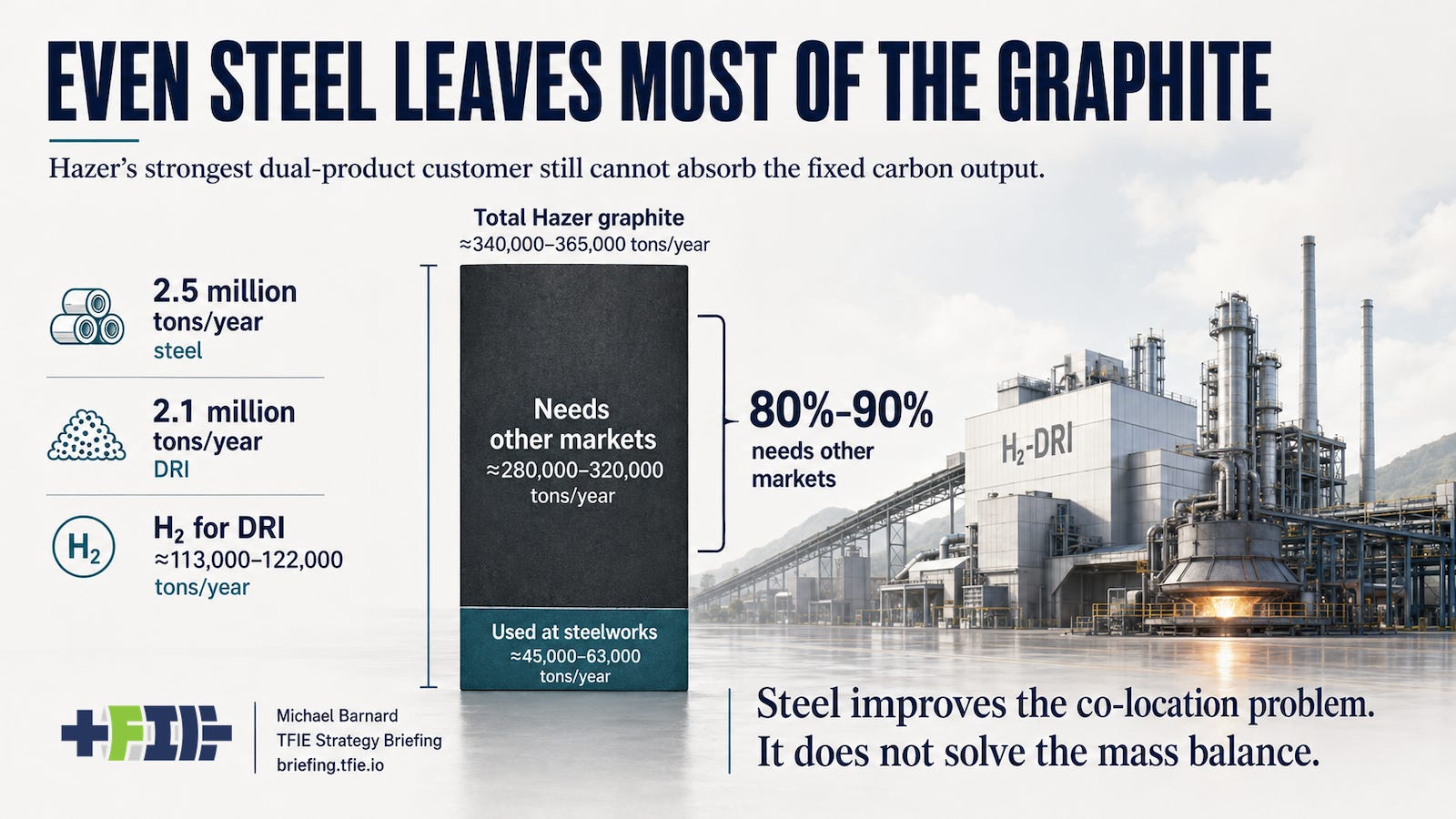
A modern hydrogen-DRI steelworks provides a useful scale test. Stegra’s Boden project in Sweden is designed around 2.1 million tons of DRI feeding an initial 2.5 million tons of finished steel annually. At roughly 54 to 58 kg of hydrogen per ton of DRI, that requires about 113,000 to 122,000 tons of hydrogen a year. Supplying that hydrogen through the Hazer process would create roughly 340,000 to 365,000 tons of graphite.
Hydrogen-DRI does not eliminate carbon from the electric arc furnace. Carbon is still useful for final steel chemistry, FeO reduction, slag foaming and process energy. Recent modelling of carbon-free H₂-DRI cases uses roughly 18 to 25 kg of injected carbon per ton of steel, although actual requirements vary with metallization, iron feed, steel grade and furnace operation. Applied to a 2.5-million-ton steelworks, that is around 45,000 to 63,000 tons of carbon annually. Even this unusually favorable pairing therefore consumes only a fraction of the carbon produced alongside its hydrogen. Roughly 280,000 to 320,000 tons a year, around 80% to 90% of the Hazer graphite, would still need other customers.
Those other markets are not empty spaces waiting for carbon. Steelmakers already choose among petroleum coke, anthracite, natural graphite, synthetic graphite and other carbon products, with biochar increasingly being developed as a lower-carbon alternative. Battery manufacturers need highly engineered graphite and can choose among natural, synthetic and increasingly recycled sources, with qualification depending on purity, morphology, particle size, surface characteristics and electrochemical performance. Concrete and asphalt are harder still to count as enormous graphite markets because carbon is an optional additive rather than a fundamental ingredient. Hazer may prove competitive in some of these uses, but each is a distinct materials market with incumbent suppliers, specifications, qualification requirements and logistics.
That exposes the structural difference between methane thermolysis and conventional carbon supply. Existing carbon supply chains are largely decoupled from the customers they serve. A steelmaker can contract for the types and quantities of carbon it needs, switch suppliers, alter grades or increase biochar content without forcing an unrelated plant to manufacture something else. A battery-material producer can blend natural and synthetic graphite and increase recycled content as economics and qualification permit. Carbon production responds to carbon demand.
Methane thermolysis couples the two businesses chemically instead. Hydrogen demand determines how much solid carbon is produced. Hydrogen’s difficult transportation characteristics also encourage production close to the hydrogen customer, meaning the hydrogen market largely determines where the carbon appears. The much larger solids stream must then be stored, handled, graded or pelletized as required, qualified into multiple applications and transported to enough customers to clear production continuously. At commercial scale, a methane-thermolysis hydrogen facility is therefore also a substantial carbon-materials and logistics business.
None of that means Hazer’s process is a bad idea. A site with biogas or suitable natural gas, a durable industrial hydrogen requirement and one or more nearby carbon consumers could be attractive, particularly if Hazer graphite displaces higher-emissions synthetic graphite, coke or other fossil carbon. Hazer may also prove unusually good at processing its graphite into useful grades and developing markets for it. That would distinguish Hazer commercially.
It would not change the structural constraint shared by methane-thermolysis processes. Hydrogen output and carbon output are chemically coupled while hydrogen and carbon demand remain economically independent. Steel, probably the best dual-product industrial customer available, substantially improves the match and still leaves most of the carbon requiring other buyers. When the co-product is three times the mass of the headline product, its market is part of the process.
Subscribe to TFIE Strategy Briefing for more denominator-first transition analysis.
As a side note , this process can be driven by solar radiation:
https://someinventions.wordpress.com/2022/04/04/hydrogen-from-natural-gas-with-very-few-emissions/
The carbon could just be deposed at a safe place, if the hydrogen gained is cheap enough for steelmaking. No need to make money from it too.