

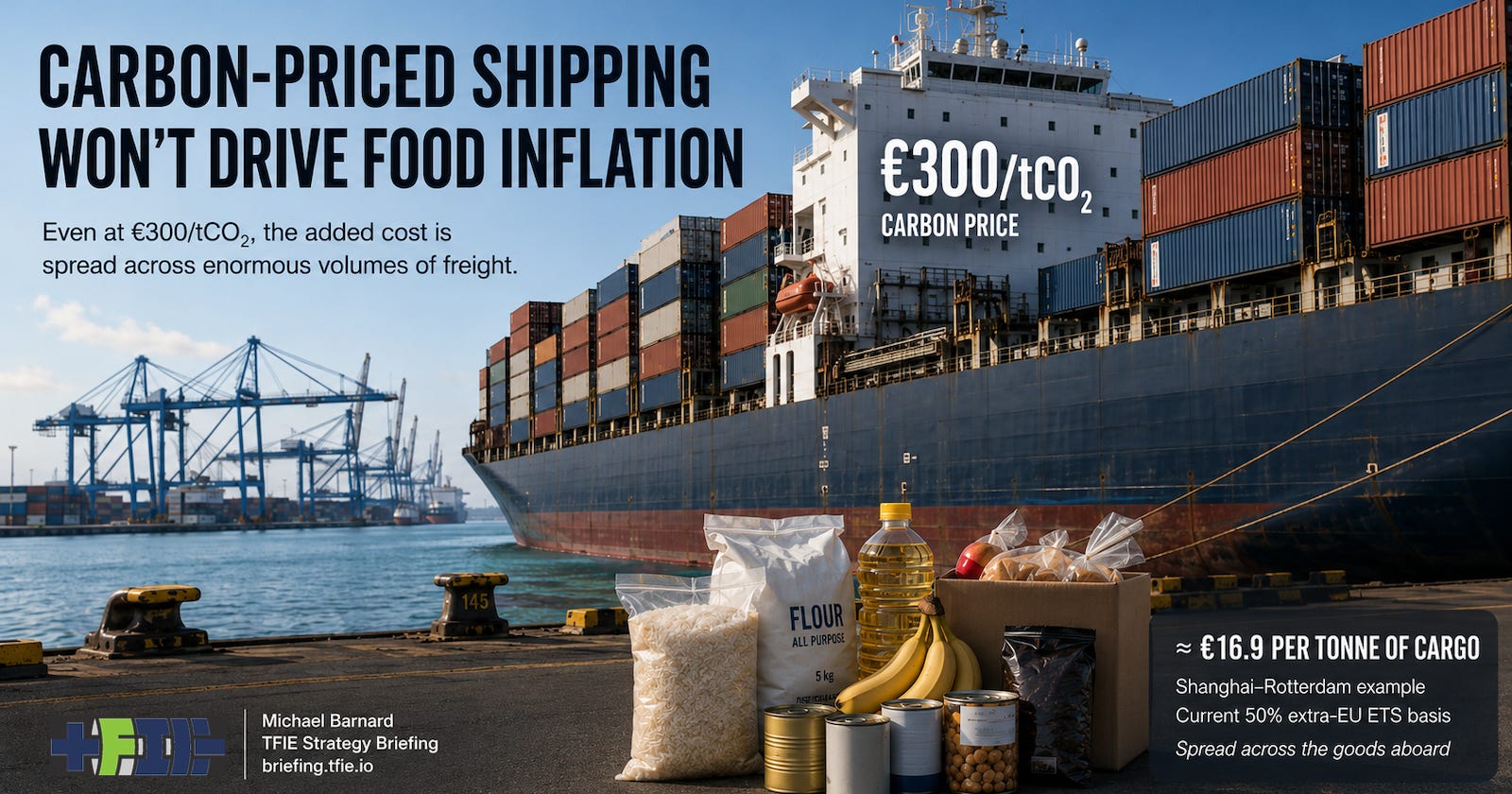
A carbon price of €300 per tonne of CO₂ sounds enormous. Applied to international shipping, it certainly matters to shipowners choosing vessels, fuels and routes. But it does not mean €300 added to a tonne of food, steel, electronics or anything else crossing an ocean. Shipping performs an extraordinary amount of freight work for every tonne of fuel it consumes, and once the carbon cost is divided by the cargo being moved, the number seen by the cargo owner is dramatically smaller.
Take a Shanghai–Rotterdam voyage of roughly 19,400 kilometres. Using the Transition Pathway Initiative Centre’s 2022 sector-wide international-shipping benchmark of 6.54 grams of CO₂ per tonne-kilometre as a broad stress-test denominator, a tonne of freight travelling that distance corresponds to about 126.9 kilograms of CO₂. Value those emissions at a deliberately aggressive €300/tCO₂, and the full physical carbon value is about €38 per tonne of cargo. Under the EU ETS boundary for a voyage between an EU and non-EU port, where 50% of voyage emissions are in scope, the corresponding CO₂-only exposure is about €19 per tonne of cargo.
That is enough money to influence shipping economics without being remotely equivalent to a €300 increase in the price of a tonne of goods. Another €19 matters more to grain, fertilizer or another low-value commodity than it does to machinery, pharmaceuticals or electronics, and highly import-dependent economies can be unusually exposed to freight costs. But even the deliberately aggressive €300 carbon-price case produces a cargo-level number that has to be considered alongside the existing freight bill, inland transport, processing, packaging, wholesale and retail margins before reaching a consumer.
A useful reality check comes from UNCTAD’s Review of Maritime Transport 2024. Its modelling of the much broader freight-rate shock associated with Red Sea and Panama Canal disruptions estimated that, if the increases persisted, global consumer prices could rise by about 0.6%. Small island developing states could see about 0.9%, with processed-food prices up around 1.3%. Shipping costs clearly can produce inflation when the shock is large enough. That reference class also gives some perspective on maritime carbon pricing: it is a different and much more bounded cost signal than a system-wide freight-rate surge caused by rerouting, congestion, capacity constraints and longer voyages.
Europe is nevertheless making the carbon signal real. Under the EU ETS maritime rules, 50% of emissions from voyages between EU and non-EU ports fall within geographic scope, while intra-EU voyages and emissions in EU ports are covered at 100%. The temporary surrender phase-in is a separate matter: emissions occurring in 2026 reach full phase-in, so companies surrender allowances in 2027 for 100% of their reported 2026 emissions that were already inside ETS scope. Methane and nitrous oxide also join CO₂ in maritime ETS coverage for 2026. FuelEU Maritime is operating alongside it, tightening lifecycle greenhouse-gas intensity requirements from an initial 2% reduction toward 80% by 2050.
So where does a carbon price that is modest at the supermarket become commercially decisive? Below the paywall, I work through the freight denominator behind the €300 stress test, then follow the cost into different shipping routes to show where it changes vessel economics, where batteries start to win, and why Europe and China are pushing maritime electrification along very different parts of the fleet. That denominator-first approach—separating a dramatic headline number from where the money actually lands—is central to the paid TFIE Strategy Briefing.