

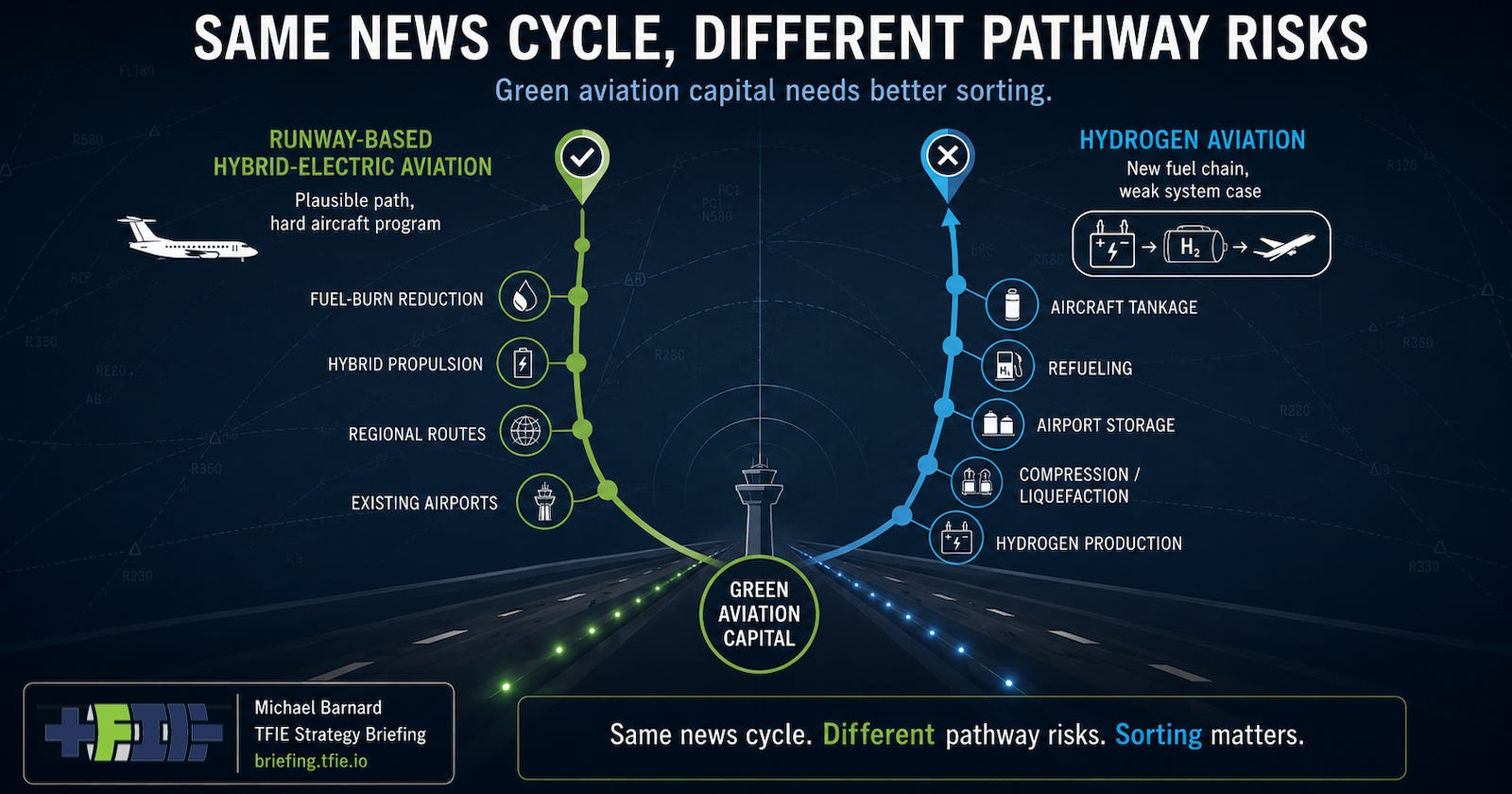
Maeve Aerospace and ZeroAvia had bad weeks in the same news cycle, which made it tempting to wrap them in the same narrative: promising green aviation companies reaching the point where aerospace development gets expensive and investor patience gets thin. That framing is convenient, but it is not very useful. Maeve and ZeroAvia were not pursuing the same kind of aviation decarbonization pathway, and the distinction matters more than the shared timing.
Maeve Aerospace, the Dutch hybrid-electric aircraft developer, entered insolvency after failing to close a reported €20 million raise. It had been developing the MAEVE Jet, a proposed 75 to 100 seat hybrid-electric regional aircraft, with serious aviation names around the table including Pratt & Whitney Canada, Collins Aerospace, MHI RJ Aviation Group, SkyWest, Delta, and Japan Airlines-linked interest. The aircraft changed configuration over time, ending as a rear-mounted open-rotor hybrid-electric regional aircraft aimed at existing airport infrastructure and an early-2030s service entry.
That was a large and difficult aerospace undertaking. A 75 to 100 seat aircraft requires certification, supplier integration, thermal management, maintenance intervals, dispatch reliability, residual-value assumptions, battery replacement economics, and airline fleet economics to line up well enough for repeat procurement. Maeve was more plausible than many green aviation stories, but plausible is not the same as bankable, certifiable, or easy.
ZeroAvia’s news was different. Founder and CEO Val Miftakhov stepped down in late May, with executive chair Christine Ourmières-Widener taking operational control while the company searches for a successor. The leadership change followed a period of funding pressure, layoffs, and the much harder task of turning hydrogen aviation demonstrations into a commercial aircraft business.
The distinction matters because Maeve was in the conventional takeoff and landing regional aircraft lane. That means existing airports, familiar operating patterns, recognizable maintenance ecosystems, and aircraft intended to reduce fossil liquid fuel burn without requiring aviation to build an entirely new fuel system beside the runway. Hybrid-electric regional aircraft still face a steep road, but the road at least connects to the aviation system that exists.
ZeroAvia’s problem was never that hydrogen aircraft could not be made to fly in demonstration form. The problem was whether the full commercial system could work once delivered hydrogen cost, compression or liquefaction, airport storage, refueling, safety systems, aircraft tankage, payload, range, maintenance, certification, and airline operating economics were all included. That is a much longer chain of dependencies than reducing fuel burn with hybridization or using batteries where route lengths and reserve requirements allow them to make sense.
I have been making this distinction since 2021. My aviation decarbonization work has consistently landed on batteries and biofuels, not aluminum or hydrogen, as the practical stack for aviation. Batteries and hybridization can matter in shorter regional aviation where the route structure fits the technology, while sustainable aviation fuels and other residual liquid fuels remain necessary for long-haul aviation where energy density is decisive. Hydrogen has stayed outside my base case because it keeps failing the delivered-cost, infrastructure, aircraft-integration, and comparator tests.
The same sorting problem appears in eVTOLs. I have long treated broad urban air mobility claims as overpromoted, even where certification progress is real. Certification is necessary, but it is not a business model. Utilization, insurance, vertiports, weather, maintenance, routing, fares, noise, pilots or autonomy, and actual customer demand still have to work before an aircraft type becomes a meaningful aviation decarbonization pathway.
This matters for capital allocation. Hydrogen aircraft and eVTOLs were easier to sell as transformation stories because they photographed well, presented well, and gave airlines, airports, governments, and investors a way to talk about aviation decarbonization without spending too long on route bands, airport electrical capacity, delivered fuel cost, utilization, and fleet replacement cycles. They fit the communications needs of the sector better than they fit the operating constraints of aviation.
Hybrid-electric CTOL aircraft are a harder story to sell because they do not claim to reinvent cities or replace the aviation fuel system in one leap. They require the slower work of matching aircraft size, battery systems, regional routes, charging or fueling infrastructure, certification, airline operations, and maintenance economics. That makes them less exciting in a capital market that has rewarded spectacle in climate tech, but it also makes them closer to the set of problems aviation actually has to solve.
That is the connection between Maeve and ZeroAvia. It is not that ZeroAvia literally took Maeve’s missing €20 million. Capital markets are not a single pool of money, and some hydrogen or eVTOL investors were chasing moonshots, strategic positioning, climate branding, defense optionality, or public-market excitement. Many of them might never have funded a sober regional aircraft company under any circumstances.
The stronger claim is that green aviation was sorted badly. Too much capital, policy attention, airline signaling, and media coverage flowed toward pathways where the system case was weak, while more plausible but less dramatic pathways had to compete in a category increasingly shaped by overpromising. When the excitement faded and fundraising became harder, the whole category began to look suspect, including the parts that were closer to aviation’s real transition constraints.
The denominator was never whether something flew. Aviation has been making things fly for more than a century. The denominator is whether the pathway fits the aircraft, the airport, the route, the energy system, the certification process, the maintenance regime, and the balance sheet of airlines that are not famous for generous margins. Memoranda of understanding, renders, test flights, and strategic partnerships are useful signals only when they point toward repeatable operations.
Maeve still had to prove itself against that denominator. It had not certified an aircraft, entered airline service, demonstrated dispatch reliability, or shown battery-system cost, maintenance economics, and route-level operating costs in the field. Its ambition to build a 75 to 100 seat aircraft raised the development burden substantially. It should not be turned into a simple morality play about a good startup and a bad startup.
But the comparison is not Maeve against perfection. The comparison is Maeve against the alternatives that absorbed attention and capital. On that basis, Maeve was in a more credible transition lane than hydrogen aviation. It was trying to improve a part of the aviation system that can plausibly be improved, using infrastructure that mostly exists, in route bands where electrification and hybridization can have a role. That is a different kind of risk than betting on a new aircraft, a new fuel chain, new airport infrastructure, and better hydrogen economics arriving together.
ZeroAvia may continue, pivot, restructure, raise capital, or find narrower markets. This is not an obituary. It is a reminder that hydrogen aviation has always required many favorable assumptions to hold at once. The aircraft demonstration was never the decisive evidence. The decisive evidence would be certified aircraft carrying useful payloads on useful routes with delivered low-carbon hydrogen at costs airlines can tolerate, through airport infrastructure that does not require heroic subsidy, with repeat purchases following actual operation. That evidence has not arrived.
Disclosure belongs here, but only lightly. I have been an advisor to aviation-related companies including FLIMAX and Electron, and I have been publishing aviation decarbonization assessments for years. That does not make my position correct. It does mean I spend a lot of time looking at the operational, infrastructure, and investment constraints behind the claims, which is where aviation transition assertions usually become much less tidy.
The aviation demand and decarbonization projection through 2100 I am updating and formalizing now separates those constraints explicitly: route bands, residual liquid-fuel demand, SAF limits, hybrid-electric displacement, and update triggers for claims that deserve watching but not belief. The sector does not need less ambition or less engineering effort. It needs a more disciplined separation between pathways that fit the aviation system and pathways that mostly fit investor decks, airline announcements, and conference panels.
Maeve and ZeroAvia landing hard in the same week is not a story about two equivalent pioneers reaching the same valley of death, which many are claiming. It is a story about why aviation pathways need to be sorted before capital, policy support, and press-release oxygen are spent. Some companies fail while pursuing difficult but plausible routes. Others struggle because the route itself was weak. Aviation decarbonization will not be helped by pretending those are the same thing.
Subscribe to TFIE Strategy Briefing for transition analysis that separates operating evidence from announcement logic, with the professional layer in paid posts: scorecards, denominator checks, update triggers, and decision-grade context.