

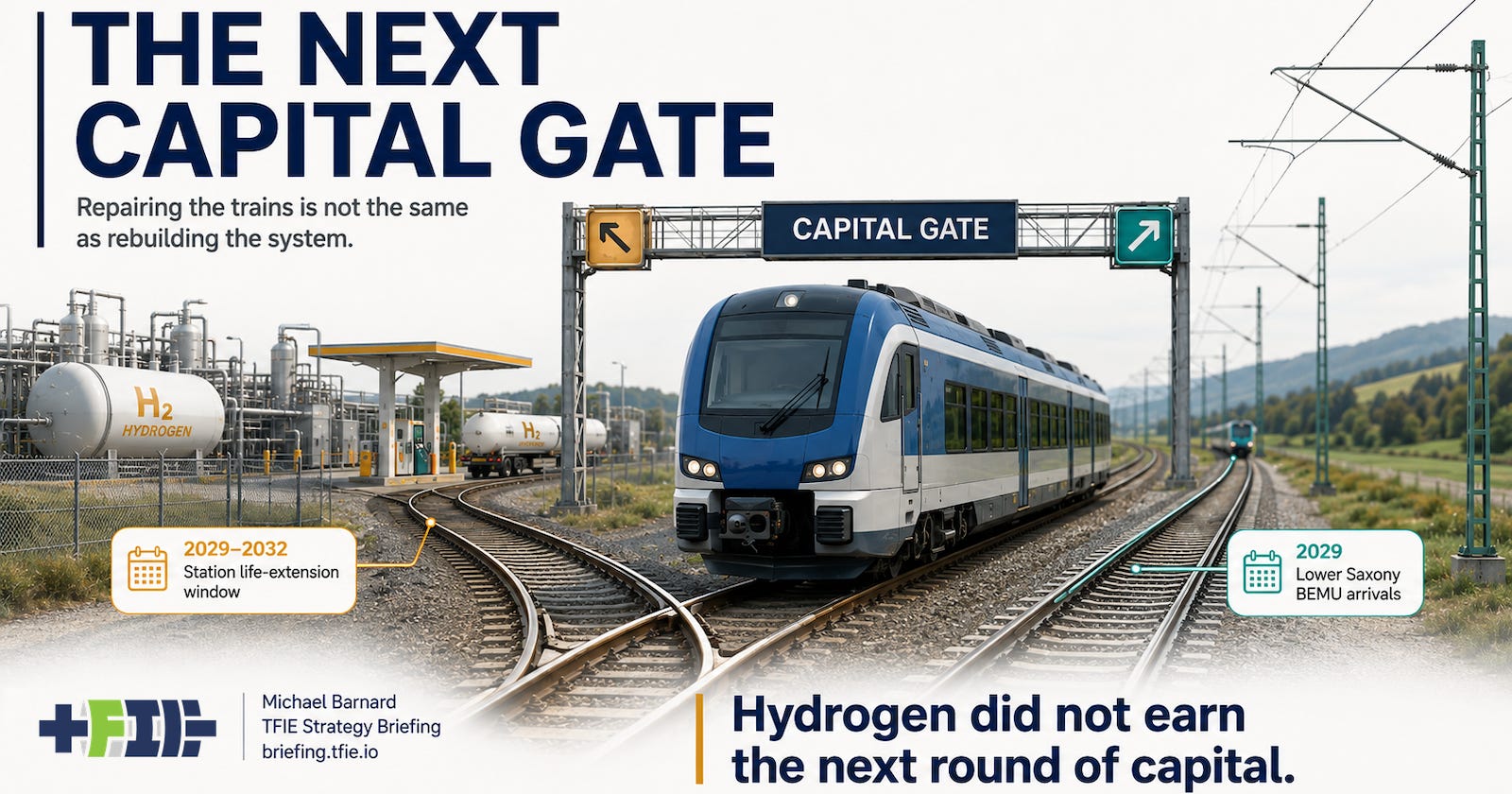
Lower Saxony’s hydrogen trains will probably not be retired because a politician announces that battery-electric multiple units were the better technology. They will be retired when Linde presents the bill for extending the life of an underused, non-strategic hydrogen station and the state has to compare that cheque with buying the battery-electric future it has already selected. The first major station recapitalization is likely to arrive around 2029 to 2032. Lower Saxony’s first large battery-electric multiple-unit, or BEMU, fleet is also expected from 2029. The dates are converging on the same strategic decision.
Richard Rumelt’s kernel of good strategy requires a diagnosis of the central challenge, a guiding policy that concentrates effort on overcoming it, and coherent actions that reinforce one another. The diagnosis is not simply “hydrogen trains are unreliable.” Lower Saxony owns a tightly coupled and increasingly orphaned transport system in which trainsets, proprietary fuel-cell modules, a dedicated station, trucked industrial hydrogen and long maintenance commitments only have value when every link works. The weakest link sets the value of the rest.
The latest fleet-specific public figure I can verify is from August 2025, when EVB said that only four of the 14 Coradia iLint trainsets were operating because replacement fuel-cell modules had not arrived. Diesel units were covering some, but not all, of the gaps, and EVB said they offered fewer seats than the hydrogen trains. In April 2026 Alstom bought Cummins’ rail fuel-cell engineering, product and support activities. Alstom’s own explanation focused on reliability growth, maintenance of installed fleets and completion of contracted programs in Germany, Italy and France. That is prudent liability containment, but it is not the profile of a propulsion platform attracting repeat orders and a widening supplier base.
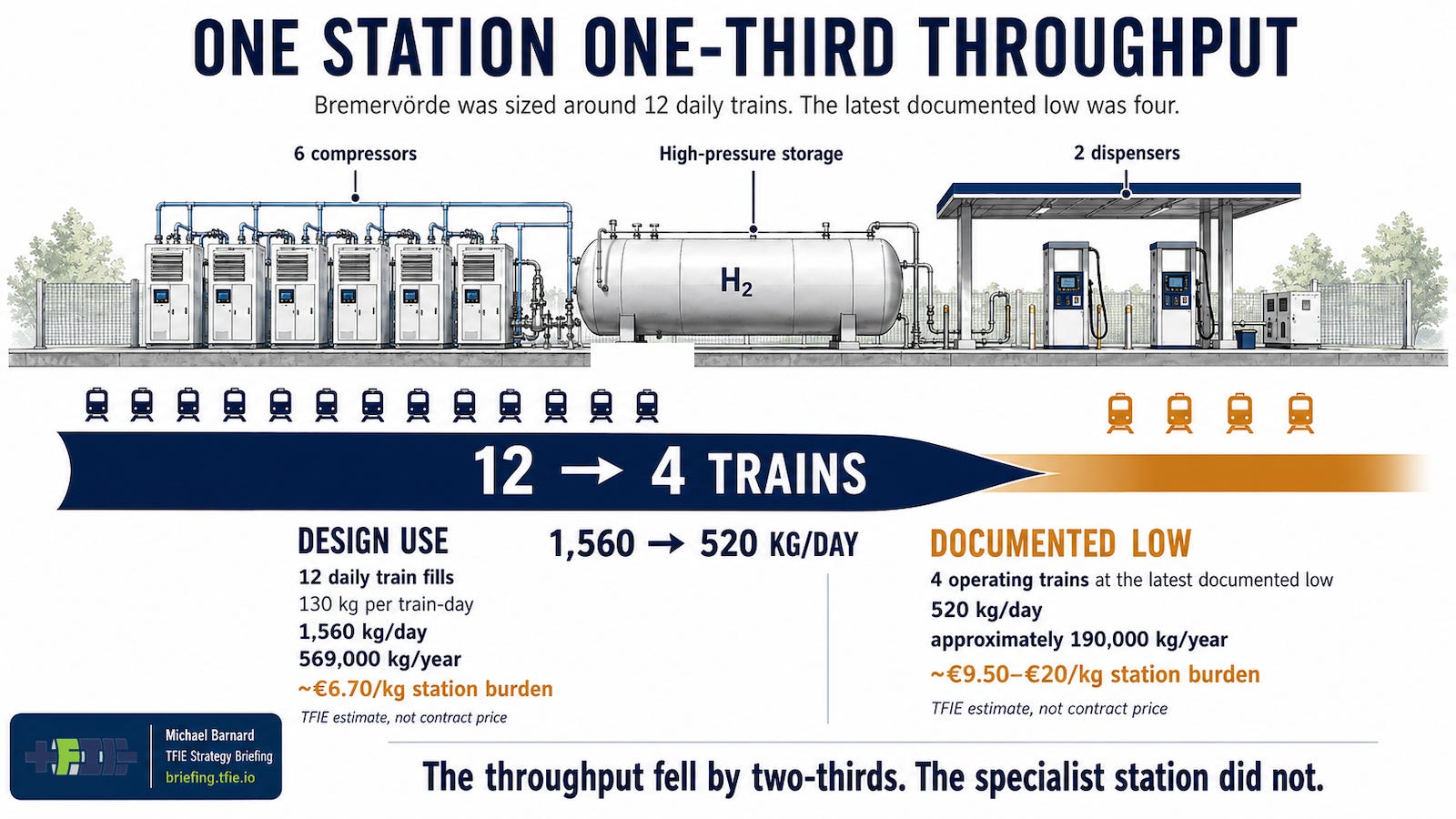
The capital already committed is substantial. Lower Saxony committed €81.3 million to the trains, while the federal government added about €8.4 million, and the original deal included 30 years of maintenance and energy supply. Linde built, owns and operates a dedicated refuelling station estimated at €10 million and supported by federal funding. The station has six compressors in three twin units, high-pressure storage and two train dispensers. Linde says it was engineered to refuel 12 passenger trains with about 130 kg each per day, or 1,560 kg daily, close to its 1,600 kg nameplate capacity. Four operating trains require roughly 520 kg per day. A system sized around 12 daily trains was therefore operating at about one-third of intended throughput at the latest documented low point.
That denominator turns an expensive station into a startling one. Annual recovery of €10 million over 20 years at 5% is about €800,000. My analysis of six years of NREL data from 55 California hydrogen stations pointed toward maintenance near 30% of capital expenditure at design throughput, not the 3% to 4% used in many models. Aberdeen’s roughly £1 million Kittybrewster station incurred operating costs near £325,000 a year and required significant life-extension work after about nine years. The same reference class implies about €3 million a year for Bremervörde at design use.
Linde’s actual invoice is confidential, and California maintenance events rose with throughput. This is a reference-class warning, not a claimed contract price. At design throughput, €800,000 of capital recovery plus €3 million of operations and maintenance is about €6.70 per kg before buying, purifying, compressing and trucking hydrogen. At four trains, the station burden is roughly €9.50 per kg if most maintenance falls with use and about €20 if much remains fixed. Low use does not make pressure vessels, redundant compressors, controls, safety systems and specialist inspection disappear.
At full design throughput the fleet would consume about 569,000 kg a year. Even a low station-inlet price of €3 per kg adds €1.7 million annually; €6 adds €3.4 million. With the station reference-class cost, the hydrogen system reaches roughly €5.5 million to €7.2 million a year before module replacement, train maintenance, diesel substitution and passenger disruption. The same daily hydrogen contains about 52 MWh of chemical energy and, at roughly 50% fuel-cell efficiency, supplies about 26 MWh of electricity. Allowing for charging losses, an equivalent BEMU fleet would likely draw 10 to 12 GWh a year, costing €1.5 million to €3 million at €0.15 to €0.25 per kWh. Route engineering would refine the estimate, but the order of magnitude is strategically useful.
The emissions claim is weaker than the launch publicity implied. EVB calls the fuel an otherwise unused chemical-industry by-product. NDR traced it through Linde’s partners to Dow’s chemical complex at Stade, about 40 road kilometres from Bremervörde. Dow produces chlorine and caustic soda through chlor-alkali electrolysis, with hydrogen as a co-product, and Dow’s own site description lists hydrogen as an input to energy generation. Diverting it to trains is therefore not automatically the use of a waste gas that would otherwise be vented. It may displace another fuel or energy source inside the chemical complex.
Allocation makes the carbon number genuinely uncertain, but not unknowable in scale. EU screening criteria use up to 2.45 MWh of electricity per ton of chlorine for chlor-alkali production. The chemistry produces about 35.5 kg of chlorine for every kilogram of hydrogen, associating roughly 87 kWh of electrolysis electricity with each kilogram of hydrogen before any allocation among chlorine, caustic soda and hydrogen. Germany’s 2025 grid averaged 344 grams of CO2 per kWh. Assigning all of that electricity to the hydrogen would produce about 30 kg of CO2 per kg of hydrogen. Assigning almost none to a by-product produces a very low number. Economic, mass and substitution allocations land elsewhere. Dow offers renewable-energy mass-balance attribution for some caustic soda, but I found no evidence that the train hydrogen carries it. The public project material does not disclose the allocation method or what replaces the hydrogen Dow otherwise uses for energy.
That gap is not academic. At 130 kg per train-day, the full-electricity allocation would be almost 3.9 tons of CO2, while Linde’s own rule of thumb says the same hydrogen replaces about 585 litres of diesel, whose combustion emits roughly 1.6 tons of CO2. The full-allocation case is worse than diesel. A by-product allocation can be much better. Compression, purification and two daily truck movements add more. The defensible conclusion is not that the trains have a known 30 kg-per-kg hydrogen footprint. It is that the project has never publicly demonstrated a material lifecycle emissions reduction, while a BEMU’s emissions would be tied directly to a German grid that is already decarbonizing. “Zero emission” described the exhaust pipe, not the energy system.
Low train availability adds another loss. At more than €6 million per trainset, eight unavailable units relative to the station’s 12-train operating design represent about €49 million of idle rolling-stock capital. Annualized over 30 years at 5%, that is about €3.2 million a year before repairs. Underused station capacity adds at least €0.5 million of annual capital recovery and potentially much more in poorly absorbed operations. A reasonable estimate is €3.5 million to €5.5 million a year of destroyed economic value at four-train availability before the higher energy-chain cost. Contracts decide whether it appears in LNVG’s budget, Alstom’s remediation costs, Linde’s margin or settlements, but the system pays it somewhere.
Rumelt’s diagnosis must identify the actors rather than invoke generic stakeholders. LNVG owns the trains and needs reliable service while preserving its claims. EVB wants dependable capacity regardless of propulsion. Alstom wants to cap remediation exposure, avoid a refund precedent and preserve Lower Saxony as a customer. Linde wants payment for operating and eventually overhauling a specialized single-customer station, not speculative exposure to an abandoned growth market. Federal funders want a defensible result. Political leaders want to protect passengers, public money, industrial employment and the reputation of a project once presented as the future of rail. Those incentives do not naturally produce the whole-system answer.
The guiding policy should be explicit: continuation must earn the right to exist at the next capital gate. Lower Saxony should prepare an executable BEMU end state while requiring Alstom and Linde to price and underwrite any continued hydrogen operation. The state should not attempt to forecast proprietary fuel-cell durability or compressor remaining life better than the suppliers. It should require them to guarantee the performance and cost claims they are best placed to understand.
The coherent actions follow from that policy. First, no major station overhaul, onsite electrolyzer or energy-contract extension should proceed without a whole-system comparison against BEMU replacement. Second, Alstom and Linde should submit a binding continuation offer covering at least 11 serviceable trains, module inventory, maximum repair times, station availability, life-extension capital and an all-in cost per train-kilometre. They should also submit a priced exit offer covering residual train value, cancellation of future obligations, bridge operation and station decommissioning. Third, LNVG should engineer route charging, depot changes, partial catenary, grid connections and vehicle procurement now for a 2029 to 2030 transition. A credible alternative is not merely contingency planning. It changes who has negotiating leverage.
The path through the mess is a managed runoff. Alstom repairs enough trains and funds a spare-module pool to maintain service through the transition. Linde operates the present station for a defined bridge period without committing its balance sheet to another full lifecycle. LNVG procures standardized BEMUs and charging infrastructure. Federal support follows the zero-emission transport outcome rather than remaining attached to one energy carrier. Alstom can contribute cash, trade-in value, cancelled maintenance charges or conversion work and still spend less than it might on litigation, refunds and decades of support for an orphan platform. Linde can receive a paid bridge and orderly exit instead of financing an overhaul against uncertain demand.
The authority to make this coherent is distributed formally but concentrated politically. The LNVG supervisory board can authorize negotiations and replacement planning. The Finance Ministry exercises the state’s shareholder rights. The transport ministry can implement the battery program. Minister-President Olaf Lies can align them and explain the pivot. He sponsored the hydrogen project as transport minister and later championed the battery procurement, giving him unusual legitimacy to say that Lower Saxony was right to test a first-of-kind option under uncertainty and is equally right to act on the operating evidence now.
Calling the project a success would be evasive. Calling it simply a failure would encourage every participant to defend the past. The more useful formulation is that the demonstration produced the evidence demonstrations are supposed to produce. Hydrogen did not earn the next round of capital. The first investment was made under uncertainty. Rebuilding the station for another decade would be made despite the evidence. Good strategy is making that distinction before Linde’s overhaul proposal becomes another repair item, another contract extension and another ten years of policy by default.
Excellent. An orderly and defensible exit to an idea that just did not work out, whereas Toyota has reached the class action stage in its failed H2 fuel cell car in California. Hydrogen -- The Unbearable Lightness of Failing.