

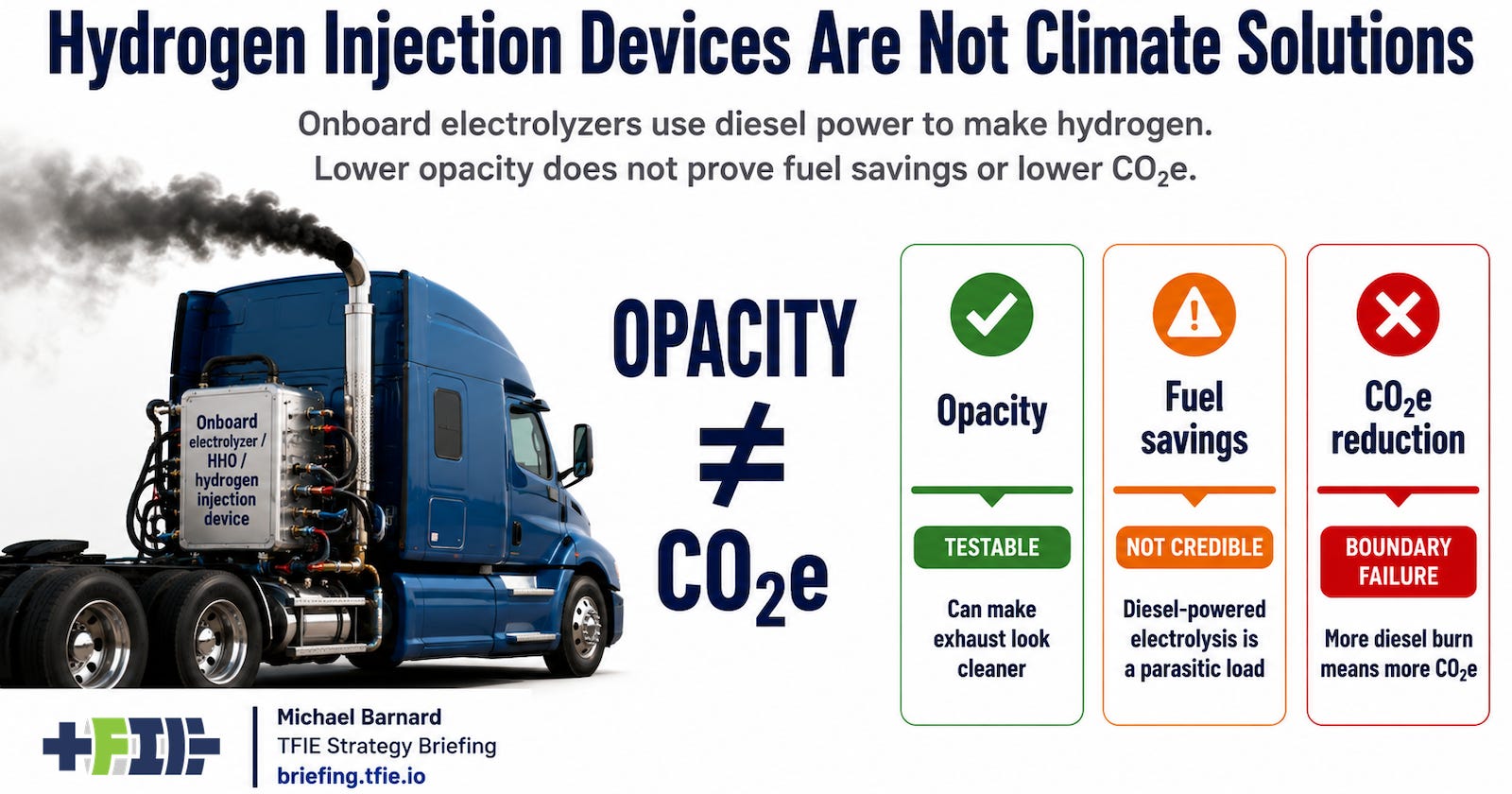
Diesel hydrogen-injection add-ons have been returning to the market for decades with new names, new boxes and the same claim structure. The current language is usually cleaner than the old water-fuel gadget language, but the move is familiar. A small device uses electricity from the diesel vehicle to split water, makes hydrogen or a hydrogen-oxygen gas mixture often marketed as HHO or oxyhydrogen, injects the gas into the intake, and then turns a narrow combustion or smoke result into a broader fuel-efficiency and carbon-reduction story.
Recently one of the principals of one of the firms reached out after reading one of my hydrogen analyses pitching one of these Rube Goldberg contraptions and making extraordinary claims, claims which were written out clearly on their website. I’ve looked at variants of these things four or five times in the past couple of decades, but never written down why they aren’t remotely climate solutions. The interaction triggered me to pull together an analyses of the past and current firms pitching this, their claims, the regulatory landscape, their claims and an analysis of why their claims are indefensible.
The defensible kernel is opacity, the measurement of how much visible smoke blocks light in an exhaust plume. If a little hydrogen or oxyhydrogen changes combustion conditions, visible smoke can change. That is not exotic, because soot formation is sensitive to local combustion conditions and smoke opacity is a real measurement. It is also a narrow measurement. Lower opacity means the exhaust looks less black under the test condition, not that the truck used less diesel, reduced carbon dioxide equivalent emissions, or made a modern engine’s emissions-control system unnecessary.
That distinction matters because the public claims in this category rarely stop at opacity. The pitch usually migrates from cleaner-looking exhaust to lower emissions, then to lower carbon, then to fuel savings, then to maintenance savings, and finally to some version of a green-hydrogen bridge for diesel fleets. The ladder is doing the work. Opacity is the measured or plausible result. Fuel savings and carbon dioxide equivalent reduction are the commercial claims, and the evidence for the first does not automatically travel to the second.
The system boundary is the problem. In these onboard-electrolyzer systems, the hydrogen is not an external fuel. It is made on the vehicle using electricity ultimately produced by the diesel engine. The chain is diesel fuel, engine shaft work, alternator electricity, electrolysis, hydrogen or HHO, intake, combustion, and back to the same engine. Every step has losses. If the device is sold as a combustion modifier, then the question is whether the combustion effect is large enough to overcome the alternator and electrolysis load. If the device is sold as a fuel saver, the question is even less forgiving: where did the saved energy come from?
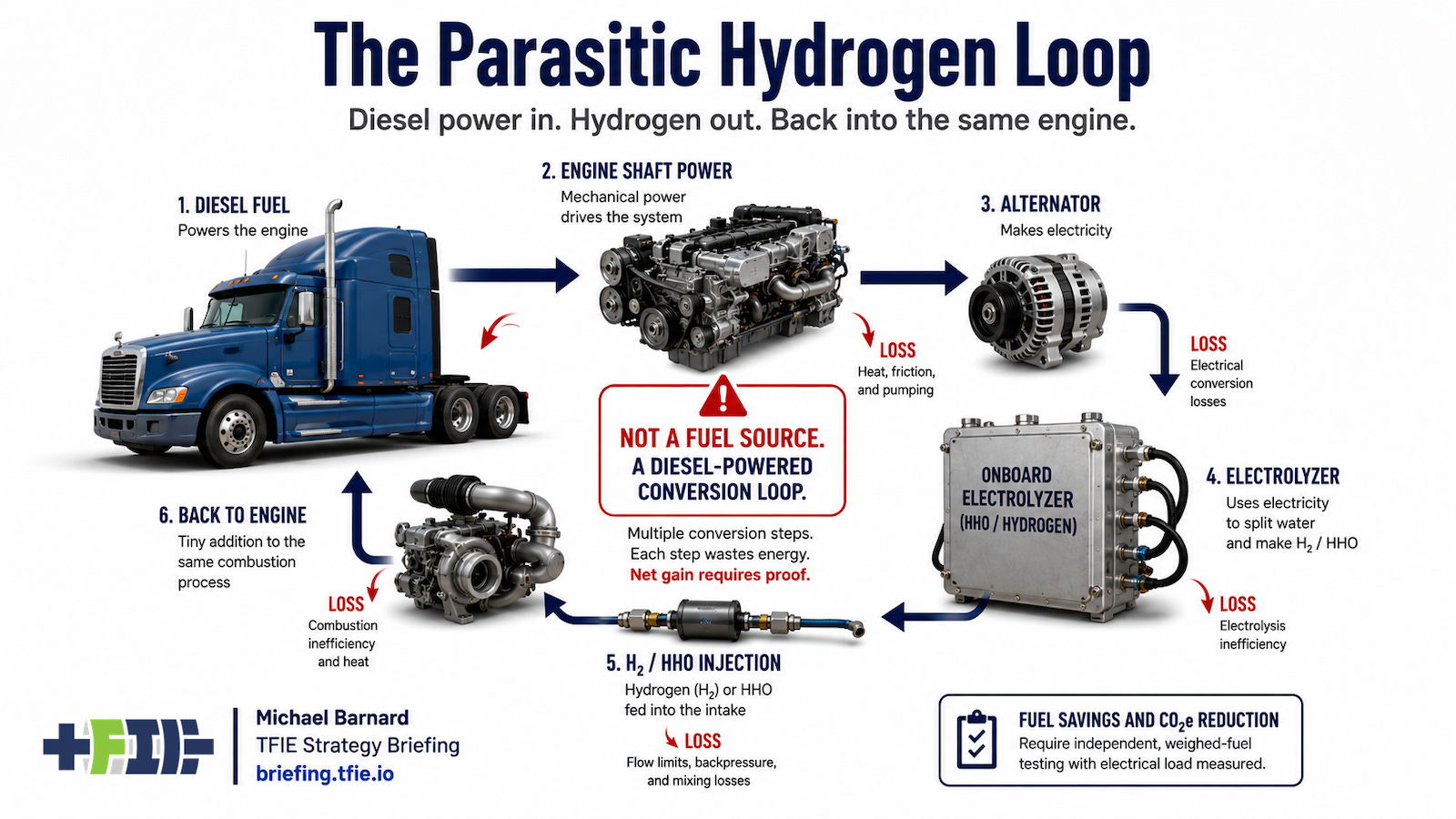
There is no carbon accounting escape hatch here. Diesel carbon dioxide is closely tied to diesel gallons burned. If the device causes the truck to burn more diesel to power an electrolyzer, carbon dioxide rises. Hydrogen leakage or unburned hydrogen slip would add a smaller climate penalty on top, but it is not the main issue. The main issue is simpler and uglier: diesel-powered electrolysis adds load to the engine before any possible combustion benefit appears. The default expectation is a fuel penalty unless independent, protocol-grade testing proves otherwise.
A screening model puts the burden of proof into scale. Using a representative public claim of 40 litres per minute and the central engine, alternator and electrolyzer assumptions in the accompanying workbook, the onboard loop implies a fuel-economy penalty of about 8.7% if the quoted flow represents total HHO gas. If the same 40-litre-per-minute claim is interpreted as pure hydrogen, the estimated penalty rises to about 13.0%.
These are not measurements of a specific commercial device and they are not predictions for every engine or duty cycle. They are system-boundary screening results. They show the scale of the parasitic load that any claimed combustion improvement must first overcome before the device can produce a net fuel saving or carbon benefit. The generous case still begins with diesel energy being converted into shaft work, then electricity, then hydrogen, before being returned to the same engine.
The usual response is that the hydrogen is not meant to supply much energy. It is meant to improve combustion. That is the only serious version of the argument, but it does not rescue the class. If a tiny gas stream improves the combustion process enough to create measurable net fuel savings after the electrolysis load, that result should show up in controlled comparison tests using weighed fuel, with electrical load logged, gas flow measured, route and load controlled, emissions split by pollutant, and aftertreatment behavior recorded. It should not need fleet anecdotes, before-and-after stories, unreviewed dashboard data or a smoke test pressed into service as carbon evidence.
The strongest version of this class still has a weak climate case. A more serious vendor with structured third-party testing has reported modest fuel-savings results in a controlled test, not the large 15% to 25% claims that appear elsewhere in the category, and even that report did not show a noticeable carbon dioxide difference. A diesel-generator study of onboard HHO found the opposite pattern: fuel consumption rose as HHO injection increased, because the energy cost of producing the gas was not recovered by the combustion effect. That is exactly what the system boundary predicts.
The regulatory and warranty implications are not side issues. A device that changes intake gases, alternator load, combustion behavior, sensors, engine calibration, diesel particulate filter regeneration, selective catalytic reduction behavior, diesel exhaust fluid consumption or onboard diagnostic readiness is entering the emissions-control system, not merely clipping an accessory to the outside of the truck. The diesel particulate filter is the system that traps soot. Selective catalytic reduction is the system that uses diesel exhaust fluid to reduce nitrogen oxides. Onboard diagnostics are the vehicle’s monitoring and fault-reporting systems. Claims about “no diesel particulate filter” or “no diesel exhaust fluid” are therefore not just marketing claims. They are regulatory claims. For modern certified diesel engines, they require engine-family-specific evidence that the vehicle remains compliant in the configuration being sold and installed.
This article is not about purpose-built hydrogen internal-combustion engines. It is not about externally supplied hydrogen dual-fuel demonstrations where hydrogen is stored onboard as a second fuel and actually displaces diesel. Those are different claims with different problems. This is about onboard hydrogen-on-demand or HHO devices added to diesel engines, especially systems that use the vehicle’s own electrical system to make hydrogen from water while the engine is running. That category should not be allowed to borrow credibility from external green hydrogen, fuel cells or clean-sheet engine programs.
The real comparator is not a dirtier diesel engine from another era. For local soot and criteria pollutants, the comparator is proper maintenance, certified aftertreatment, cleaner certified engines and compliance with the system the truck was designed to use. For climate, the comparator is reduced fuel use, freight efficiency, route optimization, modal shift where relevant, battery-electric trucks across the duty cycles they can already serve, and retirement or replacement of old diesel assets as economics allow. An aftermarket electrolyzer has to beat those options on delivered outcome, not on a photo of a cleaner-looking exhaust stack.
The cleanest public verdict is narrow. Hydrogen injection can plausibly affect smoke opacity under defined conditions. That is not enough. The fuel-savings claim is not credible. The carbon dioxide equivalent claim is not credible. Diesel particulate filter and diesel exhaust fluid avoidance claims are regulatory red flags unless covered by specific certification, exemption or compliance evidence. The climate claim should not leave the starting line until those tests are passed.
The paid evidence layer below applies the Red Flags evidence pack to the class: current company claims, prior litigation history, regulatory scope, independent test results, warranty and service risk, and the energy-balance workbook.
