

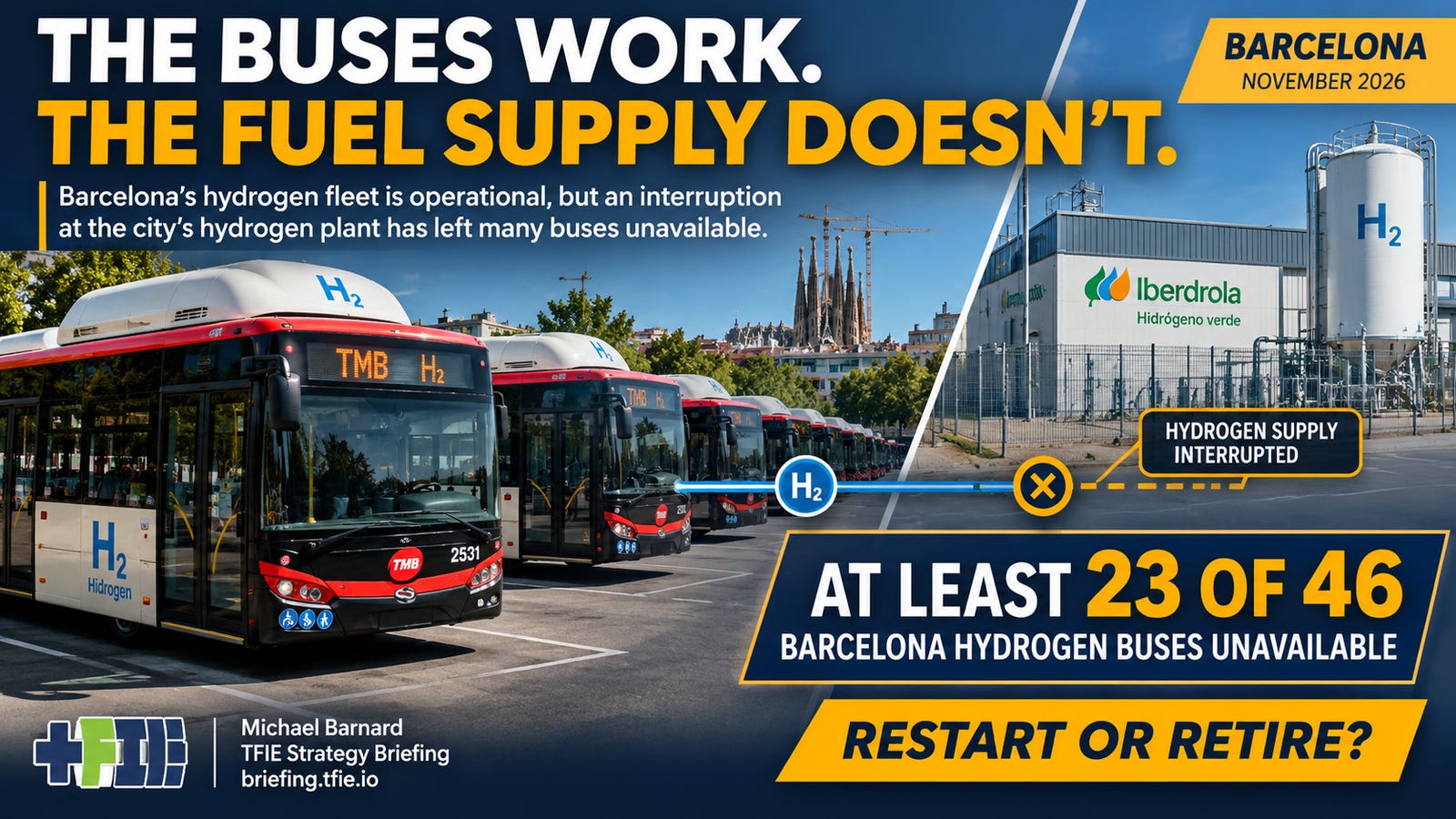
The hydrogen bus death spiral is gathering pace. Aberdeen has abandoned 25 hydrogen double-deckers after a prolonged refuelling shutdown, while Barcelona now has at least 23 of its 46 hydrogen buses sitting in depots because fuel production has stopped. One city has decided to leave hydrogen behind. The other faces the question of whether its buses should return to service at all. Each exit reduces demand for the fuel, components and specialist support required to keep the remaining hydrogen fleets operating.
In Barcelona, the disruption has reduced scheduled bus service by 2.5% to 3.8%, with waits on some affected routes increasing from seven to nine minutes. At times, only a quarter of the hydrogen fleet has been operating. The buses themselves are functional, but the hydrogen plant supplying them is unavailable and alternative fuel deliveries have been insufficient.
According to La Vanguardia’s November 21 reporting, the shutdown is connected to Cummins’ recommendation that customers stop operating affected electrolysers following a safety review. Plant operator Iberdrola separately told ARA that the interruption involved a problem with the electrolysers’ valve systems. The precise relationship between that fault and Cummins’ broader safety concerns has not been established publicly. Attempts to deliver replacement hydrogen from the Tarragona petrochemical industry have been constrained by industrial action, transport restrictions and available supply. Barcelona’s transit operator, TMB, has a ten-year hydrogen supply agreement worth €14.5 million, with compensation provisions for failures to deliver fuel. Compensation cannot restore the bus service that passengers have already lost.
Cummins announced in February 2026 that it would stop pursuing new commercial electrolyser business after years of disappointing demand. In September, its Hydrogenics subsidiaries recommended that customers stop operating HyLYZER electrolysers following a review of operating data. Cummins’ November quarterly filing confirmed that no formal recall had been initiated and that the company was still assessing the modifications required to return affected equipment to service. I examined the implications in Cummins’ Hydrogen Hangover Is a Warning to the Rest of the Market. Cummins can retreat from an unattractive market while retaining contractual support obligations. Its customers have much less freedom when the equipment they depend on stops working.
TMB’s immediate priority is restoring dependable bus service, but repairing the hydrogen equipment will not resolve the economic question. If restarting the fleet requires substantial expenditure, should the agency commit to more years of hydrogen operations or accept the original investment as lost and begin replacing the vehicles?
Aberdeen, Scotland, has already confronted that choice. It purchased 25 Wrightbus hydrogen double-deckers for approximately £13.9 million, with the vehicles entering service in 2021. They were central to the city’s ambitions to become a hydrogen hub, providing demand to support production and refuelling infrastructure. In July 2024, problems with the hydrogen supply infrastructure left the buses stranded. Returning them to service required investment in facilities whose economics depended on commitments to future hydrogen purchases. The buses remained out of operation while the city and its partners considered how to proceed.
In February 2026, Aberdeen decided to dispose of the fleet rather than keep spending to restore hydrogen operations. The subsequent proposed sale demonstrated how little residual value the original investment retained. First Bus was set to acquire 23 vehicles for £30,000 each, against an original average purchase price of £556,000. Two more were allocated to GeoPura at £63,000 each. The expected £816,000 in proceeds represented just 5.9% of the original vehicle expenditure. First Bus was considering conversion to battery-electric operation rather than returning the buses to hydrogen service. I covered the decision in Aberdeen’s Hydrogen Bus Fleet Ends in Failure and the subsequent collapse in residual values.
Aberdeen had already lost most of its investment. Abandoning hydrogen prevented further expenditure on restoring and sustaining the system. Keeping the buses would not have recovered their purchase price. It would have required more spending on hydrogen infrastructure, fuel, maintenance and specialist support, with no assurance that the problems which stranded them would not recur.
Liverpool reached a related conclusion in December 2025. Its 20 hydrogen buses had barely operated because a dependable fuel supply had not been established. Ten had never carried passengers, while the other ten had completed just 450 passenger-carrying journeys. Rather than continue trying to make hydrogen work, the Liverpool City Region Combined Authority decided to convert all 20 buses to battery-electric operation, with the supplier covering the conversion cost. The engineering work remains to be completed, but the decision to exit hydrogen was made. Wiesbaden had previously disposed of its ten hydrogen buses, with depot constraints contributing to its choice to concentrate on other drivetrains.
The fleets are different, but the decisions reveal a common principle. A hydrogen bus does not have to reach the end of its mechanical life to become uneconomic. An expensive fuel-system repair, a failed supplier or an extended interruption can make early retirement the least costly remaining option. Money already spent buying the buses and constructing infrastructure cannot justify further expenditure when a cheaper way of delivering the same service is available.
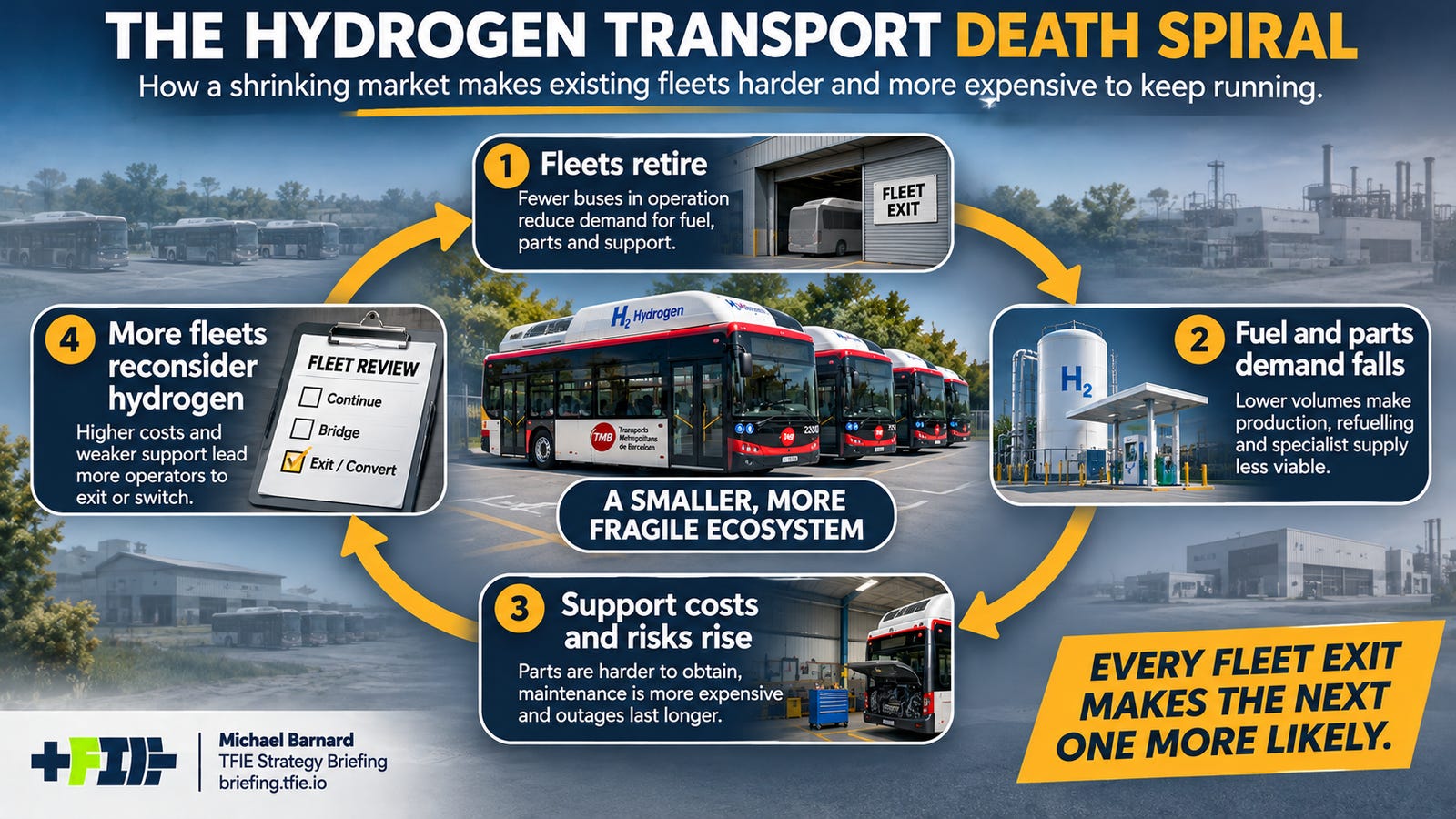
The market surrounding these vehicles makes the decision increasingly pressing. Battery-electric buses are being purchased in much greater volumes, supporting vehicle manufacturing, charging equipment, maintenance capacity and component supply. Hydrogen buses remain concentrated among relatively few agencies dependent on substantial public funding. My October procurement analysis documented the overwhelming battery-electric share of the orders identified, although subsequent research found additional US hydrogen purchases missing from the original sample.
As hydrogen fleets disappear and new orders remain scarce, the fixed costs of supporting the remaining vehicles fall on fewer customers. Specialist fuel-cell parts, engineering teams, diagnostic equipment and maintenance expertise become less attractive businesses. Refuelling infrastructure faces the same problem. Its capital and operating costs must be recovered from declining hydrogen throughput, increasing the cost of the remaining fuel and reducing the incentive to maintain supply. Higher costs and deteriorating support encourage further exits, shrinking the market again. The feedback loop compounds hydrogen’s existing disadvantages against direct electrification in energy efficiency, fuel production, distribution and infrastructure costs.
The supplier failures are already evident. In October 2024, German commercial vehicle manufacturer Quantron entered insolvency proceedings. IKEA Austria had purchased five Quantron hydrogen delivery trucks alongside 56 battery-electric vehicles. Manufacturer failure created uncertainty about vehicle support, warranties and specialist components. Quantron subsequently resumed business under new ownership, but the original company did not survive intact. IKEA’s later sustainability reporting continued to identify hydrogen trucks as a challenge in decarbonizing deliveries. I examined that exposure in Another Day, Another Hydrogen Transportation Failure, This Time Quantron & IKEA.
Alstom provides evidence of the financial burden when a manufacturer remains responsible for vehicles after a supplier retreats. Cummins’ withdrawal from rail fuel cells led Alstom to acquire the relevant Hydrogenics operations in March 2026 for a nominal €25,000, preserving approximately 140 employees and the technical capabilities needed to support existing hydrogen trains. Its November financial statements disclosed a €172 million adjustment to expected hydrogen project costs, including claims and warranty exposure over contracts extending up to 30 years. An equal non-cash accounting benefit offset that adjustment in reported earnings, but the future support obligations remain. I explored the implications in Cummins Could Exit Hydrogen. Alstom Inherited the Support Tail.
For North American transit agencies, New Flyer, part of NFI Group, faces a narrowing business case for continuing hydrogen-bus production. The publicly identified North American hydrogen-bus market peaked at 288 orders in 2023, dropped to 96 in 2024 and no more than 45 gross orders in 2025, with a stricter reconstruction identifying approximately 15. The 38 buses identified in 2026 procurement decisions do not establish a recovery; the 2026 figure includes different approval stages and cannot be compared directly with the stricter 2025 count. New Flyer continues to sell hydrogen buses and has announced no withdrawal. But a manufacturer supporting thousands of vehicles across its wider operations has decreasing incentive to maintain a costly specialist product line if annual hydrogen orders remain in the tens. Discontinuation becomes more plausible as specialist engineering, parts and product development compete with its much larger conventional and battery-electric businesses.
Its critical fuel-cell supplier is changing direction as well. Ballard acquired GeoPura in August 2026 and is directing investment and management attention toward integrated hydrogen power systems, generator rentals, hydrogen supply and recurring Energy-as-a-Service revenue. It continues to manufacture fuel cells and support bus customers, so this is a shift of emphasis, not an announced exit from bus modules. The 500-module commercial framework Ballard announced with New Flyer in March is not evidence of 500 funded bus orders. Both companies can preserve the possibility of new hydrogen-bus business while prioritizing stronger commercial opportunities. Existing New Flyer hydrogen fleets face the risk that a discontinued or shrinking product line will eventually make replacement components, diagnostic expertise and specialist maintenance more expensive and harder to obtain. Their buses could remain mechanically serviceable long after the product line ceases to attract investment.
Cummins’ retreat has interrupted a fuel-production dependency, Quantron’s insolvency threatened vehicle support, Alstom had to acquire specialist capabilities to meet existing obligations, and New Flyer’s hydrogen-bus business faces a shrinking market while Ballard pursues other opportunities. These are distinct risks, not evidence that every supplier is about to fail. Each increases uncertainty about the long-term economics of keeping hydrogen fleets in service. Aberdeen and Liverpool have already decided their buses were not worth returning to hydrogen operations. Barcelona has an opportunity to assess whether the same choice now makes sense before committing more money to restarting its fleet.
When does restarting a hydrogen fleet cost more than retiring it? How should agencies account for remaining contractual obligations, future supplier withdrawals and the cost of replacement service? The analysis below sets out the forward-cost comparison and the exit thresholds transit boards should apply before another major repair.
