

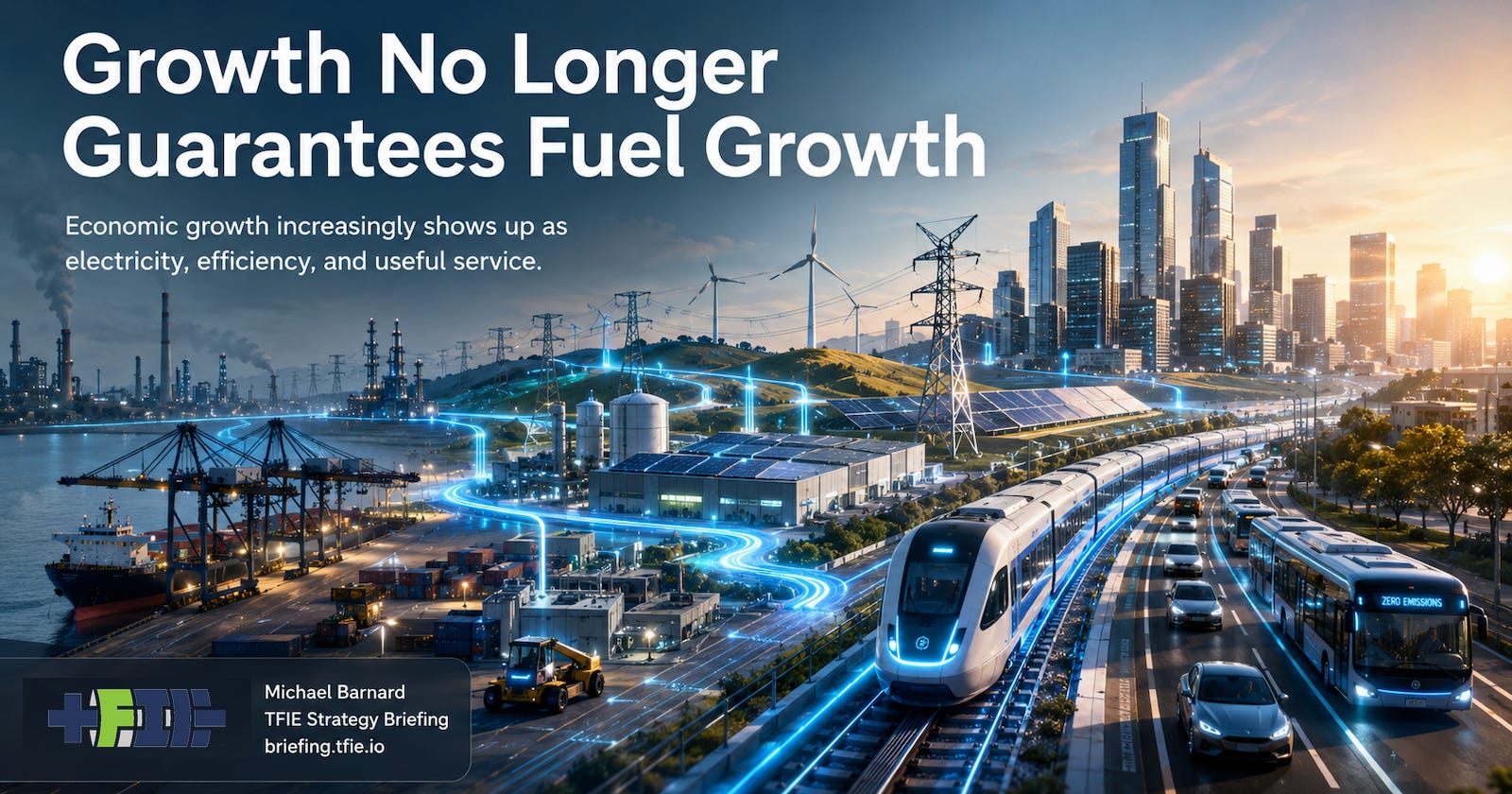
One of the easiest ways to get 2100 wrong is to treat GDP growth as a reliable proxy for fossil fuel growth. For much of the industrial era, that shortcut looked reasonable. More economic activity usually meant more fuel burned, more heavy industry, more freight, more refineries, more power plants, and more fuel bills. Energy demand rose with output, and fossil fuel demand captured most of the increase. A great deal of energy forecasting still carries that history inside it.
That history is no longer a safe denominator. Economic growth still matters, and energy demand still matters, but GDP no longer guarantees fossil fuel growth. More of the next increment of economic activity shows up as electricity, efficiency, digital control, clean infrastructure, electric transport, heat pumps, storage, transmission, and better use of existing assets. Fossil fuels can still grow in a given year, region, or sector. That old inference no longer holds: more GDP does not automatically mean more fossil fuel.
Paul Martin’s phrase, the primary energy fallacy, is a useful way to state the first part of the problem. Fossil systems waste enormous amounts of primary energy as heat before useful service is delivered. A joule of chemical energy in coal, oil, or gas is not equivalent to a joule of electricity delivered to an efficient motor, heat pump, inverter, or industrial process. Treating them as interchangeable because they share a unit is an accounting convenience, not physics. It makes the transition look larger than it is in useful-energy terms, and it makes fossil fuels look more indispensable than they are.
This has been obvious to people working from useful energy rather than fuel volume for a long time. Mark Z. Jacobson and colleagues were making the same basic point in the wind-water-solar work of the late 2000s and early 2010s: when end uses are electrified, total energy demand falls because combustion losses disappear and electric technologies are more efficient. One does not need to accept every system design choice in Jacobson’s work to accept that core arithmetic. Electric motors waste less than internal combustion engines. Heat pumps deliver multiple units of heat per unit of electricity. Electric rail, electric buses, electric trucks, electric industrial heat, and well-managed grids turn more input energy into useful service. The fossil system discards a large share of its primary energy before useful work is done.
Kingsmill Bond’s recent electrotech framing usefully updates that older insight for the present market. The relevant shift is not simply “renewables replace fossil power plants.” It is a suite of technologies — solar, wind, batteries, grids, electric vehicles, heat pumps, sensors, software, power electronics, and flexible demand — that converts more of the economy into electricity and then uses that electricity more efficiently. Electrotech is not a moral category. It is a technology stack with learning curves, modularity, manufacturing scale, and declining costs. That is more consequential for fossil fuel demand than targets that are not matched by deployment.
The distinction matters because primary energy can fall while useful service rises. In a combustion-heavy economy, much of primary energy is rejected heat. Electric vehicles still deliver mobility, heat pumps still deliver heat, and electric rail, port equipment, industrial machinery, and logistics systems still deliver the work firms and households need. The fuel volume falls because the pathway is less wasteful. That is why primary energy, final energy, electricity demand, useful energy, and delivered service have to be kept separate. Once they are separated, the GDP-to-fossil shortcut becomes much less convincing. That is where the GDP link breaks: growth can increase delivered service while reducing the fuel required per unit of service.
The live evidence is already visible. The International Energy Agency’s Global Energy Review 2026 found that low-emissions sources supplied nearly 60% of global energy demand growth in 2025, with solar PV alone meeting more than a quarter of the increase. Oil, gas, and coal still grew, but more slowly than in 2024. That is not proof that fossil demand is now in permanent decline. It is evidence that marginal growth is being contested in a way that older energy-growth models did not expect.
Electricity is the center of that contest. The IEA expects electricity consumption to grow more than twice as fast as total energy demand in the near term, driven by industry, cooling, data centers, electric vehicles, appliances, and electrified end uses. Ember’s 2026 global electricity work found that clean power grew fast enough to meet all new global electricity demand in 2025, preventing an increase in fossil generation. One year is not a trend by itself, but it is evidence worth explaining.
China and India make the shift harder to dismiss because they are the usual test cases for fossil growth assumptions. In my piece on China and India breaking fossil growth models, the point was not that either country had solved fossil demand. They have not. The point was that GDP and electricity demand can grow while fossil growth weakens or even reverses in key parts of the system. China’s clean power buildout, electric vehicles, electric buses, high-speed rail, battery-electric trucks, and industrial electrification are now large enough to change the demand arithmetic. India’s clean electricity additions and early coal-power reversals outside recession conditions are not sufficient yet, but they are no longer consistent with the old fossil-growth script.
That is the practical meaning of the assumption. Growth is still real. Development is still real. Electricity demand will rise substantially as cooling, industry, data centers, vehicles, heat pumps, rail, ports, factories, and urban systems require larger, stronger, better-managed grids. The argument is not that energy demand disappears. It is that the unit of growth changes. More GDP increasingly means more useful service delivered through electricity and efficiency, not more fossil fuel volume by default.
There are real limits to the claim. Fossil fuels can still grow where grids are weak, capital is expensive, policy is poor, industrial demand is rising, or coal and gas are protected by incumbency. Aviation, shipping, chemicals, fertilizer, some high-temperature industrial processes, backup systems, and military logistics will keep some molecule demand. Petrochemicals are not cars, and heavy industry is not residential heat. A serious projection has to keep those distinctions. Electrification does not remove every fuel use, and it does not make infrastructure constraints disappear.
Those limits narrow the claim. They do not restore the old shortcut. A forecast that assumes GDP growth flows first into coal, oil, gas, and liquid fuels needs stronger evidence than it used to. It needs to explain why electricity, efficiency, learning curves, policy, security concerns, fuel-price volatility, air pollution, and industrial competitiveness fail to take more of the marginal demand.
That is why this assumption sits underneath the 2100 work. GDP can shape aviation, shipping, steel, buildings, road transport, industrial heat, freight, and reliability demand, but it does not determine their fuel pathways. Each sector has its own denominator: passengers, tonne-kilometres, stock, heat, freight, industrial output, reliability, and delivered service. A projection that starts with GDP and preserves incumbent fuel volumes has skipped the part where the actual service is identified.
For investors, this changes risk. Fossil fuel growth stories increasingly depend on defending old conversion losses, old infrastructure, old customer habits, and old policy protections. Clean electricity and electrotech growth stories depend on scale, grids, manufacturing, permitting, reliability, and integration. Neither side is risk-free. The difference is that one side has to preserve fuel volume in a world learning to deliver service with less fuel, while the other side has to build the infrastructure for the services people still want.
For policymakers, the same distinction matters. Energy security, affordability, resilience, and competitiveness are not helped by treating fossil fuel demand as the default measure of economic health. A country that grows GDP while reducing exposure to imported fuels, fuel-price spikes, combustion losses, urban air pollution, and methane leakage is not accepting lower prosperity. It is changing the energy denominator. That requires grids, markets, permitting, storage, efficiency standards, electrified end uses, and serious industrial policy. It does not require treating primary energy charts as if waste were value.
The evidence that would weaken this view is clear enough. The assumption weakens if fossil fuels regain most marginal global energy demand growth for several consecutive years despite record clean additions, or if electricity demand stalls while fossil demand grows with GDP. It also weakens if EVs, heat pumps, grids, batteries, renewables, and industrial electrification lose cost and performance momentum, or if major developing economies lock into fossil-heavy infrastructure faster than clean alternatives can scale. That is why the assumption has to stay tied to evidence, not preference.
The better starting point is simple: GDP no longer guarantees fossil fuel growth. The 20th-century relationship between output, energy, and fuels was built around combustion, waste heat, and limited alternatives. The 21st-century relationship is increasingly built around electricity, efficiency, and useful service. That does not make the transition easy, fast enough, or evenly distributed. It does mean that any long-range scenario preserving fossil fuel growth by default is carrying an assumption that now needs to be defended.
I do not claim to be right. I claim to be less wrong than most. In this case, being less wrong starts by not mistaking primary energy waste for useful economic demand.
TFIE Strategy Briefing goes deeper into the pathway reviews, workbooks, assumptions, evidence tests, and update triggers behind these public arguments. Subscribe if better long-range views of transition capital, energy demand, infrastructure, and industrial strategy would improve your decisions.