

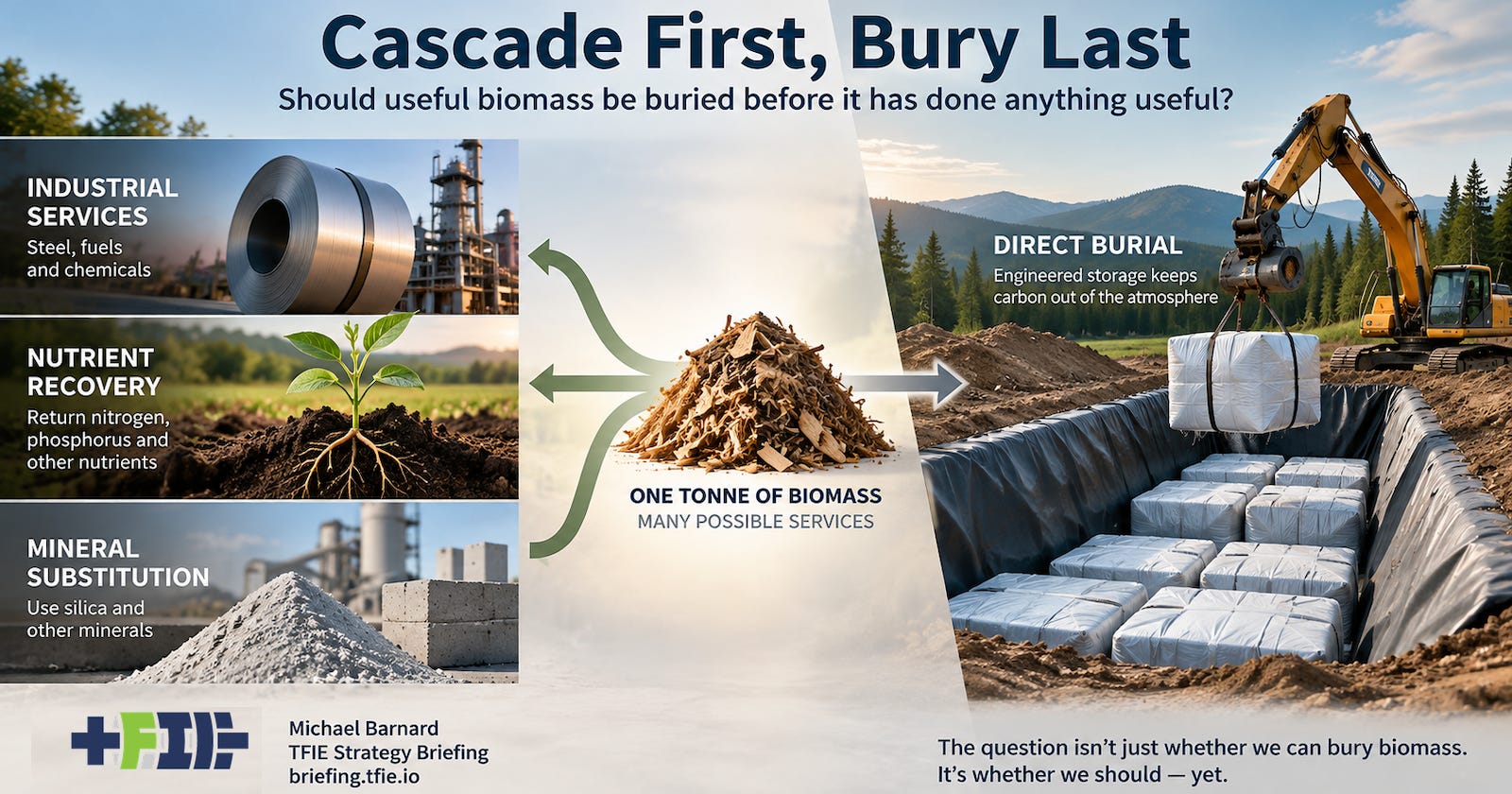
I was listening to Tom Raftery’s Climate Confident podcast conversation with carbon sequestration firm Graphyte’s founder when I started making a list of questions. The concept is appealingly physical compared with many engineered carbon-removal proposals: take waste biomass that would otherwise decompose or burn, dry it, make it resistant to water and microbes, and put it underground where the carbon should remain for a very long time. There is biomass going in, blocks going underground and a relatively direct measurement problem between the two. But drying takes energy, the blocks are wrapped in something waterproof, fresh forest residues are very different from dry agricultural wastes, and the boundaries around a carbon-removal process can make a great deal disappear. By the end of the conversation I wanted to know what those details did to the claimed removal.
If you are considering an investment in Graphyte and want to go beyond the public claims, email me. I have a full workbook behind this analysis covering the carbon, process, feedstock, logistics and competing-pathway assumptions, and can walk through the diligence in the context of an actual investment decision.
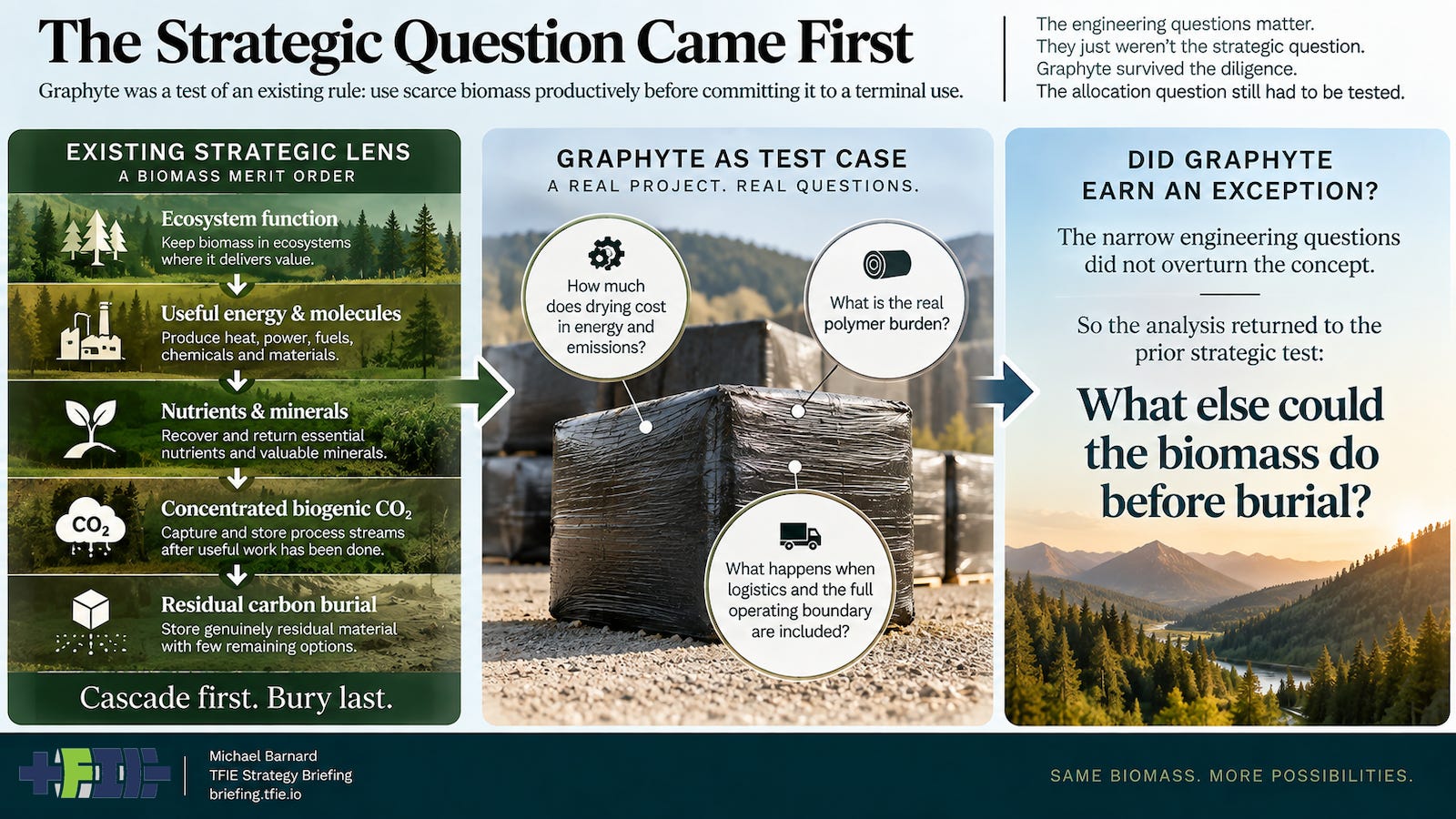
There was another question in the background before I opened a spreadsheet. For years I have increasingly organized energy and climate pathways around sequencing: use a scarce resource for the things it does particularly well before consuming it in a lower-order or terminal use. When contributing to TenneT’s 2050 target-grid scenario work in the Netherlands, that discipline showed up repeatedly. Electricity used directly for transport, heat and industry generally deserves consideration before turning the same electricity into hydrogen or synthetic fuels and accepting the conversion losses. In technoeconomic assessments across industrial technologies, fuels, infrastructure and carbon-management proposals, the same pattern keeps appearing in different clothes: define the useful service, identify the real alternatives, widen the system boundary and look for the point where a valuable resource gets consumed. My work on carbon capture and sequestration had already pushed me toward the same view from the other direction. Concentrated biogenic or industrial CO₂ streams produced after useful work has been done are inherently more interesting to me than systems that consume useful energy or material simply to manufacture something to sequester.
So I did not come to Graphyte looking for the idea of cascading biomass before burial. I came to it wondering whether Carbon Casting might be an exception.
Graphyte’s process takes residual biomass, dries it, forms it into dense blocks, wraps and isolates those blocks from water and oxygen, and places them into engineered storage. Its Loblolly project in Arkansas has been operating since 2024 using rice hulls, while Ponderosa in northern Arizona is intended to use wildfire-risk forest thinnings. Recent Isometric removal records from Loblolly provide something unusually useful for diligence: operating data on electricity, feedstock moisture, polymer use and transport that can be connected to physical tonnes rather than inferred from a generic process diagram.
The immediate diligence therefore started much more narrowly than the strategic question. How much does drying reduce the removal? How much fossil carbon is embedded in the polymer system being buried along with the biomass? What happens when logistics and the rest of the operating system are included rather than looking only at the finished block? Those were ordinary technoeconomic questions about energy, mass and system boundaries, and they looked potentially damaging when I started, particularly for freshly harvested forest material.
Instead, Graphyte survived them reasonably well. Dry rice husk requires almost no incremental drying heat. Plastic wrap emissions are measurable but modest compared with the carbon being stored. Wet forest thinnings carry a much larger drying penalty, but they also contain substantially more carbon per dry tonne. Adding the visible process burdens did not make Carbon Casting fall apart.
That result brought the pre-existing strategic question to the foreground. The interesting boundary was no longer around the dryer or wrapper. It sat before Graphyte received the feedstock at all. Carbon Casting was taking a useful biological resource and moving it immediately to a terminal use where its other value propositions are taken permanently out of circulation. The analysis had to test the question I had brought to it from the start: what happens if the biomass does useful work before we bury what remains?
Below the paywall: I follow the same dry tonne of rice husk and forest thinnings through Carbon Casting and several productive alternatives, track where their carbon, nutrients and minerals go, and test whether direct burial really deserves priority.