

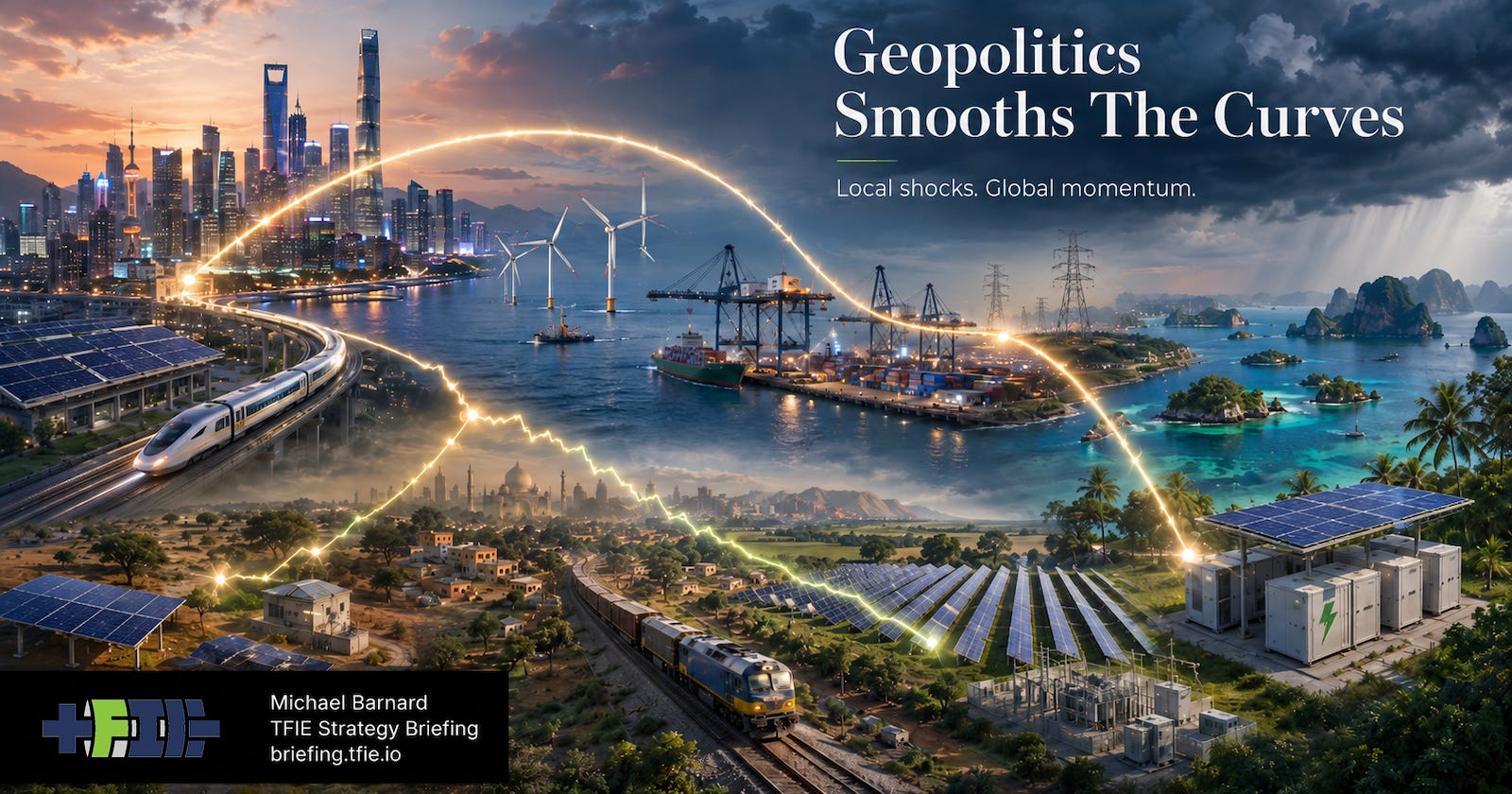
One of the easiest ways to misread the transition is to stand inside one country and mistake local political weather for the global climate. A U.S. reversal, European permitting drag, Indian coal and grid constraints, Indonesian diesel and nickel politics, Pakistani fuel-price exposure, Chinese overbuild, Latin American commodity cycles, Gulf hedging, or African distributed-solar growth can each look decisive from the inside. They are local signals in a much larger curve.
That is not how I read the century. My working view is that geopolitics smooths the curves. Local paths remain jagged, and countries remain self-interested, inconsistent, competitive, and occasionally ridiculous. Global deployment is the aggregation of many jurisdictions moving at different speeds through industrial strategies, supply chains, trade fights, technology races, crises, and energy-security shocks. A country can damage its own trajectory without becoming the world’s trajectory. A supply chain can be weaponized and still push diversification. A fossil chokepoint can trigger bad short-term policy while making electrification more strategic. Incumbents can win a local delay while manufacturing and learning keep moving somewhere else.
This view does not depend on elegant global coordination or sudden geopolitical wisdom. The transition is increasingly driven by competition, resilience, energy security, affordability, industrial policy, trade advantage, commodity exposure, climate damage, and the continuing improvement of solar, wind, batteries, grids, motors, heat pumps, electric vehicles, and digital controls. Some of that competition is wasteful, protectionist, or expensive, and some produces announcements instead of assets. It still builds factories, ports, grids, rail, storage, vehicles, processing capacity, and deployment experience.
The United States is the clearest example of why a single-country view is dangerous. U.S. policy can move in a countergrade flow for years, and because the country is rich, loud, militarily powerful, and culturally over-covered, that reversal can look globally decisive. It matters enormously inside the United States and for its allies: investment slows, agencies are damaged, standards weaken, firms hesitate, and industrial competitiveness suffers. But the rest of the world does not wait for Washington to become sensible. China keeps building, Europe keeps regulating and pricing carbon, India electrifies rail and expands solar and grids, and smaller countries, energy importers, mineral exporters, ports, grid operators, and manufacturers all face their own incentives.
That pressure is reinforced by the long history of oil and gas shocks. Embargoes, revolutions, wars, tanker risks, pipeline coercion, LNG price spikes, sanctions, cartel discipline, and chokepoints have reminded governments for roughly sixty years that fossil energy is not merely an input cost. It is geopolitical exposure, currency exposure, balance-of-payments exposure, insurance exposure, and a domestic affordability problem. Resilience, security, and affordability are often the political names under which electrification becomes acceptable, urgent, or unavoidable.
Ireland is useful because it is small, windy, grid-constrained, politically specific, deeply tied to interconnection, and historically shaped by large state-backed electrification. A country peripheral to global emissions can still define a practical pathway built around electrification, wind, grids, interconnection, heat pumps, transport, and industrial choices. The global transition is made of those specific pathways, not only the moves of the largest economies.
The Netherlands is the richer-system counterpart to Ireland, and my work there leaned heavily on professional system planning rather than outsider intuition. The work around TenneT’s 2050 scenario process was about what a port-centered, North Sea-connected, grid-constrained industrial economy has to make physically real. That includes offshore wind, interconnection, industrial electrification, port energy flows, flexible demand, storage, and the difficult boundary between useful molecules and molecule enthusiasm. The Netherlands has its own constraints: land, grid congestion, industrial clusters, North Sea buildout, European market rules, and the physical challenge of moving far more electricity through a compact country. Those constraints shape the pathway, but they do not make the country’s future a referendum on Washington.
India is where outside certainty should be handled carefully. My India work has been shaped by data, policy documents, sector specialists, and the repeated lesson that India is not a simplified version of China, Europe, or the United States. It still has coal, diesel, industrial growth, air pollution, poverty, grid constraints, and enormous development needs. It also has national-scale rail electrification, large solar deployment, grid expansion, battery and manufacturing ambitions, and a government that treats energy as industrial policy and security rather than only climate compliance. India is not already clean. Its growth denominator is being contested earlier and more visibly than a fossil-first model expects. Growth does not automatically become fossil growth when the cheapest new electricity is increasingly renewable, rail electrification is national policy, and imported fuel exposure remains a strategic problem.
Indonesia and Pakistan show the same smoothing effect under different development pressures. Indonesia’s archipelago geography, remote diesel systems, state utility, nickel position, China-linked processing, and need for modular infrastructure make it a clean example of geopolitics shifting rather than disappearing. PLN’s remote diesel problem can be treated as repeatable solar-and-battery infrastructure: controls, logistics, procurement, and operations assembled as a program rather than hundreds of bespoke local projects. Pakistan is driven less by formal planning than by price, reliability, and imported-fuel exposure. Households, firms, and systems respond when imported fossil fuels are expensive, unreliable, and geopolitically exposed, while solar panels become cheap enough to change the practical choice. Neither country is waiting for rich-country climate virtue. Both are making energy choices under affordability, reliability, resilience, and security pressure.
Country work is also a reminder that outside analysis needs local correction. Global datasets and books are useful, but they do not replace people who live inside the systems. Grid operators, engineers, policy people, developers, investors, academics, and others close to the ground often know which official target is real, which one is theater, and which constraint only looks obvious from abroad. The better country work pairs denominator analysis with that local expertise.
Clean technology diminishes oil and gas geopolitics because it changes the nature of exposure. A battery, wire, wind turbine, solar panel, transformer, electric motor, or heat pump is not a cargo of oil or LNG that must be bought, shipped, insured, burned, and replaced. Durable clean infrastructure shifts energy security away from continuous fuel dependence toward asset buildout, grid integration, manufacturing capacity, materials management, standards, software, and maintenance. That is a different risk structure: more capital-intensive upfront, less exposed to daily fuel markets, and better able to improve with learning and replacement cycles.
Clean technology does not eliminate geopolitics. It shifts the map. Minerals, processing, battery manufacturing, power electronics, grid equipment, transformers, software, cyber risk, industrial standards, equipment shipping lanes, and concentrated supply chains all matter. China’s dominance in several parts of the clean-tech stack is a strategic fact, not a spreadsheet nuisance. Critical minerals can be weaponized. Trade rules can raise costs. Local-content rules can slow deployment. Grid equipment can become a bottleneck. A cyberattack on electricity infrastructure is not less geopolitical because the electrons are clean. The electrostate has geopolitics; it just has less exposure to continuous fossil fuel coercion and a different set of risks that can be managed through industrial strategy, diversification, recycling, standards, and infrastructure competence.
China is the largest reason the global curve does not simply follow Western political cycles. China’s clean-technology manufacturing, mineral processing, solar and battery scale, rail electrification, HVDC buildout, port capacity, and industrial execution have changed the global transition curve. That does not make China virtuous, risk-free, environmentally pure, or geopolitically benign. It means deployment, manufacturing learning, supply-chain depth, and cost reduction are not dependent on U.S. or European coherence. The central comparison is not ambition on paper, but ambition turned into physical systems.
Europe smooths differently. It is slower, more legalistic, more internally fragmented, and more exposed to permitting friction. It also has durable tools: carbon pricing, border adjustments, regulation, standards, industrial policy, offshore wind, interconnection, heat-pump targets, and a large market capable of forcing firms to comply. Europe can look painfully slow in one file and structurally serious in another. The European response to recent fossil shocks has often made the same point in different language: affordability and security require structural reduction in fossil dependence. That does not make Europe fast. It makes Europe hard to dismiss.
The result is a smoothed global curve rather than a single national story. U.S. reversal damages the United States, but it does not stop Chinese manufacturing scale, Indian electrification, European carbon pricing, Indonesian diesel displacement, Pakistani rooftop solar, Latin American renewables, Gulf industrial repositioning, Australian solar uptake, or African distributed solar. Local curves stay jagged; the global curve is smoother in aggregate.
Fossil geopolitics pushes in the same direction, although not gently. The serious interruption of traffic through Hormuz is more than another oil-price spike. It is a preview of what happens when a fossil-dependent world collides with chokepoints, insurance markets, military escalation, fertilizer feedstocks, LNG flows, and imported-fuel exposure. The Hormuz shock does not automatically produce wise policy. It can produce bad short-term decisions, fossil subsidies, and political flailing. But it also makes the strategic value of domestic renewables, electrification, efficiency, storage, interconnection, and demand flexibility harder to ignore.
Recent grid and market responses reinforce the point. Gas shocks still hurt, but they increasingly occur in systems where solar, wind, batteries, efficiency, demand flexibility, and electrification can absorb part of the shock or change the investment response afterward.
Trade conflict complicates the curve without cancelling it. Tariffs, local-content rules, export controls, sanctions, anti-China politics, mineral nationalism, and industrial subsidies can make the transition more expensive than a clean least-cost model would prefer. They can slow deployment, duplicate factories, raise consumer prices, and produce bad national champions. They can also force diversification, regional manufacturing, new processing capacity, recycling, and strategic procurement. The world can waste money on fragmentation and still move upward because the underlying technologies keep improving and the strategic pressure to control energy systems keeps rising.
The countercase has to be kept in view. Geopolitics can slow the transition badly. War can redirect capital, trade fights can raise costs, petrostates can subsidize demand, and great powers can weaponize processing capacity. Multiple large regions could slow simultaneously, and if they did, the global curve would suffer. The smoothing effect depends on enough geographies continuing to move, enough firms continuing to learn, enough technologies continuing to get cheaper and better, and enough shocks reminding governments that fossil dependence is not the same as energy security.
The evidence I watch is the global deployment pattern: renewables and batteries, EVs and heat pumps, grid buildout, rail and industrial electrification, clean manufacturing capacity, mineral processing diversification, and whether fossil shocks keep pushing countries toward electrification rather than deeper fuel dependence. National politics matter. Aggregated deployment matters more.
For 2100 work, the implication is straightforward: do not extrapolate from whichever country is currently making the most noise. U.S. reversal, European permitting delay, Canadian provincial obstruction, Chinese overbuild, and Pakistani rooftop solar growth are all local signals. None is the global transition by itself. The worldview work is to understand how those signals aggregate.
That is the assumption: geopolitics smooths the curves. It makes local pathways jagged, unequal, competitive, and sometimes ugly, but it prevents any single jurisdiction from owning the global transition trajectory. The transition does not need every country to move first, or well, or wisely. It needs enough countries, firms, and supply chains moving for learning, manufacturing, infrastructure, resilience, security, affordability, and policy pressure to keep compounding.
I do not claim to be right. I claim to be less wrong than most. In this case, being less wrong means not confusing the country in front of me with the world.
Subscribe to TFIE Strategy Briefing for the professional layer behind this worldview: country denominators, geopolitical risk, security and affordability tests, deployment evidence, and update triggers.