


Gas distribution has an awkward economic property in an electrifying world. Customers can leave one at a time, but most of the costs of the network disappear only when whole physical sections can be retired. If half the houses scattered across a city install heat pumps and induction cooktops, the gas utility does not get to inspect half as many mains, maintain half of its pressure-control equipment or provide emergency response across half of its service territory. Revenues can decline much faster than the infrastructure required to serve the remaining customers.
I described the resulting utility death spiral in a 2023 CleanTechnica analysis of gas utilities’ disappearing business model. Fewer customers are left carrying the fixed costs of a system built for many more, making gas increasingly expensive and encouraging another tranche of customers to leave. The customers least able to respond quickly—renters, lower-income households, occupants of difficult buildings and people unable to finance new equipment—can end up supporting an increasingly expensive residual network.
The answer I proposed was to stop treating the transition primarily as millions of unrelated appliance decisions and begin treating gas infrastructure as what it actually is: a geographical network divided into sections that can eventually be isolated and decommissioned. Instead of waiting for random attrition across an entire service territory, regulators and utilities could concentrate later conversions within physical network zones, support the remaining customers through the transition and shut down complete branches when everyone downstream had an alternative.
A few days later, I followed that argument with examples from Utrecht and Esperance. Utrecht appeared to be an unusually advanced example of neighbourhood-scale gas-transition planning, while Esperance in Western Australia was preparing to shut an entire small gas-distribution network. Three years of additional evidence have made both examples more useful, although not quite for the reasons I expected in 2023.
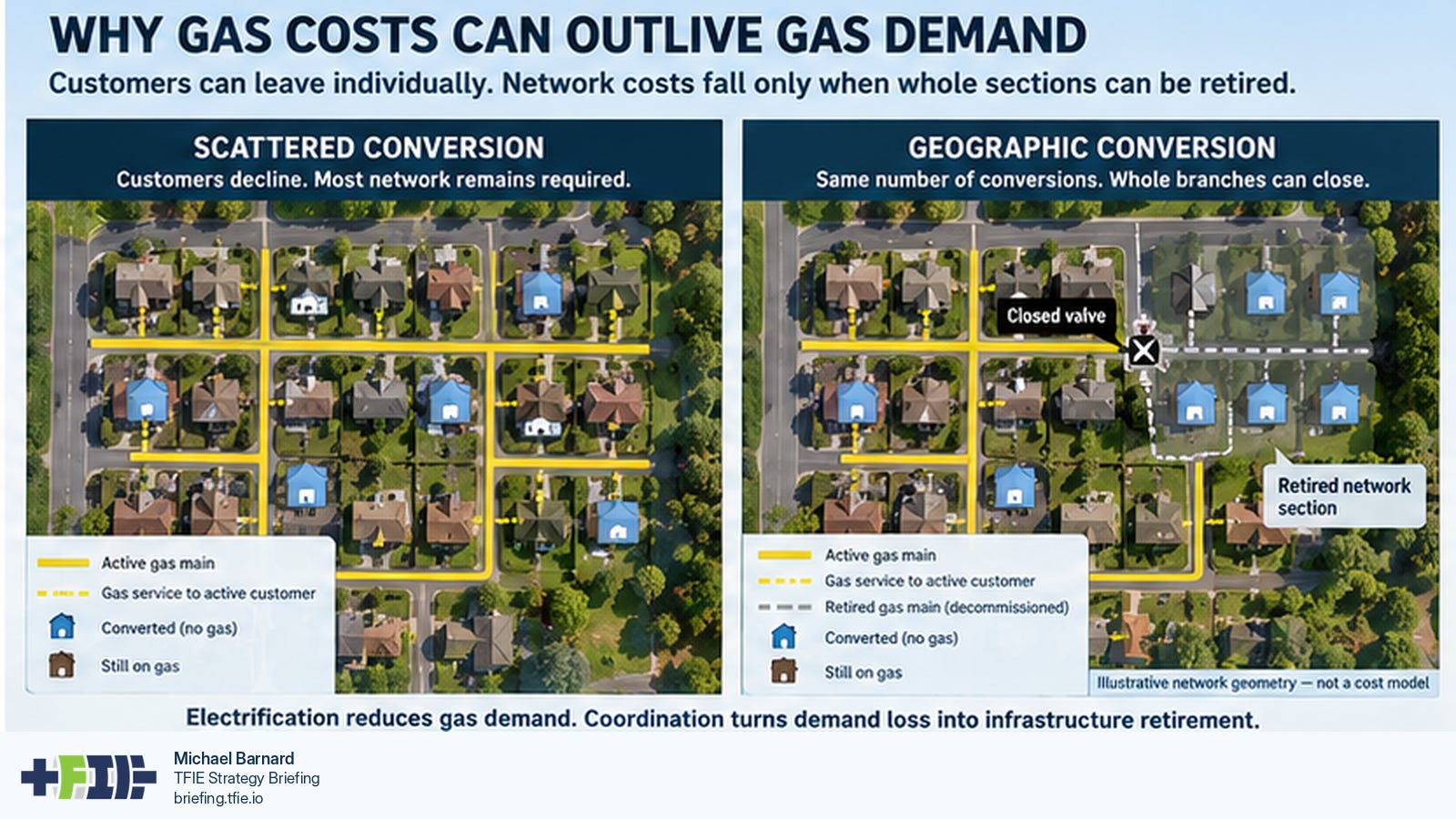
The geographical insight still holds. Random electrification reduces gas demand and emissions, but it does relatively little to shrink the physical network until enough neighbouring customers have left to close a meaningful section. Coordinated conversion can eventually remove mains, regulators, inspections, emergency obligations and future replacement spending from the system instead of merely spreading those costs over fewer customers.
That does not mean people should wait to buy heat pumps until their entire street is ready. Early electrification remains useful. It means utilities and regulators need a second layer of planning above individual consumer choices so that later incentives, network investment and final customer conversions are concentrated where they can actually retire infrastructure.
The subsequent evidence also exposes something my 2023 treatment did not develop far enough. A gas utility is more than the pipe. It is an organization containing skilled workers, engineering capability, construction and maintenance systems, customer relationships, financing arrangements, contractors, rights-of-way knowledge, regulators, debt and shareholders. If public policy gives that institution only one future—managed extinction—it should surprise nobody when the institution searches aggressively for reasons its network must survive.
Hydrogen blending, renewable natural gas and biomethane can become especially attractive under those incentives because they promise to preserve the familiar system. The existing pipes remain useful, existing capital remains in the rate base and much of the organization continues doing approximately what it already does. Whether putting expensive molecules through urban gas networks is actually the lowest-cost way of heating buildings is a different question.
A basic strategic principle applies here: there is little value in unnecessarily cornering an incumbent when conversion is possible. Gas infrastructure can be retired without insisting that every useful capability inside the gas utility be destroyed with it. Regulators should give willing utilities a credible opportunity to move workers, capital and institutional competence into heat services that have a durable economic role: thermal networks, networked geothermal, district energy, large heat pumps, thermal storage, customer equipment financing or other forms of heat-as-a-service.
That opportunity has to be conditional. A utility does not deserve a thermal network because it previously owned gas pipes. If individual heat pumps are cheaper for a neighbourhood, a shared network should not be constructed simply to preserve utility earnings. If a municipal heat company, cooperative or specialist provider can deliver better value, continuity of the incumbent company should not override competition and customer outcomes.
The policy problem therefore separates into three questions. Which gas assets should stop receiving capital and move toward retirement? What heating solution best fits that geography? Who should finance, own or operate that solution? The order matters. Answering the ownership question first is how a reasonable desire to reduce institutional resistance can turn into a new form of stranded-asset protection.
Business continuity is useful precisely because it can change incentives. A utility that has an economically defensible way to earn returns while helping customers leave gas has less reason to defend every kilometre of its gas network. Giving it a route into the future can make the transition easier; choosing the future to preserve it would reverse the logic.
The theory is straightforward; the evidence is messier. Below the paywall, I revisit Utrecht, where the first neighbourhood-scale heat plan failed its affordability test; Esperance, where an entire gas network actually shut down; Framingham, where a gas utility is becoming a thermal-network operator; and the regulatory experiments now under way in Colorado and New York. The cases show where geographic retirement works, where collective heat does not, and how regulators can give utilities and workers a future without letting incumbent survival dictate the technology. Subscribe to TFIE Strategy Briefing to continue with the case studies, their gotchas and the resulting decision framework.