

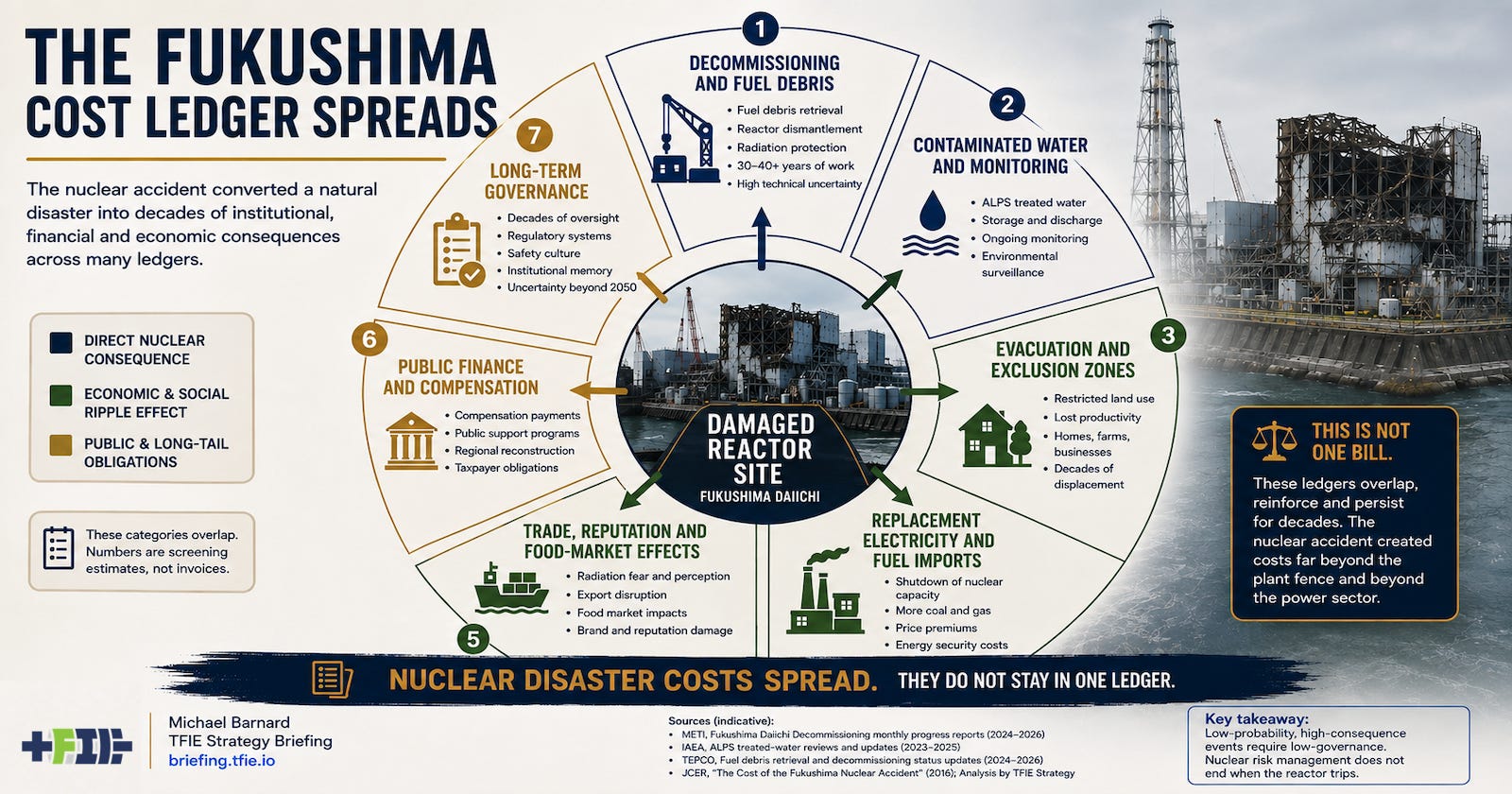
For years I have asserted that the 2011 Fukushima nuclear disaster could plausibly approach a trillion US dollars when all cost categories are counted. The point was never that there was a single clean invoice with that number on it. The point was that nuclear disaster costs do not stay inside the plant fence, the cleanup budget or even the power sector. They spread across ledgers.
Start with accountability. If the tsunami had not occurred, the Fukushima Daiichi reactors would not have melted down. That much is obvious, but it is also incomplete. If a wind farm or solar farm had been in the same location, it would have been destroyed and the economic loss would have been trivial by comparison. The earthquake and tsunami were the natural disasters, while the nuclear plant turned one part of that disaster into a decades-long technical, financial and governance problem.
It is also important to separate human lethality from economic consequence. The earthquake and tsunami killed thousands of people directly and more indirectly. The reactor meltdowns are expected to statistically shorten the lives of far fewer people. This is not a comparison of lethality, and it is not a diminishment of the earthquake and tsunami’s human toll. It is an accounting exercise for the nuclear portion of the disaster, with the nuclear generator at the center of a series of follow-on costs.
First there is the basic cost of cleaning up the reactor site itself. Completely cleaning up and dismantling Fukushima Daiichi has always been expected to take decades. In 2016, the Japanese government increased its estimate for part of the Fukushima disaster bill to about $202.5 billion, including a reactor-site cleanup component of about $75.7 billion. The Japan Center for Economic Research, a private think tank, put potential cleanup costs much higher, in the range of roughly $470 billion to $660 billion.
TEPCO has long indicated that the decommissioning effort would take 30 to 40 years. The official Japanese decommissioning framework still describes the work in those terms, and the current process remains active, technical and highly staged. As of 2026, METI was still publishing monthly Fukushima Daiichi progress materials, IAEA review material for the ALPS treated-water discharge was still being updated, and TEPCO was still presenting fuel-debris retrieval as a central phase of the decommissioning effort.
That current context matters because the difficult part of Fukushima Daiichi was never merely turning off a damaged power plant. Fuel debris, contaminated water, spent fuel, damaged buildings, radiation protection, worker safety, monitoring, ocean-release governance, public trust and local reconstruction are all part of the institutional tail. This is precisely why old estimates should not be treated as closed numbers. The work continues.
The site is very small. If it had held almost anything other than a nuclear plant, the cleanup costs would have been orders of magnitude smaller. Site cleanup costs over three or four decades of this magnitude are highly localized, while the earthquake and tsunami damage was much less concentrated. It is also important to note that the nuclear technology was comparatively old and had insufficient passive safety features, and that it was built in an area known to be vulnerable to tsunamis. If the reactors had been located uphill, or if the flood management system had been designed for the tsunami risk, many of these consequences likely would have been avoided.
My experience includes billion-dollar multiyear programs in various parts of the world. They rarely get cheaper or shorter unless requirements fundamentally change. They usually get more expensive and longer. That experience was why I found the higher JCER range more plausible than narrow official estimates. As an order-of-magnitude screen, using roughly $600 billion for reactor-site cleanup and decommissioning remains a defensible way to show the scale of the problem. It is not a precise invoice. It is the first major cost layer.
The next category is exports and reputation. I have tended to lump some of the Japanese automotive industry’s post-Fukushima challenges in with the reactor accident rather than only the earthquake and tsunami. The reality is more nuanced. There were two separate effects. The first was direct disruption of automotive manufacturing and distribution facilities by the earthquake and tsunami. That was a real impact, and it improved over time as production systems recovered. Toyota and its affiliates, for example, had factories in the Tohoku region, which was badly affected.
Then there was the radiation fear. Reports and consumer concerns about radioactive cars were mostly irrational in practical exposure terms. Many of the vehicles in question were too far from Fukushima Daiichi to represent any meaningful risk, and some were so lightly radioactive that ordinary background exposures would swamp the concern. But people are strange about radiation after decades of popular culture, political conflict and legitimate nuclear anxieties, and that fear had economic effects.
It is not fair to attribute the entire post-disaster automotive export pattern to Fukushima Daiichi. It is fair to say that the nuclear accident created reputational and trade effects that would not have existed if the damaged asset had been something other than a nuclear plant. A cautious attribution range of $20 billion to $50 billion for radiation-related fear effects on exports and related trade remains a reasonable screening estimate. No nuclear plant, no radiation fear. No radiation fear, no radioactive-car stories and no related trade drag. This is not the largest cost category, but it is an example of how nuclear costs move out of the site-cleanup ledger and into broader economic behavior.
The next category is the exclusion zone. In the years after the accident, the Fukushima exclusion zone covered a significant area around the plant, with different restrictions and return policies changing over time. At one point, the zone was often summarized as roughly 30 km by 5 km, about 150 square kilometers, though the exact restriction geography evolved. This was not empty land. Fukushima Prefecture had information and telecommunications, electronic parts, electrical machinery, chemicals, beverages, agriculture and other productive sectors. Produce from Fukushima became undesirable inside and outside Japan even when much of it was safe. Radiation risk varies by area and product, but market reactions do not always follow technical risk assessment.
At the time of the original analysis, large numbers of people were still unable to return home, and the exclusion-zone economics had a decades-long life. One rough way to screen the cost is to take the economic value of productive land and multiply it across the affected area and time period. Using a conservative productivity estimate for intensely used industrial and agricultural land, 150 square kilometers over 30 years could plausibly produce about $60 billion in economic losses. That number is not a property-by-property compensation ledger. It is a scale estimate. But the direction is clear. No nuclear plant, no nuclear exclusion zone. The tsunami destroyed buildings and infrastructure. The reactor accident created long-duration radiological restrictions, reputational effects and return-to-land problems. That puts the cumulative screening estimate in the neighborhood of $700 billion.
The next cost layer is electrical generation. Before Fukushima, roughly 30% of Japan’s electricity came from nuclear power plants. After the disaster, Japan shut down its nuclear fleet for safety reviews. Nuclear generation plunged, and coal and gas increased. That had costs, because Japan does not have large domestic fossil-fuel reserves. When a country suddenly needs much more imported gas and coal, it does not buy them at calm long-term optimized prices. It pays premium prices, especially in the short run. Gas generation jumped materially after Fukushima. Coal increased as well. Some of that was unavoidable once the government decided that restarting reactors required much tougher safety review.
This is again a nuclear-specific consequence. The earthquake and tsunami did not require Japan to shut down its entire nuclear fleet for years. The nuclear accident did. The cost of replacement generation therefore belongs, at least in part, in the nuclear-disaster ledger. A rough calculation from the original analysis put the extra fuel and generation costs at about $100 billion over the relevant recovery and replacement period. That estimate used pre- and post-Fukushima generation assumptions, higher premium fuel costs and a long transition back toward restarted nuclear, renewables and efficiency. Like the other categories, it is not a single invoice. It is a screening estimate for the cost of replacing a large fleet after a nuclear accident changes national energy policy. That moves the screening estimate toward roughly $800 billion.
Then there are the negative externalities from the additional coal and gas burned because nuclear generation was unavailable. Extra fossil generation creates health costs through particulates, NOx, SO2 and other emissions. It also creates climate costs, though the original estimate focused on health externalities rather than assigning a full carbon price. The original calculation put unexpected health costs from additional fossil generation at about $22 billion. In the context of this overall screening exercise, that is comparatively small. It is also conceptually difficult. Is it an extra cost created by shutting down nuclear after Fukushima, or a cost avoided earlier by operating nuclear instead of fossil generation? Both frames are possible. In this workup, the important point is narrower: the nuclear accident forced a large generation substitution, and that substitution had consequences beyond fuel invoices.
There is a reasonable case for identifiable costs in the high hundreds of billions of US dollars for the nuclear portion of the Fukushima disaster when site cleanup, decommissioning, exclusion-zone losses, trade and reputation effects, replacement generation and health externalities are screened together. It is not hard to see a 40-year recovery period, persistent governance costs, unresolved technical risks and excluded categories adding another 25% without straining the argument. That is why I have said Fukushima can plausibly approach a trillion US dollars when all nuclear-disaster costs are included. The important update is how that claim should be read. It is best treated as a tail-risk accounting screen, not as a precise forecast or consolidated invoice. If one is persistent and generous in cutting assumptions, the number might come down to half a trillion dollars. But that still proves the basic point: the nuclear portion of Fukushima’s economic consequence was massive, durable and distributed across ledgers.
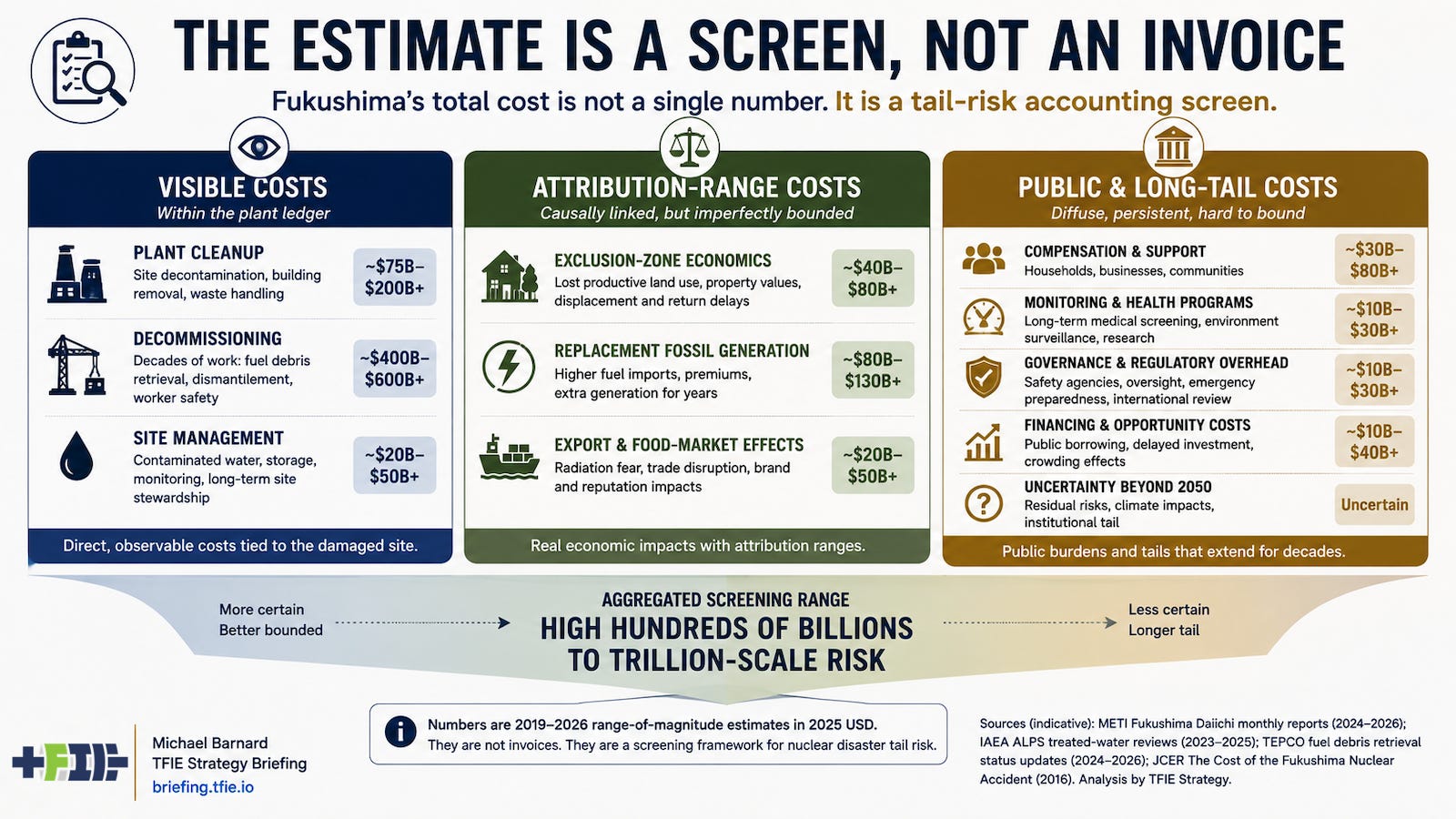
This is why nuclear disaster accounting is so hard. Reactor-site cleanup is visible. Compensation is visible. Replacement fuel is visible. Export effects, reputational fear, land-use losses, health externalities, monitoring, political attention, public financing and long-term governance are less cleanly captured. Some are direct costs. Some are opportunity costs. Some are attribution ranges. Some are public-finance burdens. But all of them are downstream of the reactor accident.
The comparison with other generation technologies matters. A wind farm destroyed by a tsunami creates a replacement-power problem and a cleanup problem. It does not create fuel-debris retrieval, contaminated-water treatment, radiological exclusion zones, international safety review, decades of public anxiety over food exports or a long-term reactor-site governance regime. A solar farm destroyed by a tsunami creates material waste and economic loss. It does not create an ALPS-water controversy or a multidecade decommissioning institution.
That is not an argument that nuclear power has no role. It is an argument that nuclear tail risk is institutionally different from ordinary industrial tail risk, and that cost comparisons need to treat it differently. Low-probability, high-consequence events belong in the denominator somewhere. So do the governance systems required to manage them when they occur.
The Fukushima disaster was caused by an earthquake and tsunami. The extraordinary economic tail was caused by the presence, design, siting and protection of nuclear reactors in that disaster zone. Without the nuclear plant, the costs outside human lives would have been much, much lower. With the nuclear plant, the costs spread across cleanup, energy markets, land use, trade, public finance and governance for decades. That is the enduring lesson. Nuclear disaster costs do not stay on one ledger.
Subscribe to TFIE Strategy Briefing for denominator-first analysis of firm power, public costs, infrastructure risk and energy-transition claims.
Updated from an article first published by CleanTechnica.