

Ireland’s Commission for Regulation of Utilities published its first national Flexibility Needs Assessment in August 2026. One of its findings was that the country’s distribution networks could require around 234 MW and 58 GWh of upward flexibility in 2028. Those figures are interesting for utilities, battery developers, aggregators and policymakers considering how to make much greater use of distributed energy resources as electrification proceeds.
But buried among the national figures is a much smaller requirement. At the Naas 38 kV/10 kV substation, which has two 10 MVA transformers, the assessment identifies 0.6 MW and 3 MWh of potential flexibility requirements for 2028. The need is concentrated in January, and there is no corresponding identified requirement for 2030 because network reinforcement is planned for completion by then. The figures describe a modelled future network constraint, not a procurement award or the specifications of a battery that somebody has decided to install.
That distinction is at the heart of a problem with how electricity flexibility is frequently discussed. Ireland might have substantial amounts of flexible generation, battery storage, managed EV charging, industrial demand response and interconnection. But a megawatt available somewhere else in the country does not automatically relieve an overloaded transformer in Naas. The asset must affect the relevant electrical flow, at the required time, in the correct direction, and within the rules governing how that part of the network operates.
The CRU’s 297-page assessment considers the electricity system at three distinct levels. System-wide flexibility deals with matters such as renewable integration and balancing. Transmission flexibility addresses congestion across the higher-voltage network. Distribution flexibility deals with constraints at particular stations and locations. The resource categories overlap, but the services are not interchangeable merely because they can all be measured in megawatts.
This is the first of a series examining the implications of The Flexibility Mesh, the whole-system architecture I published this week. The architecture begins with the job the electricity system needs done, then follows the physical resources, permissions, operational capabilities and commercial arrangements that might allow the job to be delivered. Naas is an excellent place to start because its identified requirement is so modest in national terms, yet potentially consequential at its particular electrical location.
A national megawatt doesn’t necessarily reach the constrained asset
Electricity does not travel through a network according to the preferences of electricity traders, battery developers or aggregators. It follows the electrical characteristics of the connected network. A generator or battery changes flows according to its point of connection, the network topology, the dispatch of other resources and the operating conditions at the time.
For a simplified radial distribution network, imagine electricity flowing through a substation transformer into several downstream feeders supplying homes, commercial buildings and industrial facilities. If the transformer is approaching its applicable loading limit because demand on its downstream network is too high, reducing that downstream demand can reduce the transformer’s loading. A battery on the suitable side of the transformer can also discharge into that network and reduce the net power imported across it, assuming the relevant electrical and operating constraints permit this.
Now imagine a 10 MW battery located on another distribution network, supplied through a different transformer. That battery might make money in the wholesale market, provide frequency response, reduce a different network peak or help the electricity system during scarcity. None of those capabilities establishes that it can relieve the particular Naas transformer constraint. Injecting power on the wrong side of the relevant bottleneck may have little or no useful effect on the overloaded element.
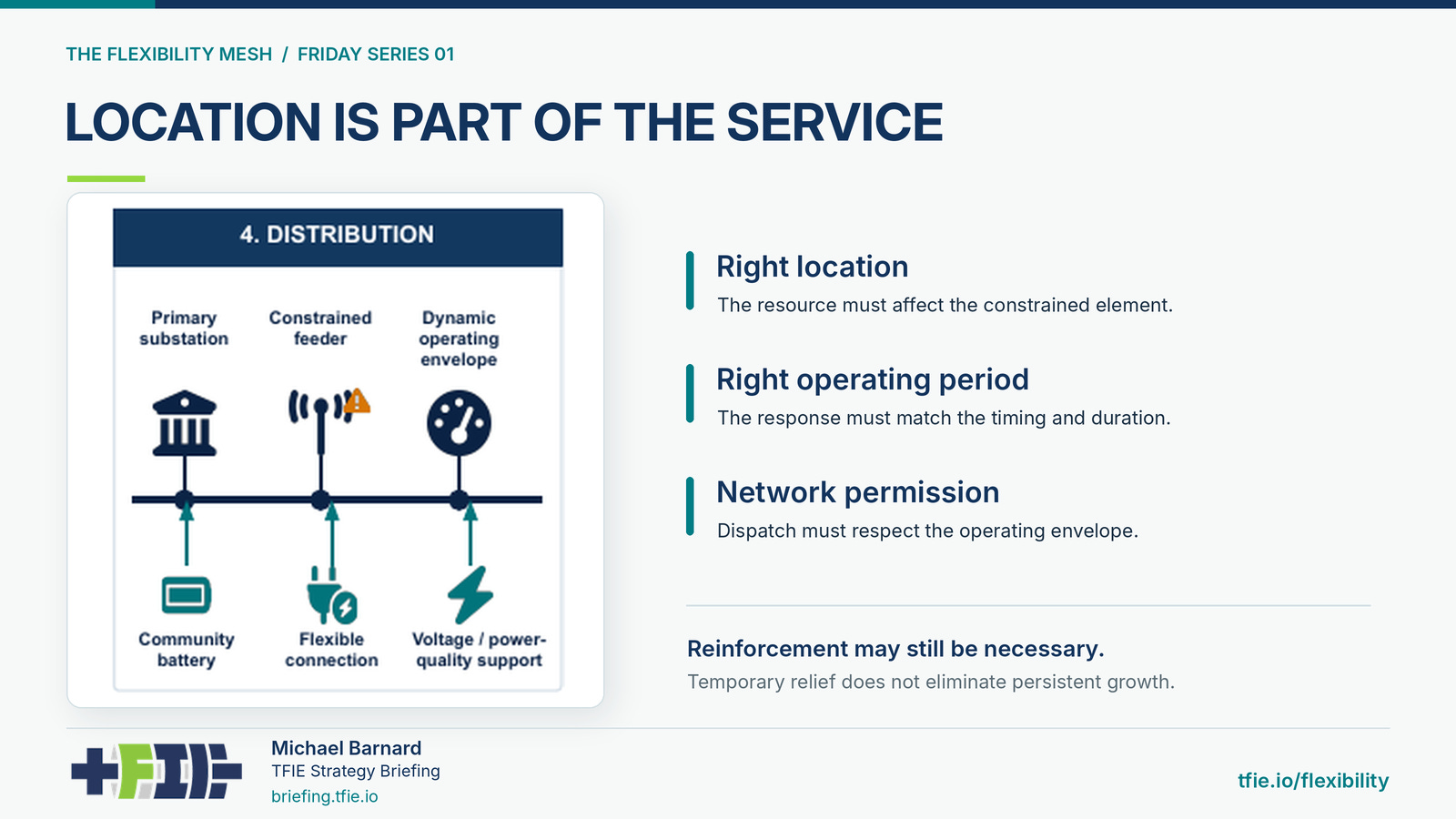
Location is part of the service. Follow the Mesh from the wider electricity system to a local network constraint.
An animated view narrows from the whole Flexibility Mesh to distribution infrastructure and a local feeder, highlighting local response, network permission and possible reinforcement. It illustrates relationships rather than simulating power flows.
The relevant electrical boundary can be much narrower than the geography of the electricity market. The animation narrows the whole-system architecture to the local distribution environment, but it is not a model of Naas or any other actual feeder. To understand the consequences, consider a second hypothetical example.
Suppose a branch of a feeder is overloaded because a growing cluster of customers downstream is drawing more electricity than the line can safely carry. A battery connected downstream of the constrained section might reduce power flow across it during discharge. A battery on another feeder from the same substation generally would not relieve that branch. A battery upstream of the bottleneck may also be unable to change the required branch flow, even though both batteries appear in the same local electricity market or geographical area.
This feeder example illustrates a different type of constraint from the one identified at Naas; it should not be mistaken for a claim about the actual Naas feeder topology. Its importance is that the relevant electrical boundary can be considerably narrower than the boundary used to define a flexibility market.
There are also cases where switching arrangements, meshed paths and network reconfiguration change which resources are electrically useful. A good distribution system operator understands these options. But that reinforces rather than weakens the argument: the suitability of a resource has to be established against the actual network configuration and the operating conditions of the constraint.
A megawatt is a measure of power. It is not a passport through every transformer and cable between the resource and the problem.
Location is only the first filter
The Naas figures contain another important distinction. The assessment records 0.6 MW and 3 MWh of flexibility need in 2028, concentrated in January. It would be a mistake to divide the energy figure by the power figure and conclude that the network requires a battery capable of delivering 0.6 MW continuously for five hours.
The peak power requirement and accumulated energy requirement describe different characteristics of the modelled need. The energy may be distributed across separate periods, with different magnitudes and durations. The appropriate resource configuration depends on the actual constraint time series, including the longest continuous event, the intervals between events, recovery requirements and the conditions under which the resource must operate.
For an existing flexible customer, those distinctions can determine whether participation is straightforward or impossible. An industrial refrigeration facility might be able to reduce compressor power for a limited period without compromising temperature requirements, but it will eventually need to restore the displaced cooling. A commercial building may be able to shift some electrical heating demand because the building’s thermal mass provides short-term buffering, but comfort and recovery impose limits. A fleet depot may be able to defer vehicle charging during a local winter peak, provided the vehicles are still sufficiently charged for their next duties.
In each case, the physically useful resource is the portion of the load that can actually change at the relevant location and time while preserving its primary purpose. The total electricity consumption of the facility is not its flexible capacity. Neither is the rated capacity of all the equipment connected behind its meter.
Managed EV charging illustrates the distinction particularly well. A large national EV fleet represents substantial electrical demand whose timing can often be managed. Yet its contribution to one overloaded transformer depends on how many connected vehicles are supplied through that transformer, their available charging flexibility, their mobility requirements, and whether the necessary controls and customer permissions exist. An aggregation platform cannot make vehicles connected elsewhere electrically useful to a local constraint simply by including them in the same commercial portfolio.
There is also a difference between ordinary time-of-use tariffs and a service that the network operator can reliably call when necessary. Tariffs can encourage customers to move charging or heating into less expensive periods and can materially reduce growth in peak demand. But customers are responding to incentives rather than necessarily making a firm, measurable commitment to a particular network operator. An explicitly contracted service can offer greater operational certainty, provided the requirements for participation, telemetry, control and verification are met.
The CRU’s assessment treats explicitly procured demand response as having particularly strong locational certainty, while recognizing the broader usefulness but lower firmness of implicit tariff-led responses. It also identifies short-duration storage as suitable for predictable, time-bound local congestion, while recognizing the need to match duration and operating requirements to the constraint. That is a more useful starting point than simply comparing the national installed capacities of batteries and flexible demand.
What could actually help at a substation like Naas?
Consider how a utility might approach a small, seasonal transformer constraint with a planned reinforcement project later in the decade. The following are potential response categories, not a proposed solution to Naas itself. Determining the actual best option would require the detailed network model, station loading profiles, connection data, customer participation information and applicable operating standards.
The lowest-cost option might involve existing controllable demand already connected to the relevant downstream network. Several commercial loads or a depot might collectively be able to reduce net demand when instructed. If the required service is confined to predictable periods, existing equipment could provide valuable relief without the capital cost of a dedicated new asset. But the utility would still need credible assurance that enough capacity is available during the required events, that operating limits are respected, and that recovery does not immediately create another constraint.
Managed charging is another candidate, especially where EV fleets, workplace chargers or other concentrated charging loads contribute to the projected peak. Reducing charging power is not the same as reducing the number of vehicles that need electricity. Charging still has to occur at another time, so the utility must establish that sufficient headroom exists for it. A shift from an evening constraint to an already crowded overnight charging period would not necessarily solve the network problem.
Existing customer-side batteries could provide a more directly controllable response where they are appropriately connected. A battery discharging during the overload period reduces net imports, while charging during the same period would generally worsen an import-driven constraint. State of charge, reserve obligations, charger or inverter limitations and the timing of replenishment all matter. If the asset is participating in wholesale or system-services markets, there must also be a way to prevent conflicting instructions when the local network requires its capacity.
A dedicated battery can provide strong locational control and very fast response, but its investment case cannot be inferred from the modelled MW and MWh requirement. The utility and developer would have to understand the expected number and duration of events, connection costs, availability obligations and the economic value of the service over the asset’s life. An asset built to address a January-only requirement that may disappear after reinforcement has a different commercial problem from one contracted to provide several complementary services over many years.
Network operating measures should be investigated alongside these resources. Depending on the actual infrastructure, reconfiguration, load transfers between substations, changes to transformer operation, enhanced monitoring or other engineering measures may alter the constraint. These are not universal sources of free capacity. They depend on the network configuration, operating limits and the consequences for other customers and components. Their value lies in making the best use of the physical system that already exists.
Permanent reinforcement is also part of the comparison, but its role in this particular article is the planning counterfactual. The CRU’s Naas entry anticipates reinforcement by 2030. If that work proceeds as planned, the 2028 flexibility requirement represents a potential interim operating problem rather than an indefinite future market. If the reinforcement schedule changes, the operating and investment cases change with it.
The conclusion is not that any one of these alternatives is automatically preferable. A credible network assessment first asks which options can relieve the identified constraint and maintain required reliability. Only the physically feasible options can then be compared on delivery timing, cost, operating risk, customer impact and persistence of the need.
Some constraints should not be offered to flexibility markets
The question of which resources can address a constraint also has a temporal dimension. Flexibility is especially useful where the problem is intermittent, where the resource can recover between events, and where the required service can be delivered economically within its physical limits.
The opposite case is a network asset that is persistently overloaded or constrained across much of the day. Short-duration storage cannot discharge indefinitely. Shifting demand becomes less useful when there is little unconstrained time into which that demand can move. Aggregating more flexible customers does not eliminate their need to heat buildings, operate machinery, charge vehicles or perform their other primary functions.
UK Power Networks’ March 2026 Distribution Network Options Assessment provides a valuable reality check. The company reported that it had discontinued flexibility tenders for substations equipped with single transformers because those sites typically experienced 24-hour constraint windows that existing flexibility markets could not address effectively on technical and commercial grounds.
That does not mean all single-transformer substations everywhere are unsuitable for flexibility, or that new types of demand management can never contribute. It means that the network operator examined a class of actual operating requirements and concluded that its tendering approach was not a suitable answer for those sites.
This is an important counterweight to flexibility advocacy that treats every identified network constraint as an addressable market for aggregators or batteries. Some constraints are intermittent and strongly suited to operational flexibility. Others are persistent, uncertain or poorly matched to available resources. Some require engineering changes or reinforcement, while others may justify a combination of permanent and operational measures.
The classification of the constraint comes before the promotion of a solution. That is equally relevant when someone argues for a battery, a new transformer, a software platform or another technology. Every proposed intervention should be assessed against the same physical requirement and its credible alternatives.
The larger question of how network reinforcement and flexibility should be compared across investment horizons deserves a separate treatment. It will be the subject of a later article in this series. For now, the UK Power Networks experience illustrates why identifying flexibility needs and actually purchasing flexibility are different decisions.
Electricity markets are larger than electrical constraints
A VPP or aggregator may have thousands of connected devices and several hundred megawatts under some level of commercial management. That is potentially valuable. Portfolio aggregation can reduce transaction costs, coordinate otherwise inaccessible resources and allow smaller customers to participate in markets they could not access individually.
Yet none of those advantages guarantees that a portfolio contains enough electrically suitable assets for a specific local-network service. A distribution operator might be interested in the portion of an aggregator’s portfolio connected downstream of a particular transformer, available during specified winter periods and capable of responding without causing a new constraint elsewhere. The remainder of the portfolio may be irrelevant to that procurement even while it has substantial value in national balancing or wholesale markets.
The technical capability to aggregate demand is therefore different from the operational capability to relieve a defined network constraint. Locational eligibility, metering, control, reliable communications, customer consent, baseline methods and coordination with other markets determine whether the service is deliverable.
These factors are sometimes treated as administrative obstacles to accessing the theoretical flexibility resource. Some really are avoidable transaction costs that should be reduced. Others are part of maintaining a safe and reliable electricity system. Dispatching a battery or reducing a load in one market cannot be allowed to create an unacceptable problem in another part of the network simply because the commercial transaction is attractive.
The distinction matters for investors as much as for operators. An impressive national flexibility-market estimate is not automatically a revenue opportunity for a particular project or platform. The addressable market depends on the services for which the resource qualifies, the locations where it has an electrical contribution, the customers whose participation can be secured, and the obligations that can be met simultaneously.
Nor does technical usefulness establish that a commercial market will exist at a suitable price. An identified need may disappear after reinforcement, be met through operating changes or prove too expensive to procure relative to alternatives. Ireland’s assessment is explicitly a needs assessment, not a commitment to buy the identified MW and MWh.
There is a further distinction between the economic benefit to the system and the payment a flexibility provider might receive. Relieving a constraint can reduce costs for a utility or its customers without creating an automatic mechanism for transferring that value to an individual resource owner. That relationship between beneficiary, buyer, payer and provider is the subject of the next article in this series.
The useful unit of flexibility is a service at a location
A planning or investment proposal should not stop at a statement that a jurisdiction has a particular number of megawatts of flexible resources. It should identify the job those resources are expected to perform, the electrical boundary at which they must act, the direction of their response and the conditions under which they must be available.
For distribution congestion, that means establishing the relevant transformer, feeder or other constrained element; understanding the size and timing of the projected overload; and identifying which candidate actions would actually change the flow across it. In more complex networks, it also means checking the effect of the response under alternative configurations and credible contingencies.
The assessment then needs to establish duration, repetition and recovery. A flexible load that can respond for one hour may be sufficient for one constraint and inadequate for another. A battery that can discharge through the relevant period may still need a viable replenishment strategy. A resource that can meet today’s problem may not meet the same problem after several years of load growth.
Only after establishing physical suitability is it sensible to compare procurement, control, connection, qualification, measurement, settlement and financing arrangements. Those arrangements can determine whether technically useful flexibility becomes a dependable service. But they cannot overcome a basic mismatch between a resource’s electrical location and the constraint being addressed.
This is why the interactive Flexibility Mesh begins with an operating situation rather than a preferred technology. Readers can examine a local network constraint, explore resources such as a community battery, and follow the physical and institutional relationships that determine whether a potentially useful asset can participate. The interactive architecture does not model a particular feeder or optimize an investment portfolio. It provides a way to identify the questions that a real engineering, operational or investment assessment must answer.
Ireland’s first national flexibility assessment is a meaningful step toward better visibility of future system requirements. Its national totals are useful, but its local detail is more revealing for understanding which resources might actually help. The 0.6 MW identified at Naas cannot simply be substituted with 0.6 MW somewhere else, and the modelled requirement is expected to change as network infrastructure changes.
That is the principle I would want preserved when flexibility markets expand and when investors evaluate the many companies promising to unlock distributed resources. More flexibility is useful, but only when the additional capability is suitable for a named service and can be delivered where and when it matters.
The question for a utility, regulator or investor is therefore not merely how many megawatts of flexibility exist. It is which of those megawatts can change the specific network condition under examination, what limits their usefulness, and whether using them is preferable to the alternatives.
A megawatt in the wrong place may still be valuable to the electricity system. It just isn’t necessarily valuable to the constraint you are trying to solve.
This is the first article in a series examining the planning, investment and institutional implications of The Flexibility Mesh, an open 99-page TFIE Strategy report with an interactive companion. TFIE Strategy provides independent assessment of electricity-system strategies and investment choices. For discussion of a specific planning or investment decision, contact michael@tfie.io.