


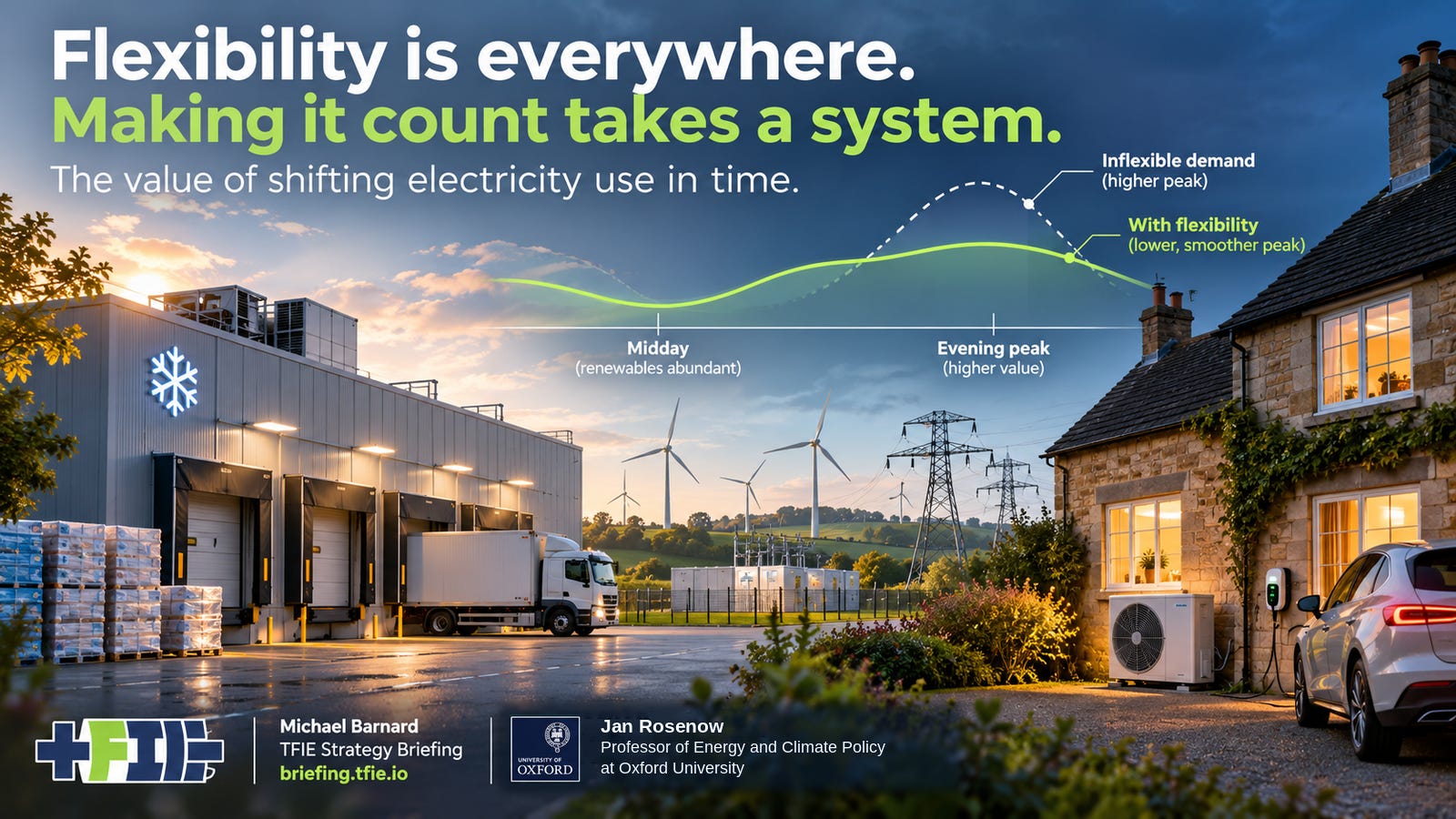
At Ornua’s Kerrygold operation in Neukirchen-Vluyn, Germany, butter has to stay cold. But the refrigeration does not have to run at any particular time as long as the temperature does not increase too much. Automated controls precool the cold store when electricity is cheap, then reduce its consumption during expensive periods. The temperature stays within the range needed to protect product quality while the business pays less for electricity.
A case study from the German Energy Agency’s KEDi programme reports about €9,670 in first-year savings from the site’s flexibility project, which covers refrigeration and electric heat production. In 2024, the operation shifted 420 MWh of electricity consumption. Ornua already had an energy-management system and flexible electricity prices. Linking its equipment to those prices added further savings.
British households with heat pumps show the same opportunity at a smaller scale. Researchers at the Centre for Net Zero and Columbia University studied customers adopting the Cosy Octopus time-of-use tariff. They estimated average annual electricity-bill savings of £321, or 18%, compared with the supplier’s standard tariff. About £245 came from changing when households used electricity, with the rest from the tariff’s price structure. Jan’s own house in Oxford shows the same: once the heat pump and electric car were automated to avoid the evening peak, energy bills fell by 30 to 40%. Its load profile was one of the charts Octopus showed Boris Johnson and Rishi Sunak when they visited the company.
Butter and warm homes may seem far removed from grid planning, but both show why flexibility has value. A business or household can lower its bill by moving consumption between hours. Across the electricity system, well-coordinated changes can also reduce the cost of balancing supply and demand, use more renewable generation, make networks more productive, reduce peaks and strengthen resilience.
In the fossil fuel system, flexibility came from stored fuel. Coal was piled up at power stations, gas held in underground storage and oil in tanks, and when demand rose, more fuel was burned. Utilities forecast demand and scheduled supply. A renewables-based system increasingly does the reverse: it forecasts supply and schedules demand. Flexibility that used to sit in fuel stocks now has to come from storage, networks and the way we use electricity.
The accompanying graphic connects these customer benefits to the whole electricity system. It shows where flexibility exists, the benefits it can deliver and how coordination turns individual capabilities into useful services. Michael’s Flexibility Mesh provides the fuller architecture and supporting evidence.
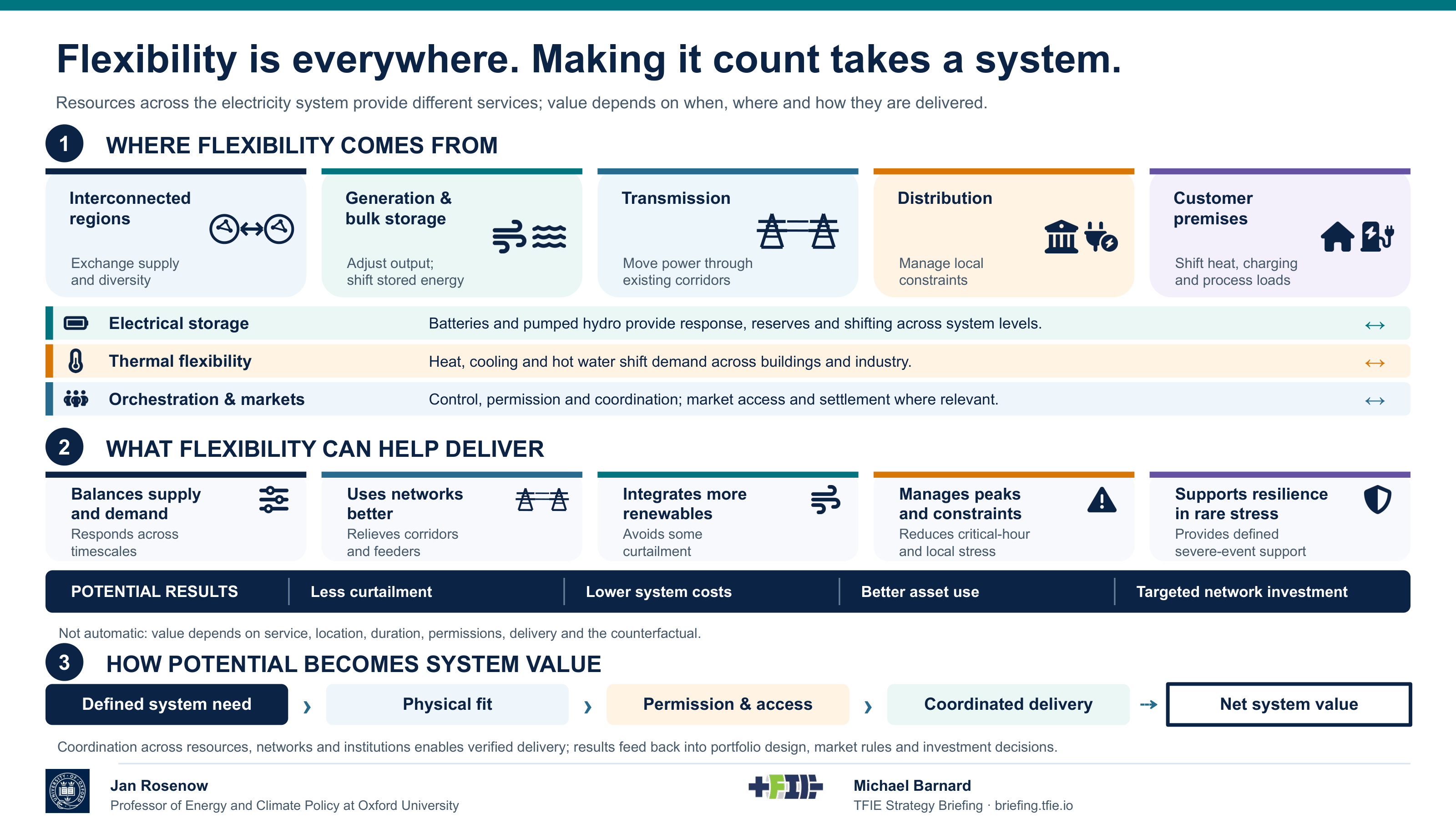
View the full-resolution vector diagram (PDF).
The cold store and the household occupy one part of that picture. Reservoir hydropower can adjust output, batteries can move electricity between hours, and interconnectors can bring together regions with different weather and demand. Transmission and distribution operators can change how power moves through their networks.
The first benefit is reducing the cost of matching electricity supply and demand. Moving consumption out of an expensive hour can reduce the need to run high-cost generation. Resources that can respond to an operator’s instruction can also earn money providing balancing services. Customers gain through cheaper electricity or service payments, while operators have more options for keeping the system supplied.
Britain’s Demand Flexibility Service provides an operating example. During winter 2024/25, the National Energy System Operator procured flexibility on 44 occasions. It settled about £944,000 in payments to providers and estimated savings of £483,000 against the alternative balancing actions available at the time.
A second benefit is getting more useful electricity from wind and solar. Their output can exceed demand or the network’s ability to move power at a particular time. Storage, interconnection and flexible demand give that electricity somewhere to go. A cold store that can precool, a hot-water tank that can heat earlier or a car that can charge during a sunny afternoon can help absorb output that might otherwise be curtailed. The benefit is greater use of generation already built.
Ornua makes the physical opportunity easy to understand. The cold store provides a buffer between electricity consumption and the service the business needs. Its electric heating equipment provides another way to move consumption. Buildings and hot-water tanks can play a similar role for households. Thermal storage expands the choices available to an electricity system alongside batteries, often by using equipment that already serves another purpose. Scaled up across industry, the potential is large: supplying just 10% of European industrial heat from electrothermal storage would provide around 80 GW of flexible load, more than double all the electricity storage installed in Europe in 2024.
Third, flexibility can improve the use of networks. Sensors and dynamic ratings help operators assess how much power equipment can safely carry under actual conditions. Changing network configurations and controlling power flows can relieve congested routes. The International Energy Agency estimates that these three approaches could allow up to 330 GW of additional generation, storage and demand to connect to existing networks without reinforcement. Its comparator is around $100 billion of investment to connect the same volume through network expansion.
For electricity customers, the value includes quicker connections and better use of the network costs they already fund. In the Netherlands, where businesses can wait years for a connection, non-firm contracts are now becoming increasingly available: customers connect sooner and more cheaply in return for accepting curtailment in the few hours a year when the network is stretched.
Fourth, flexibility can cut peak demand. Grids are built for the half hour of highest demand in the year, so a kilowatt taken off the peak is worth far more than one saved at any other time. In the British heat-pump tariff study, household electricity consumption during the evening peak fell by about 47%, while total daily consumption was essentially unchanged. The researchers also found that households continued to shift demand on very cold days, when heating places the greatest pressure on the electricity system.
That response creates an opportunity for network planners. Where peak demand drives a transformer upgrade, dependable flexibility at the relevant locations can defer the investment or change its size. In New York, Con Edison’s Brooklyn-Queens programme spent around $200 million on demand-side measures and deferred a substation investment estimated at more than $1 billion. At system level, reducing difficult-hour demand can lower the requirement for expensive peak generation. All customers benefit through lower supply costs, not only those on flexible tariffs.
Fifth, a broader set of resources can strengthen resilience. Hydropower, interconnection, storage and flexible demand give operators more ways to manage a shortage or equipment failure. Short-duration demand shifts can help bridge a difficult period, while reservoirs and seasonal heat stores cover longer periods. Near Helsinki, Vantaa is building a 90 GWh heat store in caverns beneath the city, enough for roughly two weeks of peak heating demand. Resilience comes from having useful options available across the conditions the system must withstand.
Coordination makes these benefits more valuable together. Low wholesale prices can encourage a cold store, heat pump or car charger to consume electricity at the same time. That may suit the generation available while creating a new peak on a local circuit. Controls and incentives that account for both supply conditions and local network capacity can find a better schedule. The customer still gets the required service, with fewer costs created elsewhere in the system.
There is room to improve that connection. A European survey Jan co-authored with Jaap Burger identified 480 smart tariffs for electric vehicles and heat pumps, of which 304 included dynamic pricing and only 34 incorporated local grid signals. Germany has started to close that gap: since April 2025, every distribution network operator has had to offer variable network tariffs to heat pumps, electric vehicles and home batteries.
The customer requirements should remain explicit. Ornua needs to protect product quality and production schedules. Households need heating, hot water and charged vehicles that fit their routines. The aim should be to deliver those services at lower cost, with controls that work within agreed limits. Clear consent, practical override options and a worthwhile financial benefit should be part of the offer, rather than leaving customers to manage electricity-market complexity themselves.
Ornua also illustrates why coordination involves more than a price signal. Its project had to connect control software to existing equipment and fit changes around production. The same principle applies across the grid: identify the service required, establish which resources can provide it, agree permission and access, coordinate delivery and check the result. These arrangements turn an opportunity to change electricity use into a service that customers and system operators can rely on.
The financial arrangements can take several forms. A business or household can also receive payments through a programme that purchases a defined response. Network operators may value relief from a local constraint, while the national operator values help balancing the system. The commercial task is to connect those needs to customers able and willing to provide the service.
Regulation should make it worthwhile to choose the best combination of infrastructure and operating changes. The IEA identifies a recurring problem: network operators usually earn a return on what they build, so avoiding unnecessary investment through better operation can cost them money. Funding rules and performance incentives should reward useful capacity, reliable service and lower total costs, whichever combination delivers them. In short, pay for outcomes rather than inputs.
Expansion remains essential as transport, heating and industry electrify. The best portfolio will differ between a region with reservoir hydropower, a solar-rich system, a congested city and an economy building reliable electricity access. Flexibility helps each use its investments well. It should be considered alongside new generation and networks from the outset, rather than added only when a constraint has become urgent.
The value of flexibility is already visible in a German cold store and in British household electricity bills. Flexibility gives both more choice over when electricity is used. Coordinating those choices with generation, storage and networks can spread the gains beyond participating customers, through less wasted renewable output, more useful infrastructure and a more reliable electricity system.
Subscribe to TFIE Strategy Briefing for more analysis of how electricity systems can deliver useful services at lower cost.