

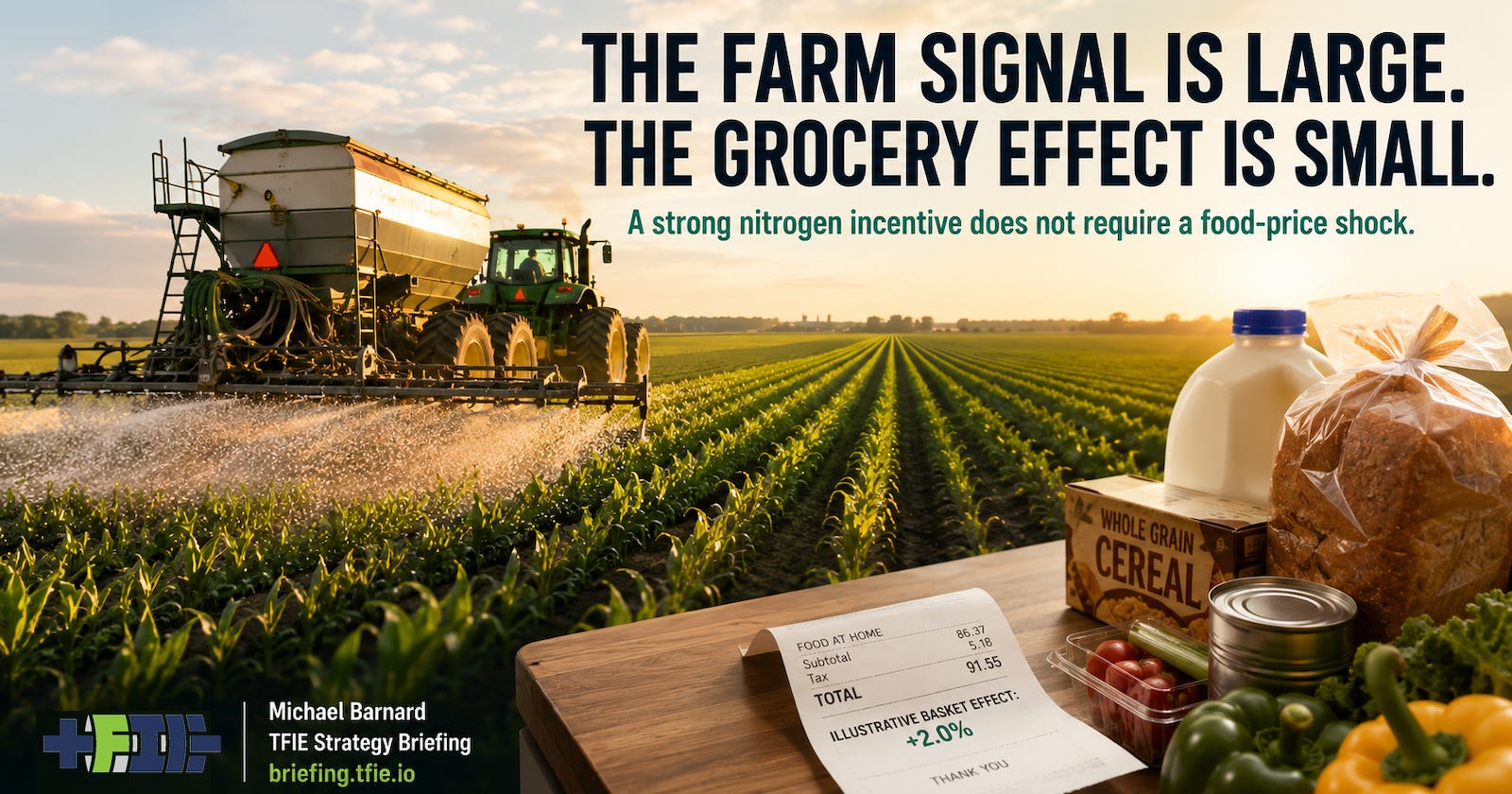
Pricing fertilizer emissions is often presented as a choice between climate policy and affordable food. The implied chain is simple: fertilizer becomes more expensive, farm costs rise and grocery bills follow. That reasoning skips two denominators. Fertilizer is only one part of farm production costs, and farm commodities are only one part of the price consumers pay for food.
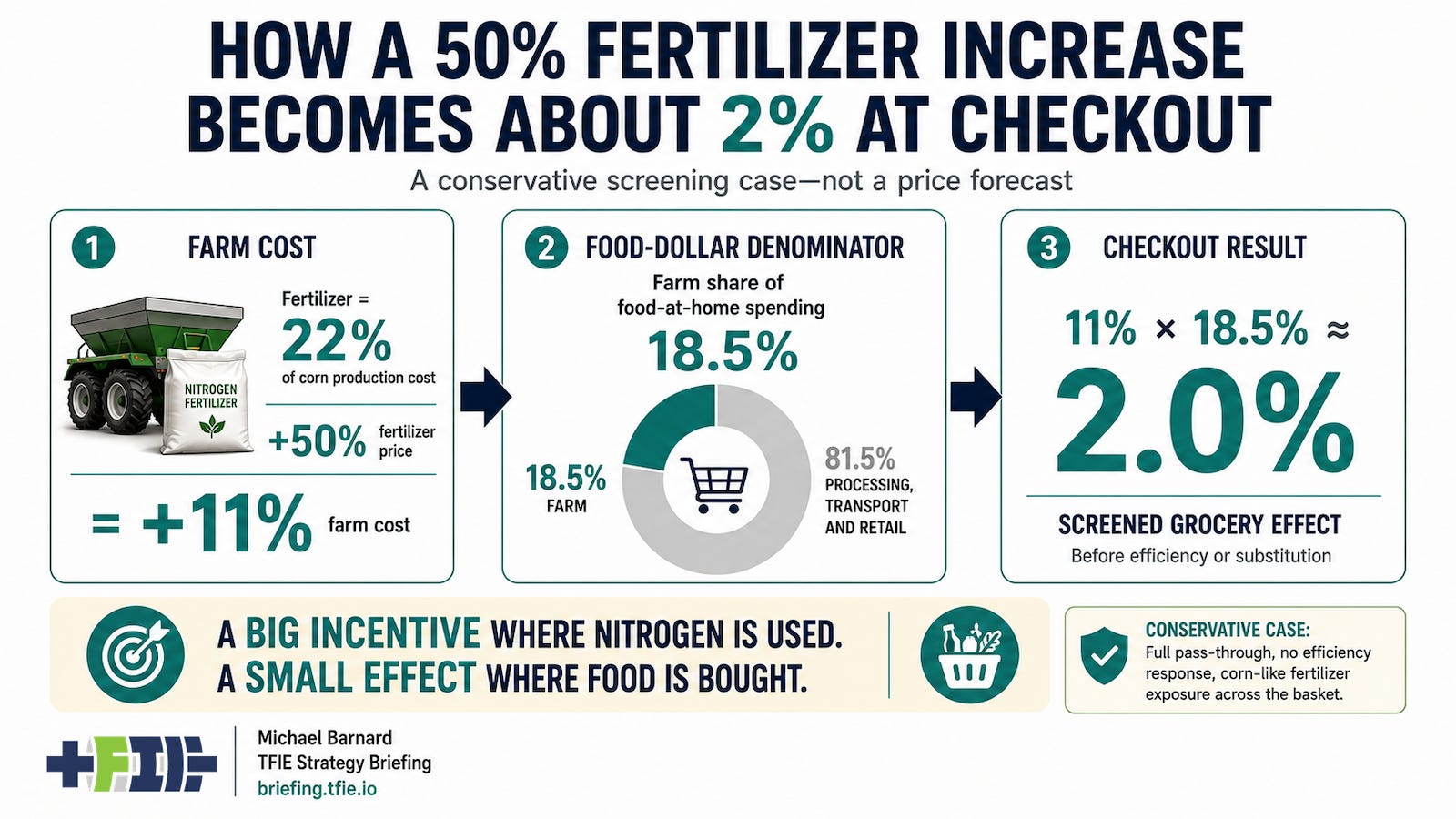
The arithmetic makes the distinction clearer. The USDA estimated fertilizer at about 22% of total corn production costs in 2024, including land, machinery, labour and overhead. A 50% increase in fertilizer cost per unit of output would therefore raise total farm production costs by approximately 11%, assuming farmers changed nothing in response.
The USDA’s revised Food Dollar data shows that farms received 18.5 cents of each dollar spent on food at home in 2024. Passing the entire 11% farm-cost increase through that share produces an estimated retail effect of about 2.0%.
That is a screening case, not a grocery-price forecast. It assumes the cost increase applies across the basket as though all food had a corn-like fertilizer exposure. It assumes full cost pass-through, no substitution, no efficiency response and no change in application rates. Most food products have lower direct fertilizer exposure, and farmers would respond to the new incentive. The broad grocery effect should therefore be treated as an upper-bound order-of-magnitude result rather than a precise prediction.
The farm signal would still be significant. Fertilizer is one of the largest variable costs that crop farmers can change from year to year. A price on its climate burden alters the economics of the marginal kilogram: the extra nitrogen applied as insurance, well before crop uptake, or on a field zone where yield response is weak. The checkout signal is small because processing, packaging, transport, wholesale and retail dominate the food-at-home dollar.
The climate burden is large enough to justify that signal. Life-cycle research in Nature Food estimates that producing and using nitrogen fertilizer accounts for approximately 5% of global greenhouse-gas emissions. About two-thirds of those emissions occur after fertilizer is applied to cropland, making nitrogen-use efficiency the most important single intervention while leaving ammonia-production decarbonization necessary as well.
The production burden begins with ammonia. Conventional ammonia plants generally obtain hydrogen from fossil methane, releasing carbon dioxide during reforming and consuming substantial energy to combine hydrogen with atmospheric nitrogen. Upstream methane leakage increases the warming burden. Electrically produced hydrogen can reduce the production emissions of ammonia, while carbon capture can reduce some reformer emissions if methane leakage, capture rates and storage performance are tightly controlled.
Neither pathway eliminates the field emissions. Once nitrogen reaches soil, microbes convert it through nitrification and denitrification. Those processes release nitrous oxide, a long-lived greenhouse gas with roughly 270 times the warming impact of carbon dioxide over a 100-year period. The emissions arrive in uneven pulses shaped by moisture, temperature, soil structure, drainage, application timing and the amount of nitrogen available beyond crop uptake.
This is why low-carbon ammonia is necessary but insufficient. Decarbonizing production reduces the factory portion of the footprint. It does not justify treating every kilogram applied to a field as climate-neutral. Ammonia remains one of hydrogen’s durable industrial uses, but the value lies in supplying the nitrogen crops require with less production pollution and less loss after application, not in preserving current volumes regardless of agronomic need.
A workable emissions price does not require measuring gas flows continuously on every field. Production emissions can be charged upstream at fertilizer plants and import points using process-specific emissions factors. Field emissions can initially be priced using default factors per kilogram of nitrogen, adjusted for crop, climate and regional conditions where evidence supports the distinction.
Farmers should receive credits for practices and products that demonstrate lower expected losses. The relevant options include soil testing, variable-rate application, better placement, split applications closer to crop uptake, improved drainage, nitrification and urease inhibitors, crop rotations with legumes, manure nutrient recovery and verified reductions in total nitrogen per unit of output. The system would improve as evidence and measurement improve, but it does not require perfect field-level sensing before incentives can change.
The first behavioural response would be less insurance nitrogen. Applying more than the expected crop requirement can appear rational when fertilizer is cheap and the perceived cost of losing yield is high. Pricing the emissions associated with excess nitrogen changes that decision without making agronomically necessary nitrogen unaffordable.
The second response would be better timing and placement. Nitrogen applied months before crop uptake has more opportunities to leach, volatilize or become nitrous oxide. Applying smaller amounts closer to the root zone and nearer the period of demand reduces the amount exposed to loss. Precision tools, agronomic services and weather information become more valuable because they avoid both fertilizer spending and emissions liability.
The technologies should still be assessed without turning every agricultural innovation into a universal solution. Enhanced-efficiency fertilizers can reduce emissions in appropriate soils and climates, but their performance varies and their higher price must be justified by lower application rates, reduced losses or better yields. Established biological nitrogen fixation through legumes and rhizobia is important, while claims that engineered microbes will consistently replace large shares of nitrogen in cereal crops need independent field evidence across multiple regions and seasons.
Drones can support sensing, crop scouting and some targeted applications, especially in specialty crops or difficult terrain. They are not the principal solution for applying the large physical volumes of nitrogen used in broadacre grain production. Ground equipment, irrigation systems, custom applicators and improved agronomic scheduling will carry most of that work.
The fertilizer market would consequently shift rather than disappear. Total synthetic-nitrogen tonnage could flatten or decline in high-use farming systems while spending moves toward agronomic services, measurement, targeted delivery and products that deliver more crop uptake per kilogram. Producers would compete on usable nitrogen and verified emissions performance instead of tonnes shipped alone.
Policy design matters because nitrogen use is profoundly uneven. Some wealthy farming systems apply more nitrogen than crops use efficiently. Other regions remain underfertilized, with low yields, degraded soils and limited access to basic inputs. A uniform global tax that raises costs for farmers already using too little fertilizer would be poor climate and food-security policy.
The practical approach is to concentrate strong incentives in high-use systems, price production emissions consistently, and combine field-use charges with revenue recycling. Some revenue should fund agronomic services, equipment access and transition support for small and mid-sized farms. Some should protect low-income households from even modest food-price effects. In underfertilized regions, policy should prioritize access, soil health and efficient application rather than simply making nitrogen more expensive.
The objective is not to eliminate nitrogen fertilizer. Synthetic nitrogen has supported enormous increases in agricultural productivity and remains essential to feeding billions of people. The objective is to stop treating a biologically active, emissions-intensive chemical as though every additional kilogram has negligible social cost.
The professional test is whether the policy changes nitrogen applied per tonne of crop, nitrous-oxide emissions, production emissions and farm profitability without materially reducing yields. Useful update measures include nitrogen-use efficiency, fertilizer spending per hectare, crop output, adoption of improved management practices, changes in low-carbon ammonia production and actual grocery-price pass-through.
The original concern—that pricing fertilizer pollution will make food unaffordable—does not survive the denominator check. A strong incentive can exist where farmers make application decisions while producing only a small change where consumers buy food. Under deliberately conservative assumptions, a 50% fertilizer-cost increase becomes about a 2% food-at-home effect before efficiency, substitution or revenue recycling are counted.
That combination is unusual in climate policy: a large emissions lever, a strong operational incentive and a modest consumer-price exposure. Pricing fertilizer emissions aligns the economics of farming more closely with the biology and physics of nitrogen without turning climate action into a threat to food security.
Follow TFIE Strategy Briefing for maintained analysis of industrial inputs, agricultural emissions, hydrogen’s remaining chemical uses and the denominator checks behind transition policy.
Originally published at CleanTechnica.
Indeed, incentives on the supply side may not add up to much.
However, demand side incentives (for behavior change like better BMPs and other farming practices) may be able to reduce demand in the first place. That may be much more effective.