

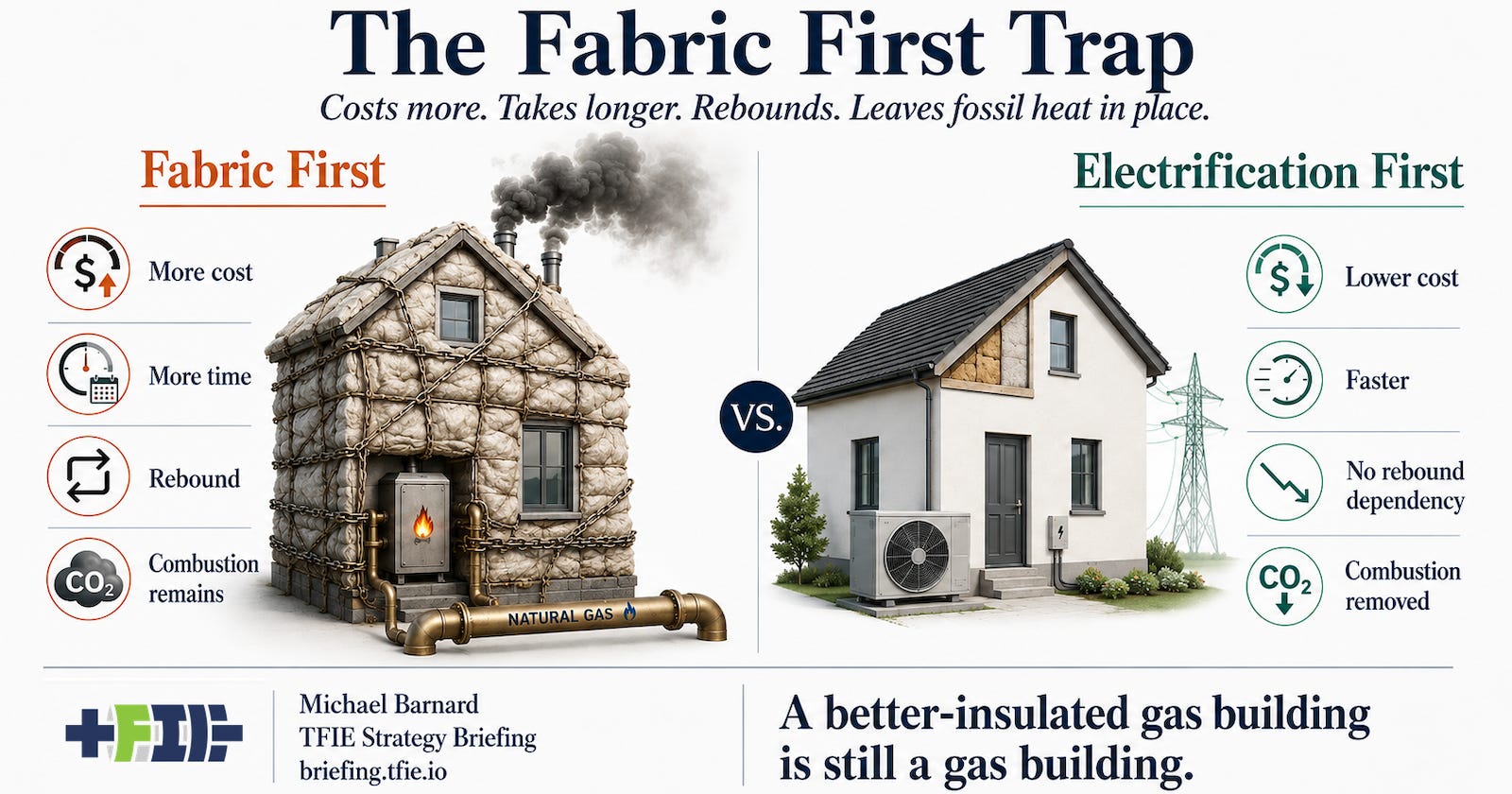
In climate and energy policy, certain well-intentioned ideas gain outsized popularity despite persistent evidence against them. One such appealing but deeply problematic approach is the “fabric first” philosophy — the notion that building decarbonization must begin by aggressively insulating and sealing structures, only later electrifying their heating systems. On the surface, it’s intuitive: if buildings leak less heat, they need less energy.
The problem is not insulation. The problem is treating aggressive envelope retrofit as the required first step in building decarbonization. Decades of measured retrofit evidence across multiple countries show that envelope-first programs often under-deliver against modelled carbon savings, especially when they delay heat pumps, clean electricity and fuel switching. Insulation and sealing matter, but they should support electrification rather than substitute for it.
I run into this constantly, most recently in discussion on my thesis of natural gas utilities transitioning to becoming heat-as-a-service utilities with district heating, geothermal loops and moderate depth geothermal, patterned on Sinopec’s extraordinary deployments in China. It’s an incredibly persistent and incorrect theme, so it was worth trotting out the evidence.
Take the United Kingdom, which offers a stark and cautionary tale. In a major study published by the University of Cambridge, researchers tracked actual gas consumption across more than 55,000 homes in England and Wales retrofitted with insulation over a twelve-year period. The results were sobering: cavity wall insulation delivered about 7% initial gas savings, which diminished to a negligible level within four years.
Similarly, loft insulation initially saved around 4% but showed virtually no net reductions after just two years. The causes were not reducible to a single behavioral story, but the pattern is familiar: households that had previously rationed heat could afford warmer rooms, longer heating periods or larger heated spaces, while extensions and other property changes also affected demand. By year four, gas consumption had returned close enough to pre-retrofit levels to wipe out the expected long-term carbon benefit from the insulation alone.
Yet this was hardly new knowledge. More than a decade earlier, the UK’s Warm Front program, launched in 2000 and evaluated in depth by researchers such as Ian Hamilton and colleagues, documented modest energy savings alongside comfort-taking rebound. Families enjoyed warmer homes but achieved nowhere near the anticipated gas reductions, despite heavy government investments.
The Welsh Arbed retrofit program is the useful counterexample that clarifies the point. It found substantial gas reductions of about 37% alongside warmer homes and better reported comfort. That supports targeted efficiency investment in poor-quality housing, especially where fuel poverty leaves households under-heated. It does not support a universal rule that deep envelope work should precede electrification everywhere. It says that fabric improvements can be socially valuable, not that they are the primary decarbonization lever.
Across the Channel, Germany’s massive national retrofit program provided further evidence. Between 2010 and 2020, German Housing Association members poured over €340 billion into building envelope efficiency improvements, yet a 2021 GdW evaluation reported by Clean Energy Wire found household heating energy use effectively stagnant. GdW argued that rebound effects and falling oil and gas prices helped explain the result. This is not peer-reviewed proof that every retrofit euro delivered zero emissions benefit, but it is a blunt warning: ever-more-expensive envelope work can become a poor substitute for low-carbon heat.
The United States has known versions of this reality since at least the 1980s. The Department of Energy’s long-running Weatherization Assistance Program was rigorously evaluated by Meredith Fowlie, Michael Greenstone and Catherine Wolfram. They found that model-projected savings were more than three times actual savings and that upfront investment costs were about twice the realized energy savings. In that study, the gap was not explained by measured increases in indoor temperature, which makes the lesson sharper: engineering estimates can fail even when simple rebound is not the main culprit.
Similarly, New Zealand’s acclaimed community insulation trial led by Philippa Howden-Chapman revealed meaningful health benefits, warmer and drier homes, and moderate energy savings. That is valuable public-health evidence. It is not evidence that fabric-first is the best decarbonization sequence. Residents who were previously under-heating their homes gained comfort, health and dignity. The carbon question remains whether the money should first preserve lower gas use in a combustion system or remove the combustion system.
Despite decades of such clear-eyed, international evidence, the stubborn popularity of “fabric first” remains. Its persistent appeal lies partly in cultural beliefs — there’s an almost moral attachment to achieving “efficiency first” as a righteous environmental act. Negawatts is a bit of a religion. However, that pursuit repeatedly confronts diminishing returns.
Beyond basic insulation and air sealing, each additional increment of building envelope improvement becomes increasingly expensive, producing ever-smaller marginal carbon benefits. Consequently, vast sums that could have financed electrification, such as heat pumps that directly eliminate fossil fuel use, are instead sunk into overly ambitious insulation measures with questionable climate benefits.
The alternative, electrification-first approach offers an immediate, verifiable and enduring solution. A 2023 Rocky Mountain Institute analysis found that replacing gas furnaces with heat pumps can yield lifetime emissions reductions of up to 93% in the 48 continental U.S. states, even with today’s partially fossil-dependent electricity grids.
Similarly, the International Energy Agency finds that heat pumps reduce greenhouse gas emissions compared with gas boilers across a wide range of grid conditions: at least 20% even on emissions-intensive electricity, and up to 80% in countries with cleaner electricity. Those benefits increase steadily as electricity supply decarbonizes.
Indeed, electrification’s climate advantage only expands with time. As grids become cleaner — a global trend documented repeatedly in annual reports from BloombergNEF and the IEA — every electrified heating system automatically grows less carbon-intensive each year. A heat pump installed today becomes progressively greener as renewable generation replaces fossil fuels, securing decades of steadily falling emissions.
Conversely, overly-insulated homes that continue relying on gas furnaces remain locked into fossil dependency, their emissions static or declining only at the pace of fuel-switching and grid-adjacent changes that have not actually happened inside the building. Envelope upgrades can reduce demand, but they do not remove combustion.
The ideal strategy emerges from rigorous comparative research like France’s comprehensive 2024 pathway modeling published in Environmental Research Letters. French researchers outlined a cost-effective decarbonization scenario for national housing: roughly 19% of mitigation from home insulation, 36% from fuel switching and 45% from fuel decarbonization.
This balanced approach — Pareto-optimizing envelope improvements rather than pursuing perfection — is economically sensible, practically feasible and dramatically more effective in emissions terms. The model does not say “ignore insulation.” It says insulation is one part of the portfolio, while fuel switching and energy decarbonization do most of the carbon work.
Similarly, the Lawrence Berkeley National Laboratory and the Brattle Group’s widely cited 2023 study, published in One Earth, modeled U.S. building decarbonization and arrived at the same system-level conclusion. Their research emphasized that efficiency, demand flexibility, electrification and rapid grid decarbonization together could yield up to 91% building CO₂ emissions reductions by 2050 while avoiding up to $107 billion per year in power-system costs.
Again, “fabric first” alone was clearly inferior. The point was not that envelope efficiency perfectly offsets every electric load from heat pumps and appliances in every circumstance. It was that a portfolio of electrification, flexibility and targeted efficiency can decarbonize buildings while keeping the grid build manageable. By contrast, diverting funds from essential electrification into ever-deeper envelope work effectively ensures continued reliance on fossil fuels, reducing overall climate benefit.
The critical takeaway from decades of global research is remarkably consistent: electrification paired with moderate, targeted envelope improvements achieves the deepest, quickest and most durable carbon reductions. “Fabric first,” meanwhile, despite its intuitive charm, repeatedly under-delivers at enormous cost when it is treated as a prerequisite to fuel switching. The real-world evidence — spanning studies in the UK, Germany, New Zealand, France and the United States over the past thirty-plus years — is both abundant and clear.
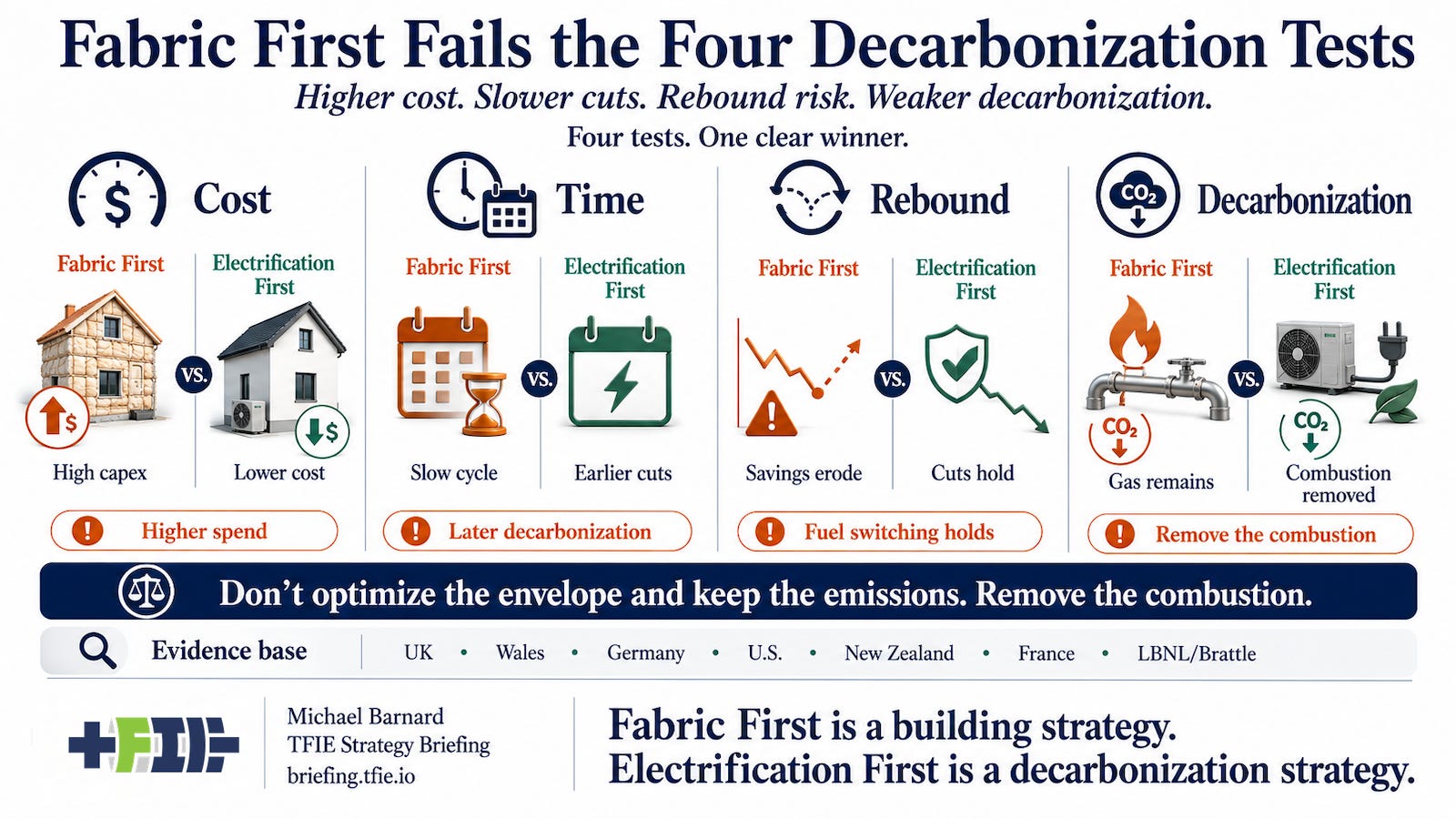
Yet many policymakers and influencers remain fixated on ambitious envelope-first programs, repeatedly misled by overly optimistic modeling, persistent cultural biases toward efficiency and disregard for behavioral and system realities.
This enduring fixation on the “fabric first” approach vividly illustrates several cognitive biases outlined by Daniel Kahneman in Thinking, Fast and Slow. Primarily, there’s anchoring bias, where early estimates set an overly optimistic baseline, causing policymakers to stubbornly undervalue subsequent evidence showing rebound effects, model overprediction and diminishing returns.
Simultaneously, it reveals the planning fallacy, repeatedly underestimating real-world costs and complexities of achieving meaningful emissions reductions through envelope retrofits alone. There’s also clear evidence of confirmation bias, as advocates continually cherry-pick modeling studies that favor insulation’s benefits while dismissing consistent empirical findings to the contrary.
Lastly, the persistence of “fabric first” policy demonstrates loss aversion and sunk cost fallacy: policymakers become emotionally and financially invested in large-scale efficiency programs and fear abandoning them, even when superior, electrification-led alternatives are demonstrably more effective. These biases collectively reinforce flawed strategies, delaying urgently needed decarbonization.
Three years ago, I published Seeing Climate Solutions Clearly Through Biases & Missing Data Is Challenging, pointing out a raft of biases which persisted despite strong contrary evidence and talked about the reasons why. As I said then:
I constantly run into people in discussions — investors, VCs, technologists, economists — who are dealing with the transformation to a low-carbon future who don’t know this. My Short List of Climate Actions That Will Work gets attacked regularly, most recently by Luxembourg’s chief strategist for energy at the country’s ministry of the economy, because I exclude efficiency as a top line item.
Electrifying everything and using renewable electricity comes with a 50% efficiency bonus, vastly more than any other efficiency gains possible.
In the face of urgent climate deadlines, continuing to push “fabric first” without carefully limiting its scope is a costly, counterproductive distraction. Real-world decarbonization demands swift and substantial electrification — immediately replacing fossil-fueled heating systems with electric heat pumps and simultaneously greening the electricity grid. Envelope improvements remain valuable, but only up to the point of Pareto optimality, where marginal carbon benefits equal marginal costs.
Beyond that point lies diminishing returns, wasted resources and continued fossil fuel dependence.
In short, after decades of experience and analysis, the lesson is clear and overdue: if the goal is truly to decarbonize buildings rapidly, affordably and permanently, electrification must lead the way. Insulation and sealing should support that goal, not substitute for it. Anything else is merely burning money and carbon while chasing a comforting illusion.
Subscribe to TFIE Strategy Briefing for the evidence layer behind building-decarbonization claims: heat-pump economics, retrofit performance, gas utility transition risk, rebound effects, denominator checks, and policy traps that survive long after the slogans stop helping.
This article was originally published at CleanTechnica and has been lightly edited for TFIE Strategy Briefing, including updated evidence framing, clearer decarbonization language, and TFIE graphics.
It seems that if there are obvious leaks , or things like that, that should get fixed first. But in the absence of obvious faults. you gotta go with electrification.
Well argued, as usual. Honestly it is a lesson I wish I had learned many years ago when renovating a previous home. I was so caught up in the fetishisation of insulation, energy efficiency and low heating demand I didn't have enough money left over to actually install the heat pump. So we achieved an impressive 45% reduction is gas consumption but missed on the approximate 75+% reduction in emissions (and consequent savings on energy bills) that I estimate we would have had with a heat pump and solar panels.