

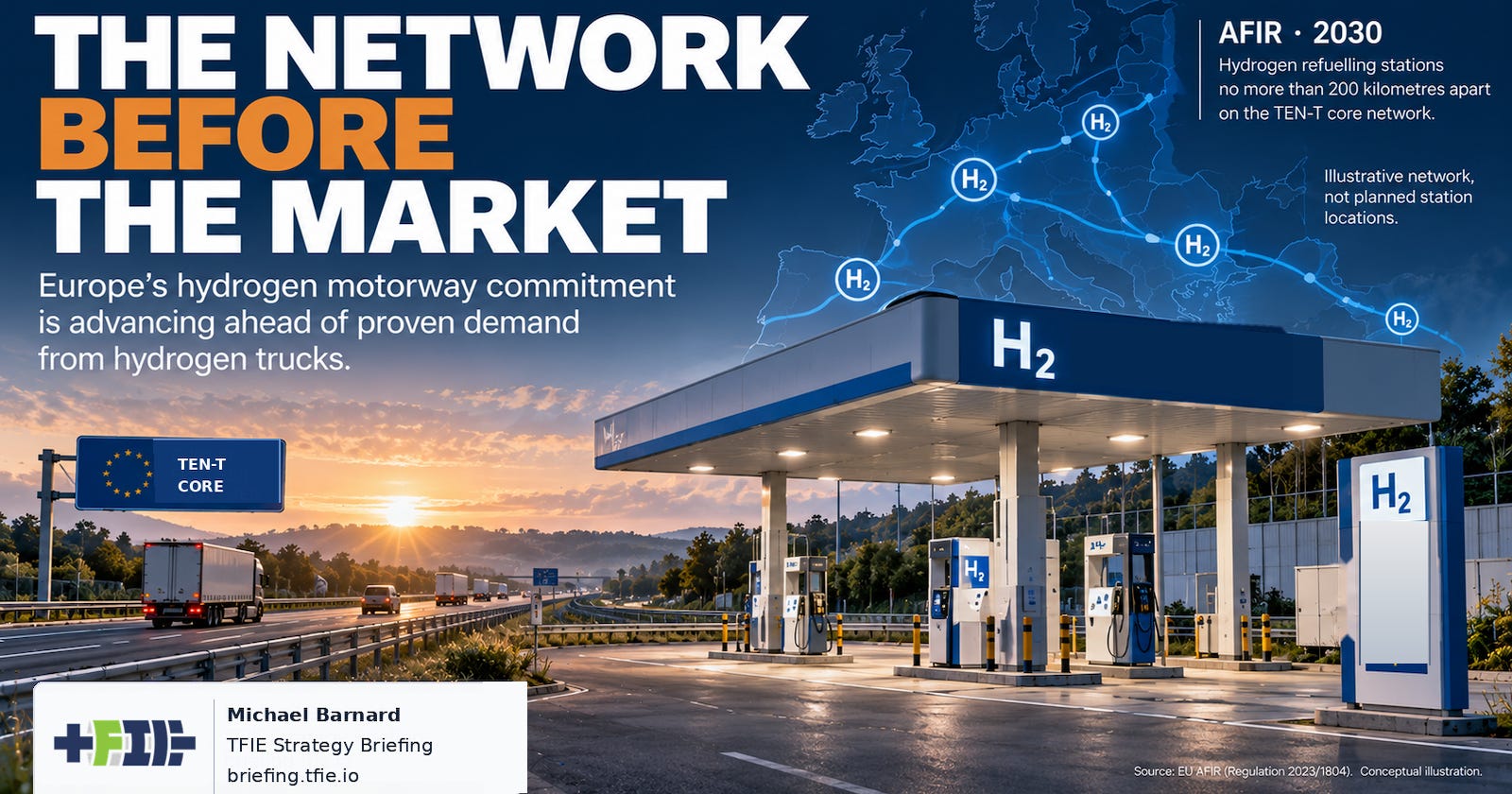
Europe is committed to placing hydrogen refuelling stations along its major motorway corridors at intervals of no more than 200 kilometres by the end of 2030. Under Article 6 of the Alternative Fuels Infrastructure Regulation, or AFIR, the stations must offer at least one tonne of daily refuelling capacity and a 700-bar dispenser. Every designated urban node must also have a publicly accessible hydrogen station. Limited exemptions and capacity reductions are permitted, but the central obligation is geographic coverage, whether sufficient hydrogen vehicles exist to make the infrastructure commercially viable or not.
Europe has already committed substantial public money to this strategy. In a March 2026 response to the European Parliament, the Commission reported 318 hydrogen refuelling stations across the EU, up from 269 at the end of 2024. Connecting Europe Facility support for hydrogen station projects totalled approximately €344 million across two funding periods, alongside additional national and European support. Not all funded stations are operational, and the existing network includes facilities that do not meet AFIR’s requirements for heavy-duty vehicles. A June 2026 Sustainable Transport Forum assessment estimated that an AFIR-compliant network would require approximately €2.1 billion in capital funding, while identifying uncertain vehicle demand and station profitability as barriers to private financing.
Those financial concerns have already been tested on a substantial scale in South Korea. Its government has spent years supporting hydrogen vehicles, refuelling-station construction and station operating losses, seeking to establish the market by developing vehicles and infrastructure together. The resulting network is extensive, but the commercial results should give European transport policymakers considerable pause.
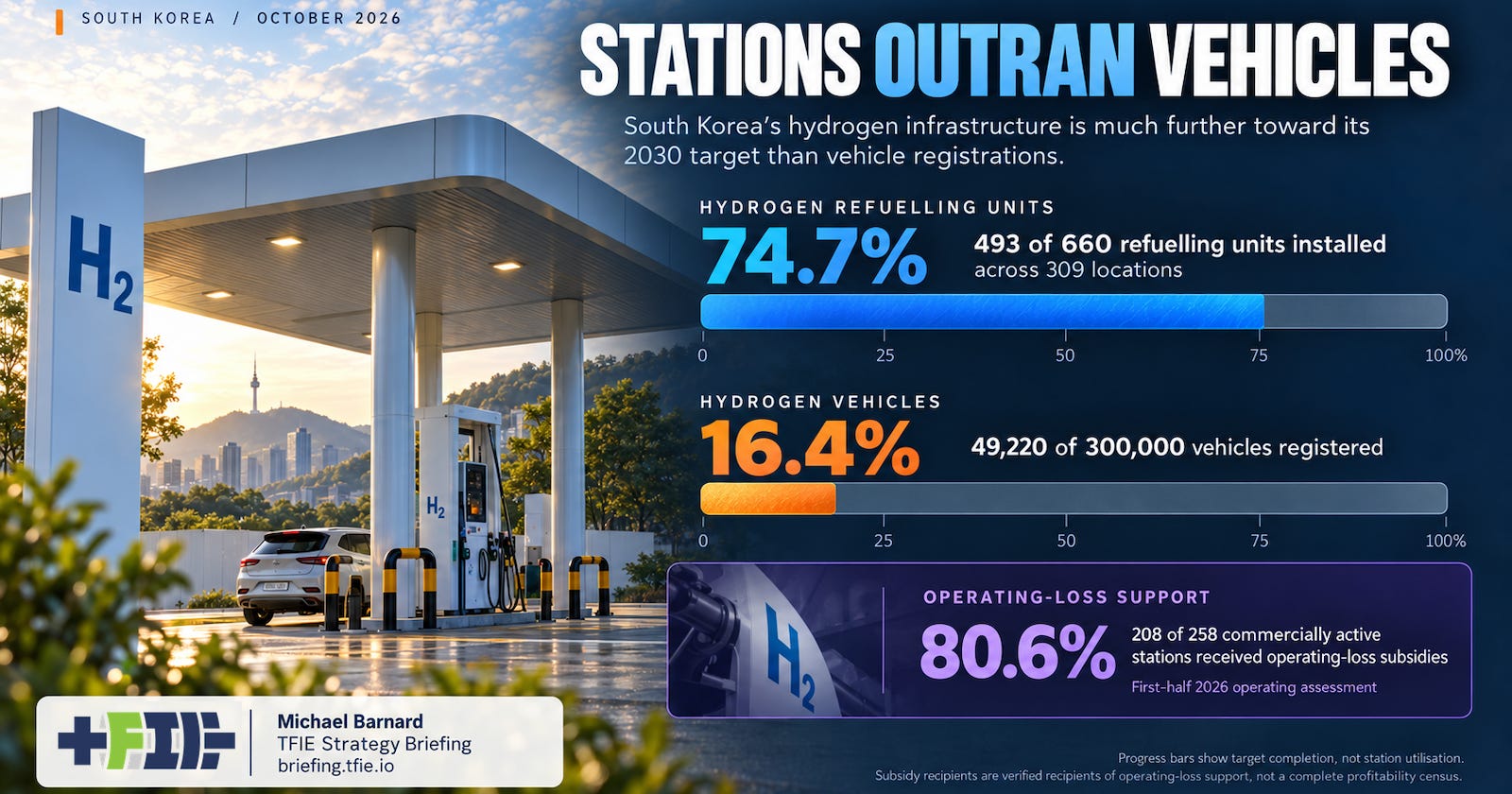
According to government data released during South Korea’s October 2026 parliamentary audit, the country had constructed 309 hydrogen refuelling locations containing 493 dispensing units by August 2026, reaching 74.7% of its target of at least 660 units by 2030. Hydrogen vehicle registrations had reached only 49,220, or 16.4% of the target of 300,000 vehicles. These are separate deployment targets rather than measures of actual station utilisation, but the disparity is striking. Infrastructure construction has progressed far more quickly than the vehicle purchases intended to support it.
The financial evidence is more revealing. Of 258 commercially active stations assessed during the first half of 2026, 208 received government subsidies to cover part of their operating losses, or 80.6%. By July, the government had distributed approximately €6.32 million to those stations and budgeted €12.71 million for operating support during 2026. Eight relatively recently constructed stations had ceased operating, four citing reasons including poor business prospects or financial losses. Some had received substantial public construction grants. The remaining 50 commercially active stations cannot automatically be classified as profitable, as subsidy eligibility and application requirements exclude some operators.
The scale of the difficulty is particularly striking because South Korea has subsidised both sides of the market. Hydrogen vehicles have received substantial purchase incentives, while the government has helped finance refuelling facilities and subsidised their losses as vehicle adoption developed. Yet hydrogen retail prices have increased rather than declined, rising 22.8% between 2022 and the first nine months of 2026, to approximately €6.90 per kilogram. The country is still supporting a large majority of commercially active stations after years of investment, while several relatively new facilities have already closed.
There is an apparent success story. Jeonju Pyeonghwa, a large hydrogen station serving a concentrated fleet of city buses, reportedly reached break-even in 2024. However, its €5.32 million construction cost included a national government grant covering 52.5% of the investment, and the operator has not disclosed financial statements establishing a full-cost project return. Its customers are buses returning repeatedly to a common depot, offering the kind of concentrated demand that a geographically dispersed motorway network cannot assume.
The hydrogen supplied introduces another problem. South Korea’s hydrogen system has historically relied heavily on fossil-derived and industrial by-product hydrogen, while genuinely renewable production remains limited and costly. A refuelling station may be able to cover its operating expenses using relatively inexpensive hydrogen without providing the lifecycle emissions reductions that justify Europe’s climate policies. Supplying renewable hydrogen improves the potential climate outcome but makes the financial challenge substantially harder. The most favourable Korean station economics cannot be translated into a European decarbonisation success without examining both the full infrastructure costs and the actual fuel pathway.
That distinction has immediate European relevance. The European Environment Agency’s latest projections put the EU on course for a 54% net emissions reduction by 2030, just short of its binding 55% target, even assuming planned policies are implemented. Transport emissions remain particularly difficult to reduce, with preliminary 2024 estimates showing a 0.7% increase over 2023. Building hydrogen refuelling infrastructure that serves few vehicles, or dispenses fuel with high lifecycle emissions, would do little to close that gap.
The European Commission has a coherent reason for requiring infrastructure ahead of demand. Vehicle operators need reliable refuelling coverage before investing in hydrogen trucks, while station investors need confidence that customers will arrive. Its 2025 heavy-duty vehicle assessment explicitly recognized this coordination problem and concluded that AFIR’s minimum network requirements were generally appropriate, despite acknowledging much greater uncertainty around hydrogen trucks than battery-electric vehicles.
South Korea’s results challenge the scale and economics of that policy choice. Europe needs to establish whether mandatory hydrogen motorway coverage will create sufficient transport and climate value to justify the full investment, including the cost of keeping stations available when customers do not arrive.
The financial evidence exposes a deeper problem than underused infrastructure. Even Korea’s most favourable break-even example leaves major questions about capital recovery, hydrogen supply costs and lifecycle emissions. Those are the questions Europe’s AFIR review needs to answer before mandating further investment.
