

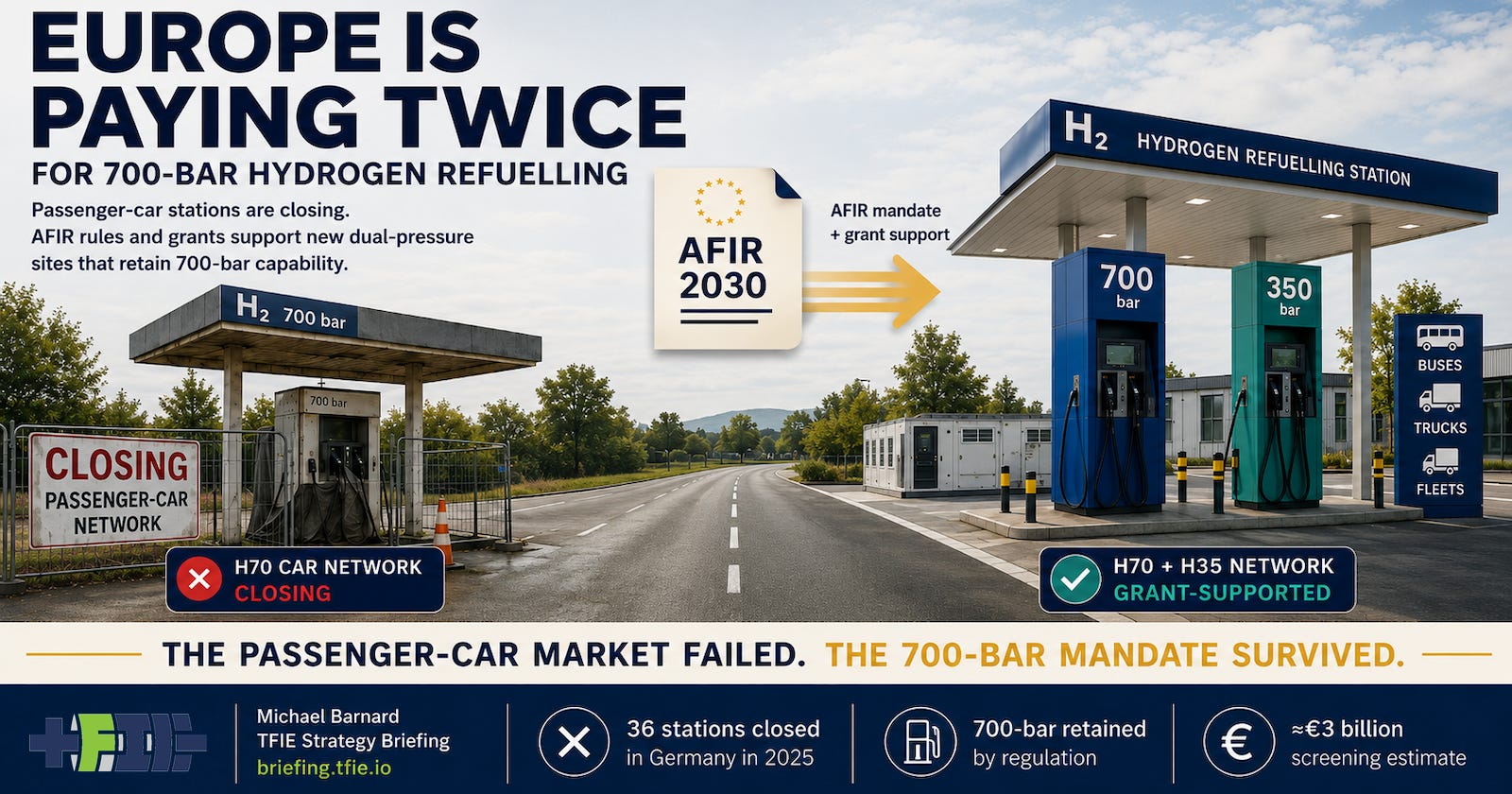
Germany closed 36 first-generation hydrogen refuelling stations during 2025. That included 22 small stations explicitly identified as serving the 700-bar passenger-car market, followed by another 14 locations at the end of the year. H2 Mobility did not conceal the underlying problem. The stations had been developed for a passenger-car market that failed to appear at the expected scale, and many could not be economically adapted to the throughput and technical requirements of buses and trucks.
At the same time, H2 Mobility and other European operators are commissioning larger stations offering both 350-bar and 700-bar refuelling. That can look like ordinary modernization, with obsolete equipment replaced by higher-capacity infrastructure. But the retained 700-bar hardware exposes a more expensive policy cycle. Europe paid to establish a public H70 network for hydrogen cars. It is now paying to close much of that network and paying again to preserve H70 capability inside many of the commercial-vehicle stations replacing it.
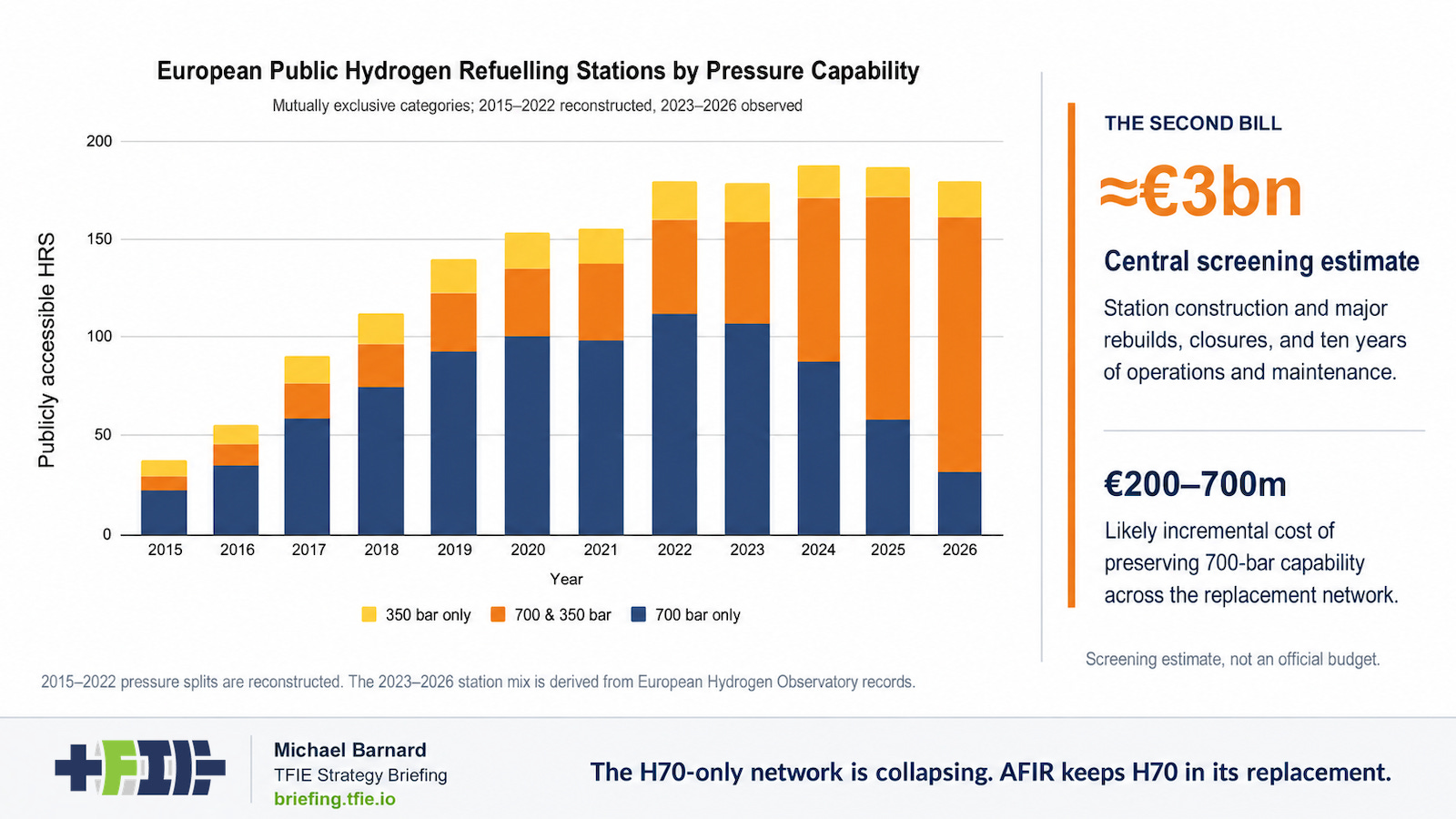
The changing composition of Europe’s station network makes that cycle visible. A station-level dataset assembled from European Hydrogen Observatory records shows 108 public H70-only stations in 2023, 50 dual-pressure stations and 20 H35-only stations. By May 2026, H70-only stations had fallen to 32, dual-pressure stations had risen to 129 and H35-only stations stood at 18. The total changed from 178 to 179.
That denominator matters. Europe’s public hydrogen network is not experiencing meaningful aggregate growth. It is being rebuilt internally. Stand-alone passenger-car infrastructure is collapsing while dual-pressure equipment expands, carrying 700-bar capability into a new generation of stations despite the failure of the market that originally justified it.
H70 is no longer exclusively a passenger-car standard. Some heavy-truck developers have selected 700-bar storage because the higher pressure puts more hydrogen into a restricted vehicle envelope. Other truck and bus manufacturers use 350 bar, while Daimler has pursued subcooled liquid hydrogen. Europe has not converged on a hydrogen pressure standard for heavy transport, and that fragmentation increases the risk that speculative infrastructure will serve the wrong vehicles or too few vehicles.
The contrast with batteries is much clearer. The European Commission’s own market assessment counted more than 15,000 battery-electric trucks in the EU at the end of 2024 and only 170 hydrogen trucks. More than 7,500 battery-electric trucks were registered during that year, compared with 106 hydrogen trucks. The Commission also counted more than 250 hydrogen stations serving approximately 4,700 cars, 320 vans, 140 trucks and 320 buses.
The same assessment concluded that the existing hydrogen refuelling network was broadly sufficient for the current vehicle fleet. Limited vehicle availability and expensive hydrogen, rather than inadequate station coverage, were the main constraints. In other words, the policy response is to require more infrastructure even though the official analysis says infrastructure is not the bottleneck.
Retaining H70 is not free optionality. A 700-bar vehicle cannot be filled quickly and completely using equipment that merely reaches 700 bar. The station requires compression and storage substantially above the vehicle’s nominal pressure. The US National Renewable Energy Laboratory’s hydrogen infrastructure testing facility compresses gas to as much as 930 bar for H70 testing and uses dedicated equipment to chill hydrogen to around −40°C before a rapid fill.
High-pressure storage vessels, tubing, valves, seals, hoses and dispensers must tolerate those conditions repeatedly. Operators also take on additional electricity consumption, inspection requirements, specialist maintenance and failure modes. A large dual-pressure station can share hydrogen supply, civil works, safety systems and parts of the compression train, so adding H70 does not double the station cost. It still adds a separate high-pressure storage and dispensing pathway, commonly including boosting, chilling and specialized components.
That incremental burden could be reasonable at a station serving a contracted H70 fleet. Repeating it across a continental network because a future truck standard might emerge is a different proposition.
The clearest reason the hardware persists despite weak demand is the Alternative Fuels Infrastructure Regulation, reinforced by grants that reward compliant dual-pressure designs. AFIR requires publicly accessible hydrogen stations along the TEN-T core road network by December 31, 2030, no more than 200 km apart. Corridor stations must be designed for at least 1 ton of daily capacity and include at least one 700-bar dispenser.
AFIR also requires a publicly accessible hydrogen station at each TEN-T urban node. The explicit H70 requirement applies to the corridor stations rather than automatically to every urban-node site, but grant-funded developers commonly select dual-pressure designs. That maximizes vehicle compatibility, protects against future regulatory changes and avoids constructing a publicly supported station that might later be considered incomplete.
Grants translate that policy into steel, compressors and dispensers. ORLEN’s second Polish Clean Cities hydrogen programme has eligible costs of €25.6 million for five stations and an EU grant of €12.8 million. Its third phase includes a production and distribution hub plus 16 public stations offering both 350-bar and 700-bar refuelling. Eligible project costs are €124.6 million, with a €62.3 million EU grant.
Those stations can support real bus operations and prospective truck fleets. But present vehicle demand would not independently finance the scale, geographic coverage or technical specification being constructed. The combination of AFIR compliance and grants covering up to half of eligible costs makes retaining H70 commercially rational for the project developer even where the wider economic justification is weak.
How much could the replacement cycle cost? There is no consolidated European budget, so any answer should be treated as a screening estimate rather than an official forecast. A low case assumes roughly 275 new stations or major rebuilds at approximately €2.2 million each, modest closure costs and ten years of operations and maintenance. That produces an economic cost of about €1 billion.
A central case assumes around 400 new stations or substantial rebuilds averaging €5 million each. That produces €2 billion in capital expenditure, approximately €800 million in operations and maintenance over ten years and about €250 million in closure, decommissioning and network-churn costs. The result is roughly €3 billion. A high case of 500 projects closer to the cost of recent large dual-pressure programmes approaches €6 billion.
The assumptions are anchored in the Commission’s AFIR impact assessment, which estimated 2025 capital costs of approximately €2.3 million for a 0.4-ton-per-day station, €3.3 million for a 1-ton station and €5 million for a 2.5-ton station. It assumed annual operations and maintenance equal to 4% of initial investment. Recent ORLEN programmes indicate that large dual-pressure projects and their associated hydrogen infrastructure can cost materially more.
The €1–6 billion range represents economic expenditure induced by regulation and supporting policy, not a claim that the entire amount will come directly from the EU budget. The cost will be divided among EU grants, national subsidies, state-owned companies, private capital and users. It also excludes hydrogen-production subsidies, distribution equipment, vehicle grants, discounted fuel and operating support for stations whose throughput cannot cover their fixed costs.
The amount attributable specifically to preserving H70 cannot be isolated precisely because much of a dual-pressure station is shared. A reasonable engineering range of €0.5–1.5 million in incremental high-pressure compression, storage, chilling, dispensing and integration costs across several hundred stations produces a plausible European H70 premium of roughly €200–700 million. That is an assumption range, not a reported programme total, but it indicates the scale of the policy choice.
The striking feature is that the Commission has already documented much of the case against building ahead of demand. Existing station capacity exceeds the requirements of the current fleet. Hydrogen vehicles remain more expensive to buy and operate than battery-electric alternatives across the Commission’s assessed use cases. The market remains fragmented among 350-bar, 700-bar and liquid-hydrogen architectures. The Commission nevertheless concluded that AFIR’s hydrogen requirements remained generally appropriate as a minimum continental network, even while projecting that batteries could represent around 90% of Europe’s zero-emission heavy-duty fleet in 2030.
Independent French and German economic and audit bodies have reached a less accommodating conclusion. Germany’s Council of Economic Experts found that potential hydrogen-truck applications were niches that did not justify a nationwide public hydrogen-refuelling network. A joint French-German economic statement recommended making battery-electric trucks the central technology, supporting megawatt and depot charging, and reassessing AFIR so infrastructure followed realistic market demand.
France’s Cour des comptes found that 46% of committed spending under the French hydrogen strategy had gone to road transport even though hydrogen road transport had become a second-ranked option behind batteries. That is not an argument that every hydrogen station is wasteful. It is evidence that public spending has remained attached to an increasingly weak transport pathway after the comparative market evidence changed.
There are defensible hydrogen-station projects. An H35 station beside a contracted bus or specialist fleet can have predictable utilization. A depot or mobile station can serve a bounded commercial use without pretending to be part of a universal public network. An H70 dispenser could be justified where a real H70 fleet has been ordered, financed and delivered.
None of those cases requires Europe to build a geographically complete public network in advance of proven vehicle demand, pressure-standard convergence or repeat procurement.
The 2026 AFIR review should replace pressure-prescriptive and distance-prescriptive hydrogen rules with contracted-demand tests, minimum utilization thresholds, pressure flexibility and staged construction. Public support should follow vehicles that are ordered, delivered and used rather than attempting to summon a vehicle market by building its refuelling system first.
Europe has already paid for one 700-bar network that the market did not use. It should not make the same bet again inside larger and more expensive stations.
Subscribe to TFIE Strategy Briefing for denominator-first analysis of energy-transition technologies, infrastructure and policy.