

In September 2025, Trafigura loaded 23,500 tons of certified low-carbon ammonia at CF Industries’ Donaldsonville facility in Louisiana. The shipment was destined for Envalior in Antwerp, where it would be used to manufacture caprolactam, an input to engineering materials. The American plant produced ammonia using natural gas with carbon capture, not renewable hydrogen. But the transaction illustrates an important industrial possibility: European manufacturers can continue producing valuable chemicals without making every upstream input domestically.
Producing ammonia requires hydrogen, but consuming ammonia does not require a separate hydrogen supply. The hydrogen is chemically embodied in the imported product. European manufacturers can purchase ammonia directly rather than importing hydrogen for domestic synthesis, avoiding the associated production plants and infrastructure. The upstream hydrogen requirement has moved to the country manufacturing the ammonia, not disappeared.
Many proposed hydrogen import corridors take a different approach. They envision producing ammonia overseas, shipping it to Europe and cracking it back into hydrogen for refineries and other industrial customers. Cracking requires additional equipment, energy, infrastructure and handling costs. Imported ammonia consumed directly in chemical manufacturing and imported ammonia cracked into hydrogen for refineries serve different industrial requirements. They should be assessed as separate routes, with their respective processing and delivery costs.
A November 2026 study by RMI and VITO examines a prospective green-ammonia corridor from Odisha, India, to Northwest Europe. It estimates delivered port prices of €665–774/t and potential trade of at least one million tons annually by 2030. Developers have announced more than 6.5 million tons of annual production capacity, although only about 0.8 million tons is under construction. The study identifies European refineries as potential early customers for ammonia cracking, illustrating why the intended industrial use matters as much as the shipping route.
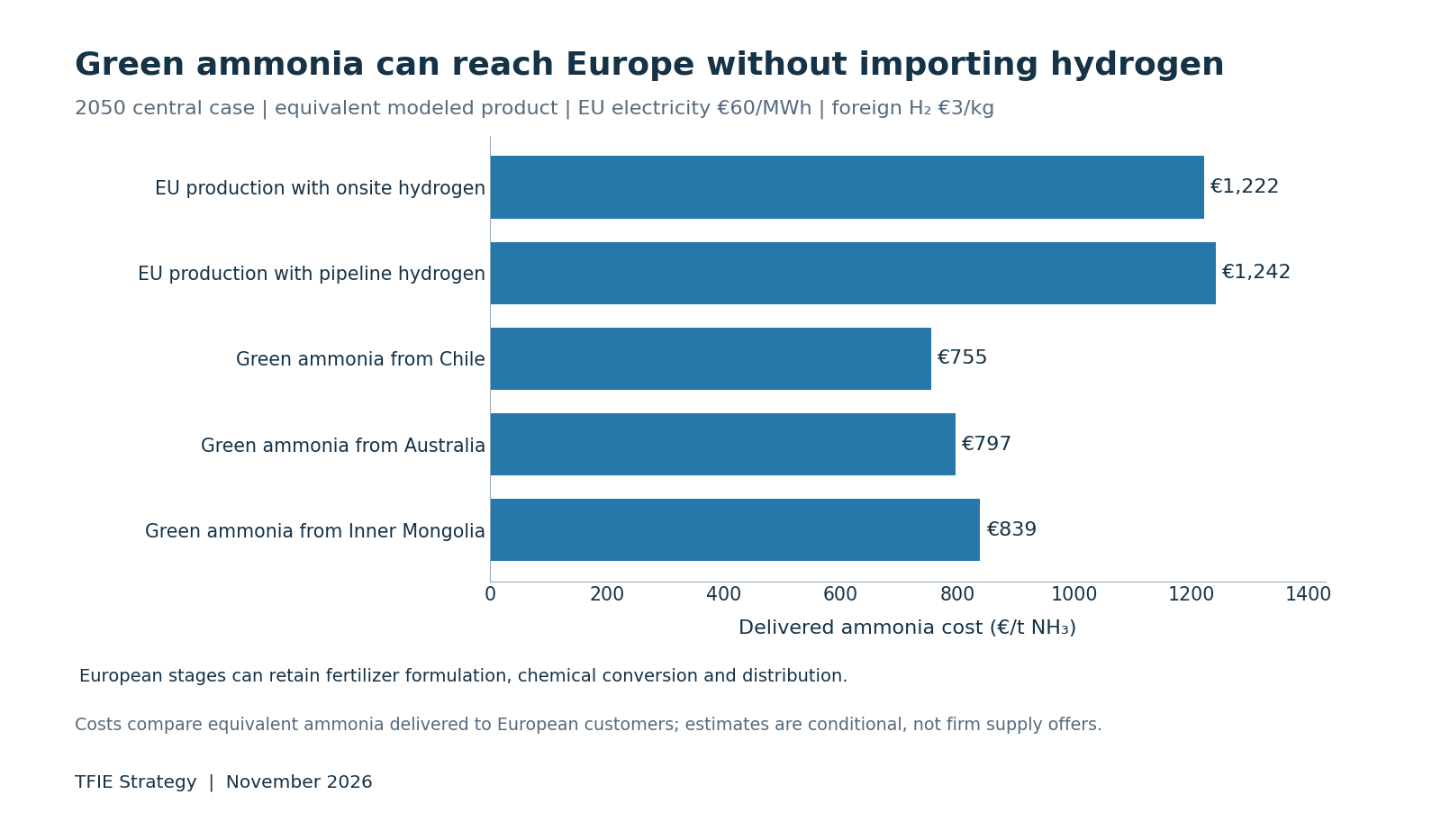
My European hydrogen assessment compares the delivered cost of industrial inputs rather than assuming that their hydrogen must be produced inside the EU. In the central 2050 scenario, European green ammonia synthesis using on-site hydrogen costs approximately €1,222/t. Qualifying imported green ammonia costs €755–839/t across the modelled suppliers. That implies an import advantage of roughly €380–470/t before accounting for strategic benefits or costs outside the comparison.
These are scenario results, not commercial offers for 2050. The model assumes particular electricity prices, equipment costs, production capacities and trade routes, with differences in the price-year conventions of underlying sources. The RMI/VITO estimates are lower than my 2050 import cases despite their earlier date, but the studies use different locations, inputs and delivery boundaries. They cannot be read as points on a common cost-reduction trajectory.
The commercial advantage of an imported input also depends on product specifications, verified emissions, supplier commitments and the costs of moving it to the industrial customer. Those requirements must be established before modelled differences become investment decisions.
What do actual ammonia contracts tell us about these costs? Can European steelmakers retain valuable manufacturing while importing green iron? And how should carbon rules, employment and supply security change the calculation? Below the paywall, I examine the commercial evidence and what it means for industrial and infrastructure investment.