
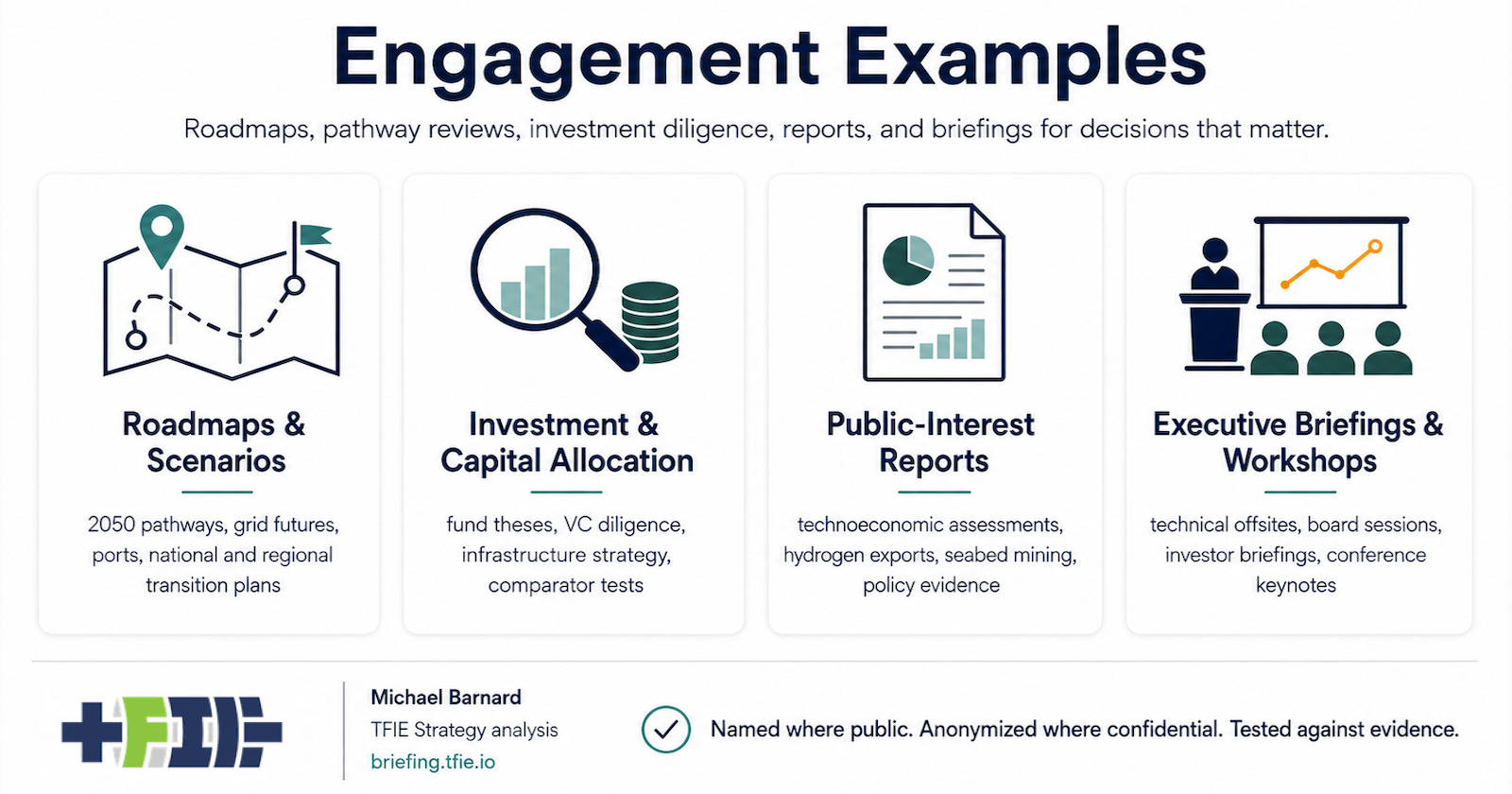
TFIE Strategy applies the same evidence discipline behind the Briefing to live decisions: investment theses, roadmaps, private pathway reviews, strategic offsites, commissioned reports, and executive briefings.
Named organizations are included only where the engagement has already been described publicly. Other examples are anonymized by sector, scale, and decision type to preserve confidentiality.
The work is not a generic consulting catalogue. It starts with the decision to be tested, the pathway being claimed, the comparators that matter, and the evidence needed to distinguish real progress from activity, narrative momentum, subsidy dependence, or strategic drift.
Roadmaps & Scenario Planning
Trifecta Ireland / SupergridEurope
Strategy process and advisory work for clean, secure, affordable energy, including an every-five-year roadmap to full decarbonization of Ireland’s energy future by 2050.
The work focuses on practical sequencing: electricity, grids, demand flexibility, storage, industrial heat, transport, land use, institutional constraints, and the decisions that have to be made in the right order.
TenneT
2050 energy scenario workshops in the Netherlands, grounding long-term energy futures in grid physics, land constraints, social acceptance, and electrification realities.
The emphasis was on plausible transition pathways, not wish lists. Scenarios were tested against infrastructure constraints, deployment rates, technology maturity, and the physical realities of moving clean electricity through a real grid.
European port and industrial decarbonization pathway
2050 decarbonization pathway work for a European port and industrial system, focused on sequencing, electrification, fuels, grid constraints, and infrastructure decisions.
The work examined which choices were likely to scale, which depended on fragile assumptions, and which infrastructure decisions would preserve optionality as policy, markets, and technology changed.
Investment & Capital Allocation
€4 billion European investment fund
Investment-thesis assessment for industrial decarbonization, heat, and grid storage across North America and Europe.
The work tested target sectors against deployment evidence, cost curves, infrastructure fit, policy durability, and comparator pathways. The purpose was not to validate enthusiasm, but to pressure-test where capital could create durable advantage.
Energy-sector venture capital client
Repeat advisory support for investment assessments, scalability filters, learning-rate realism, and policy-durability tests.
The focus was on separating promising niches from claims of broad market disruption. Technologies were assessed against denominators, deployment friction, customer economics, supply chains, and the probability that better-established alternatives would continue improving.
Top-five US investment bank client briefings
Institutional-investor briefings on SMRs, grid expansion, and likely dominant low-carbon generation pathways.
The briefings focused on what is likely to scale, what is likely to remain niche, and where market narratives are running ahead of physical, regulatory, and economic reality.
Green infrastructure fund advisory
Advisory support for investment assessments around scalability, policy durability, infrastructure fit, and comparator pathways.
The work treated low-carbon infrastructure as a system problem. Capital allocation was tested against grid access, supply chains, permitting, customer economics, operational risk, and credible alternatives.
Public-Interest Reports
National Ocean Protection Coalition
Commissioned technoeconomic assessment of seabed mining in American Samoa, co-authored with Lyle Trytten, testing technical feasibility, market exposure, and bankability.
The work examined whether the proposed pathway made sense when tested against engineering requirements, commodity markets, environmental exposure, logistics, capital intensity, and realistic commercial risk.
Corporate Europe Observatory / The Transnational Institute
Commissioned report on EU plans to import hydrogen from Morocco, Algeria, and Egypt, testing economics, infrastructure, domestic opportunity cost, and export narratives.
The work examined hydrogen import claims against production costs, water and renewable electricity requirements, infrastructure buildout, domestic development priorities, and Europe’s alternatives.
Open reports and TFIE Strategy reports
The same approach appears in public TFIE Strategy reports and paid Briefing work: define the claim, identify the comparator, test the denominator, and watch for the point where a pathway shifts from advancing to defending itself.
Executive Briefings & Workshops
Major maritime conglomerate technical offsite
Senior technical executive and engineering offsite on maritime decarbonization through 2100, focused on batteries, biofuels, methanol, and realistic fuel pathways.
The work tested maritime fuel claims against vessel classes, voyage profiles, port infrastructure, energy losses, fuel availability, lifecycle emissions, safety, and the rate at which electrification and alternative fuels are likely to penetrate different segments.
Major North American renewables developer offsite
Strategic workshop on the short list of climate actions that work, with option development, prioritization, and decision exercises.
The session focused on practical choices, not generic transition rhetoric. Participants worked through where effort, capital, policy engagement, and organizational attention were most likely to produce material climate and business outcomes.
Selected public briefings
Public briefings and conference work have included University of Twente, India Smart Grid Forum, Vancouver Maritime Centre for Climate / GreenShip, Jefferies, P3GQA Megaprojects Conference, Tsinghua PBCSF, investor forums, infrastructure conferences, and clean-energy industry events.
These engagements reflect the same pattern: evidence first, comparators always, denominators made explicit, and technology claims tested against the real constraints of scaling.
Closing CTA
If your organization faces a live investment, procurement, policy, infrastructure, or strategy decision, TFIE Strategy can apply the same pathway-review framework privately.
The work starts with the decision to be tested, not with a generic consulting engagement.