

Energy Vault’s Rudong project is about as favourable a test of block-heavy gravity storage as the technology was likely to receive. It was built in China, where large civil works, steel fabrication, electrical equipment and industrial construction benefit from deep domestic supply chains and comparatively low costs. The project had official support, grid coordination and a Chinese partner capable of constructing an enormous first-of-kind machine. If lifting solid masses inside a purpose-built structure could compete with ordinary grid storage, Rudong should have given the architecture a very good chance.
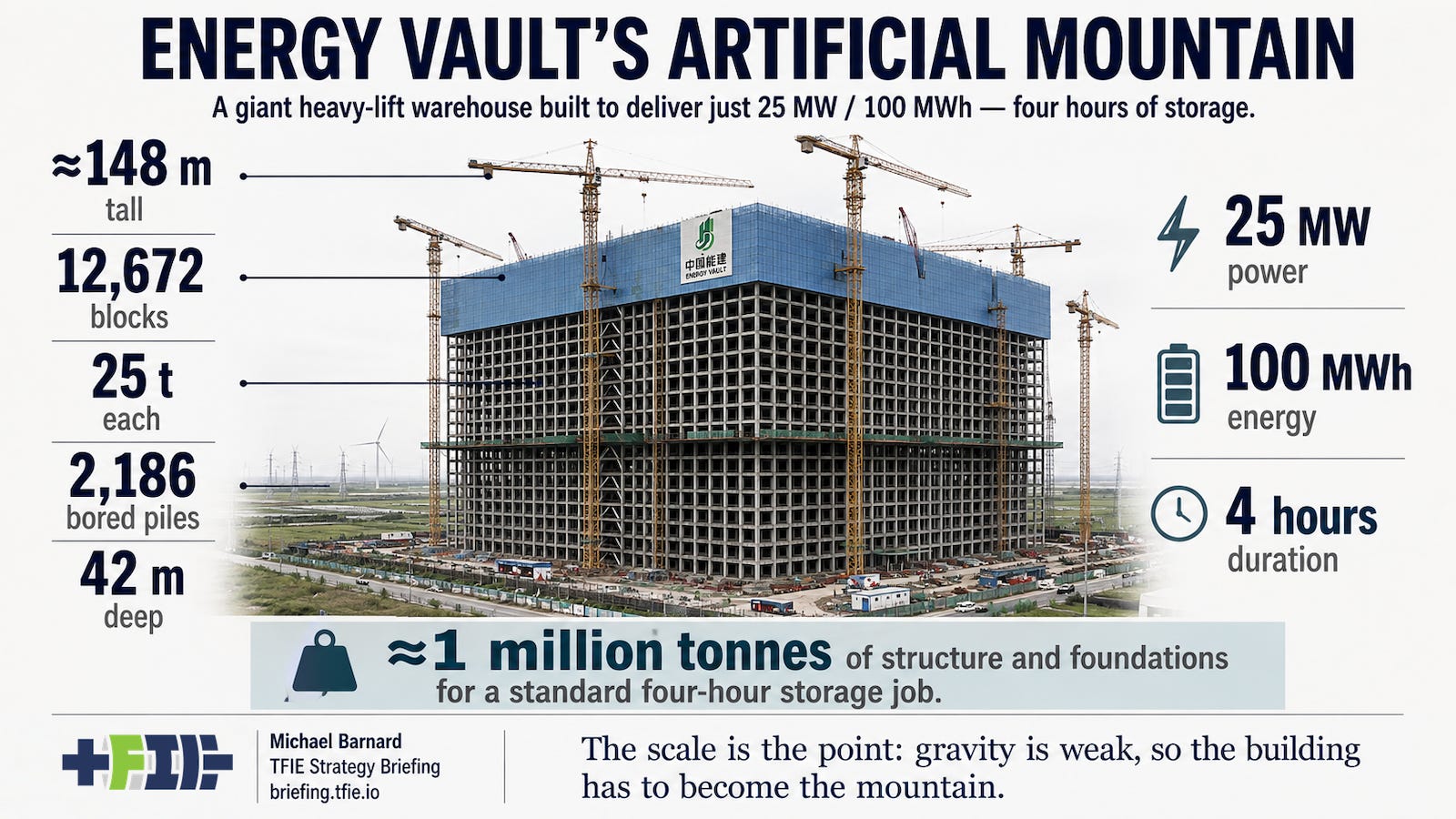
The resulting machine is difficult to reconcile with the modest electrical service it provides. Chinese reporting describes a structure roughly 122 metres long, 110 metres wide and 148 metres high, containing 12,672 nominally 25-ton blocks, 96 lifts organized into 48 operating modules, and 2,186 bored piles extending 42 metres into the coastal ground. The same reporting describes roughly 350,000 tons of storage blocks, although the detailed block count multiplied by the nominal mass gives 316,800 tons. All of that physical infrastructure provides about 25 MW and 100 MWh, or four hours of discharge at nameplate power.
For those unfamiliar with Energy Vault, its trajectory is almost as revealing as Rudong itself, and the lineage is older than the company. Californian venture capitalist Bill Gross first pursued essentially the same “pumped hydro without water” proposition in 2009 through Energy Cache, co-founded with Aaron Fyke, which proposed hauling gravel uphill and recovering the gravitational potential energy on the way down; by 2012 it had attracted backing from Idealab, Bill Gates and Claremont Creek Ventures and built a 50 kW prototype, but never made the jump to utility scale.
Gross returned to the idea in 2016, bringing in Swiss engineer Andrea Pedretti to work through new physical architectures, with Robert Piconi joining as CEO when Energy Vault was formed in 2017. The company unveiled the six-arm EV1 crane concept in 2018, built a quarter-scale prototype that year and connected a 5 MW commercial demonstration tower to the Swiss grid in 2020, only to replace the exposed-crane concept with the enclosed EVx architecture.
It then caught the cleantech SPAC wave I wrote about in 2022, going public in February 2022 following a deal struck at roughly a $1.1 billion enterprise valuation while the Swiss demonstrator remained its only operating gravity-storage system. The strategic shift came almost immediately: by August 2022 Energy Vault had announced nearly 1 GWh of conventional lithium-ion battery projects, and the EV1 demonstrator was decommissioned the following month.
By the time I revisited Energy Vault in 2023 as Rudong moved ahead, gravity storage had become one product line inside what was increasingly a conventional storage integrator; I later described the post-SPAC company as a significantly overcapitalized BESS developer, with gravity surviving principally through projects and licensing such as Rudong and a side business in hydrogen-backed resilience exemplified by the battery-plus-hydrogen Calistoga microgrid.
For the Chinese project, Energy Vault’s own project page still lists Rudong as “Commissioning” while retaining the statement that full grid interconnection was expected by the end of 2023. The project has plainly progressed beyond a rendering or laboratory prototype, and parts of the system have operated. What Energy Vault has not published is the sustained commercial record that would allow investors or utilities to treat the system as a mature reference class: monthly available MW, forced-outage rates, full revenue-meter cycles, annual maintenance expenditure and repeat customer orders placed after observing the plant in service.
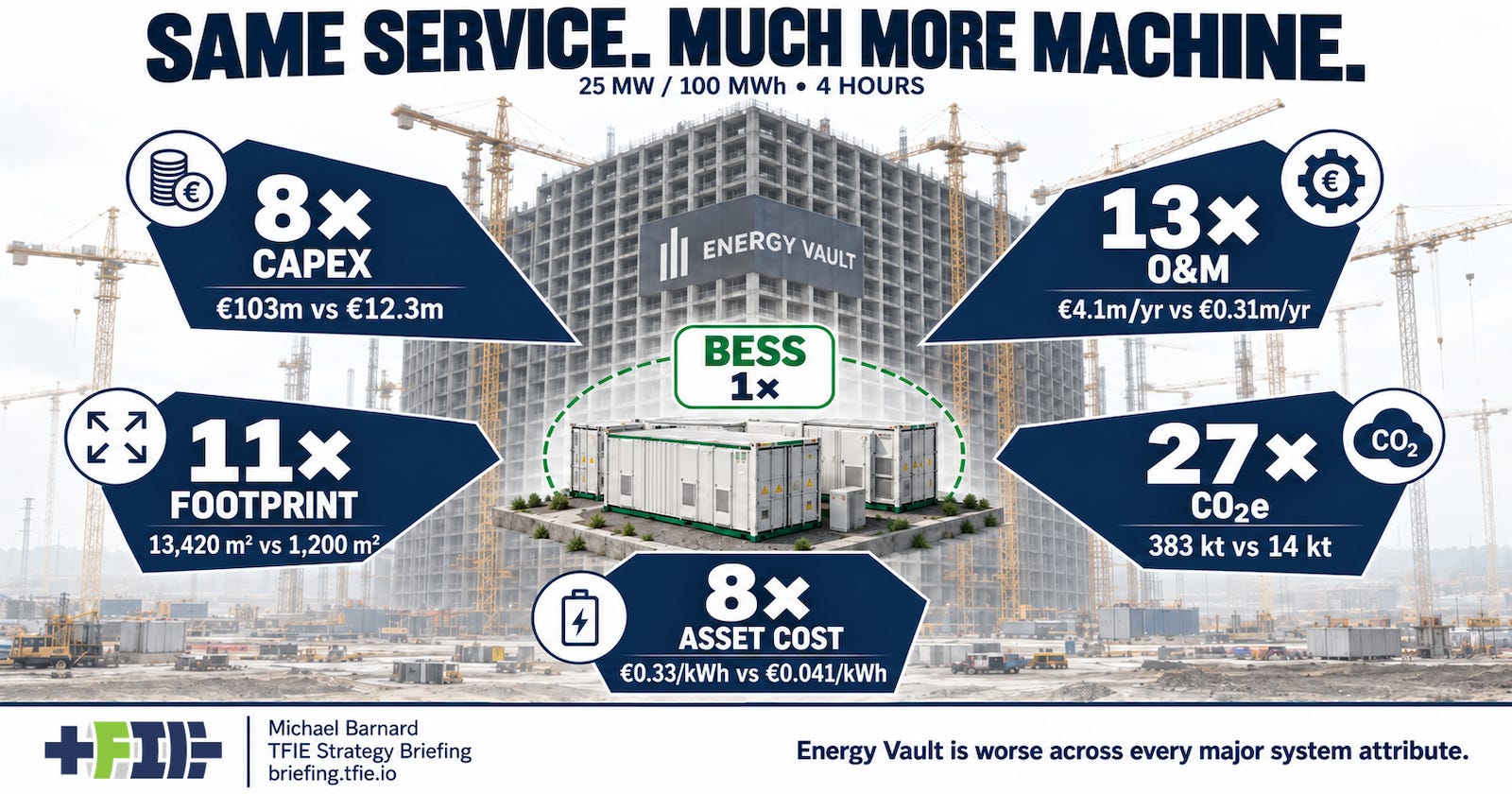
The prolonged commissioning attracts attention, but it is not necessary to the central argument. Rudong could enter flawless commercial operation tomorrow and would still have to compete with China’s existing four-hour battery market. In the first half of 2026, Chinese four-hour BESS EPC awards averaged about €123 per kWh, with an increasingly standardized procurement market. At that reference price, an equivalent 100 MWh battery plant costs about €12.3 million.
Rudong’s later publicly reported investment figure was about €83 million, while an earlier local-government account put it at about €128 million. My central reference-class estimate is €103 million, allowing for first-of-kind integration, extended commissioning, rectification, owner costs and initial spares without applying anything close to the average overrun seen in troublesome megaproject classes. Using equivalent boundaries, the resulting comparison is roughly eight times the upfront capital of a contemporary Chinese BESS, thirteen times the central annual O&M and renewal allowance, eleven times the main equipment footprint, about 27 times the initial embodied CO₂e, and a little over eight times the storage-asset cost per delivered kWh before charging electricity is added.
The footprint comparison is not against a hypothetical future battery architecture. Sungrow says a 100 MWh PowerTitan installation requires about 1,200 square metres, with 5 MWh of batteries and 2.5 MW of PCS integrated into each 20-foot AC block. The comparison is therefore being made inside the same Chinese industrial economy between a standardized manufactured storage product and a first-of-kind structure whose tower footprint alone is about 13,420 square metres.
Energy Vault’s preferred framing directs attention toward the blocks. Waste-rich ballast does not experience electrochemical capacity fade, cannot undergo battery-cell thermal runaway and can use low-value mineral material that might otherwise require disposal. Those are genuine component-level advantages. They do not describe the complete storage system, which includes the enormous fixed structure, upper and lower storage positions, deep foundation, lift machinery, horizontal carriers, brakes, clutches, reducers, shafts, generators, hydraulics, sensors, controls and power electronics required to turn passive mass into dispatchable electricity.
At four hours, batteries avoid nearly that entire heavy-mechanical architecture. At much larger gravitational-storage scales, pumped hydro uses a continuous fluid that organizes itself inside reservoirs and passes through a comparatively small number of mature machines, with geography providing much of the elevation. Energy Vault instead manufactures the elevation and divides the storage medium into thousands of individually handled solid objects. Rudong has established that this can be engineered at full scale; the public evidence has not established why a grid owner should choose it for the service being delivered.
Below the paywall is the evidence machinery behind that conclusion: the gravity-density calculation that explains the extraordinary physical scale, the four-hour handling duty, the reconstruction of the piled foundation and embodied-carbon burden, maintenance and availability reference classes, the capital and O&M forecast, and a 35-year comparison with an equivalent Chinese LFP BESS that explicitly includes battery augmentation and repowering.
