

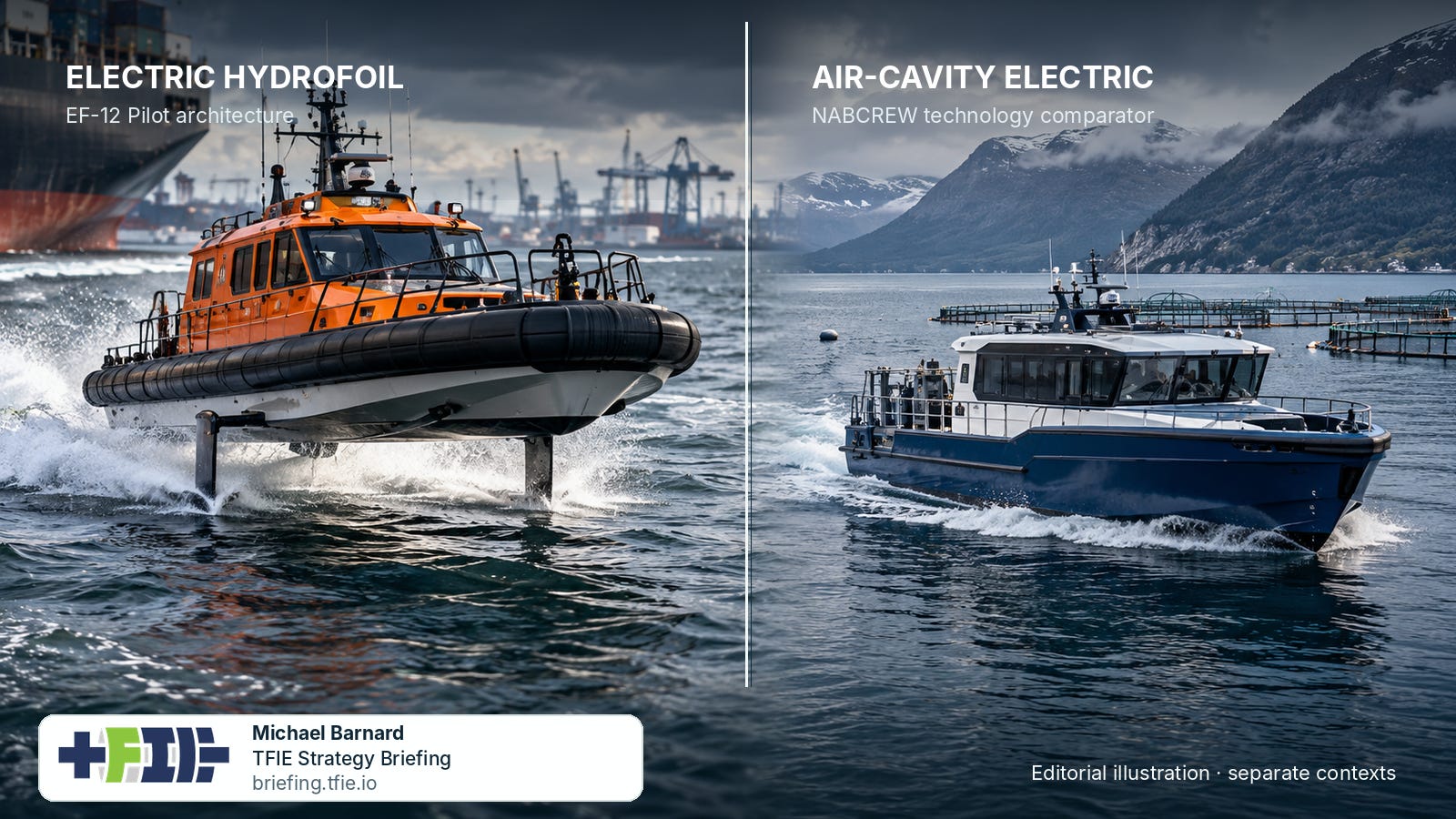
In August 2024, Antwerp pilotage operator Brabo ordered an Artemis EF-12 electric hydrofoil pilot boat. This is more interesting than fitting a battery to an ordinary workboat. A pilot tender must meet ships when their movements dictate, work through congested docks and approaches, and keep people safe when transferring them alongside a much larger vessel. Artemis has built active hydrofoil control into a vessel designed specifically for that work. Its Cork trials used an EF-12 workboat platform to test contacts with operating ships, and the EF-12 Pilot design subsequently entered sea trials in 2026.
The order made me curious about another way of removing resistance. Norway’s Moen Marin and Pascal Technologies have developed the NABCREW Zero AirBlue 1240, an electric personnel vessel that uses a pressurized air cavity beneath its hull. It is an aquaculture service boat, not a pilot tender; its boarding arrangements, certification and suitability for Brabo’s job have not been established. Nor was it a competing qualified bid in Brabo’s 2024 decision. The comparison is deliberately about propulsion architectures and their potential costs, not a claim that Brabo ordered the wrong boat.
I built a Python scenario model to examine the two low-resistance approaches alongside conventional marine diesel. Advertised range and cruise energy are only a starting point. A useful comparison has to follow the vessel through slow approaches, changing assignments, charging, missed opportunities and the cost of maintaining a service over fifteen years. The model is reproducible, but the geography, demand and vessel price inputs are exploratory rather than Brabo operational records.
Two ways to cut drag
The Artemis EF-12 Pilot uses submerged foils to lift much of the hull above the surface when speed and conditions permit. Reduced wetted area can lower resistance and wake, while active control can improve motion response. There is a price for that regime: acceleration to takeoff, enough uninterrupted water to remain foilborne, and descent before close ship handling. The foils can also provide active control while the boat is hullborne, so the engineering benefits are not restricted to high-speed cruise.
The Pascal AirHull concept keeps the hull in the water but replaces part of its wetted contact with a fan-maintained air cavity. The fan consumes power and the cavity’s effectiveness depends on speed and conditions. Moen Marin advertises the personnel boat with a 378 kWh battery and up to 40 nautical miles of range, but that quoted range uses essentially the full nominal battery rather than a marine operating reserve. I have a design-point specification, not a measured energy curve across the speeds and sea states of an Antwerp pilot tender. The existing diesel reference remains in the comparison because both electric architectures are intended to improve on combustion propulsion, not merely compete with each other.
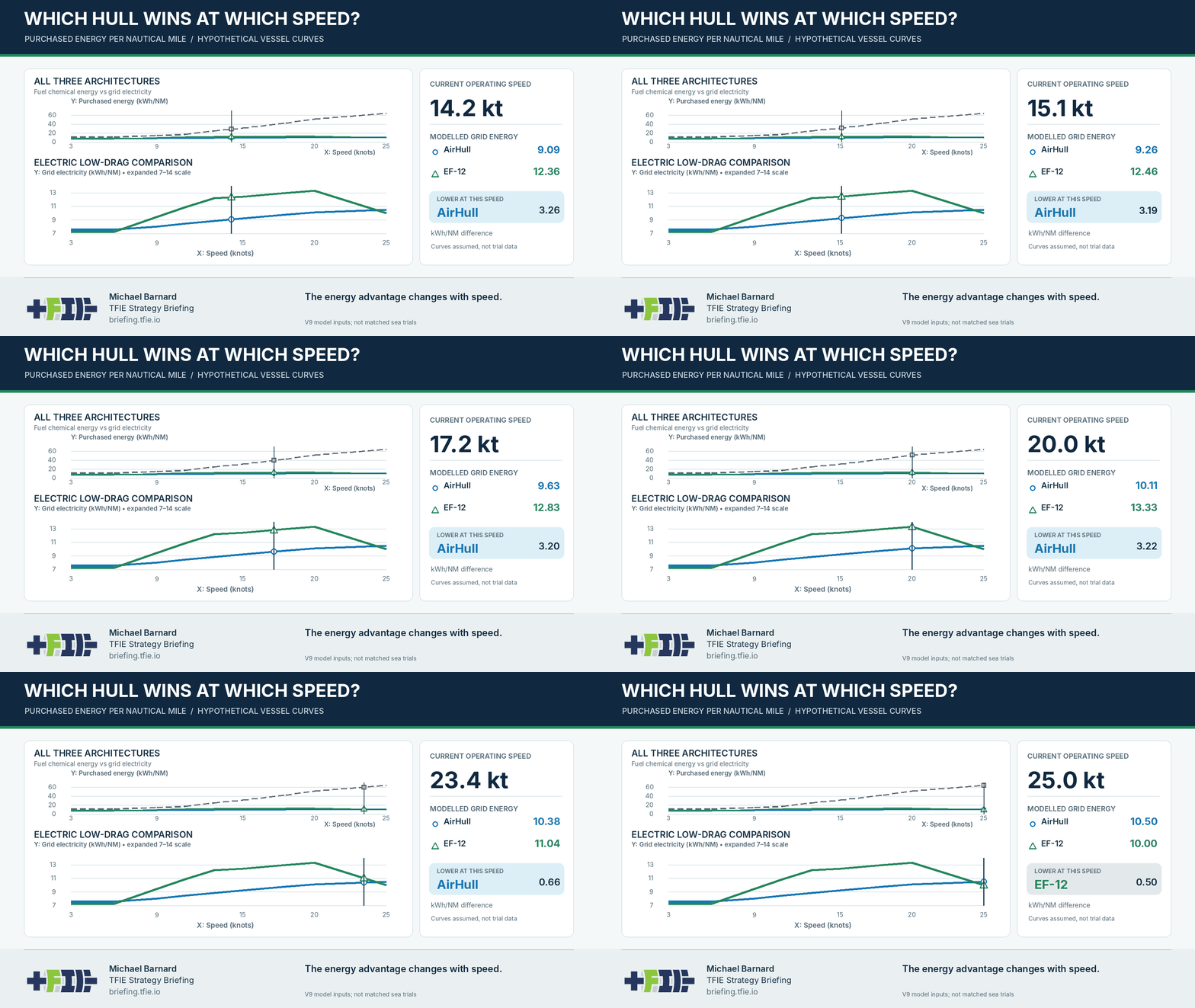
The curves make the trade-off visible. Electricity reduces purchased energy compared with diesel, but the modelled ordering between AirHull and EF-12 changes as the operating speed increases. Those curves are assumed and partly inferred, not paired sea trials. The more consequential question is how often either boat can use its favourable operating regime. That is where simulated port restrictions, real-time dispatch logic and the option of changing the diesel fuel alter the apparent ranking.