

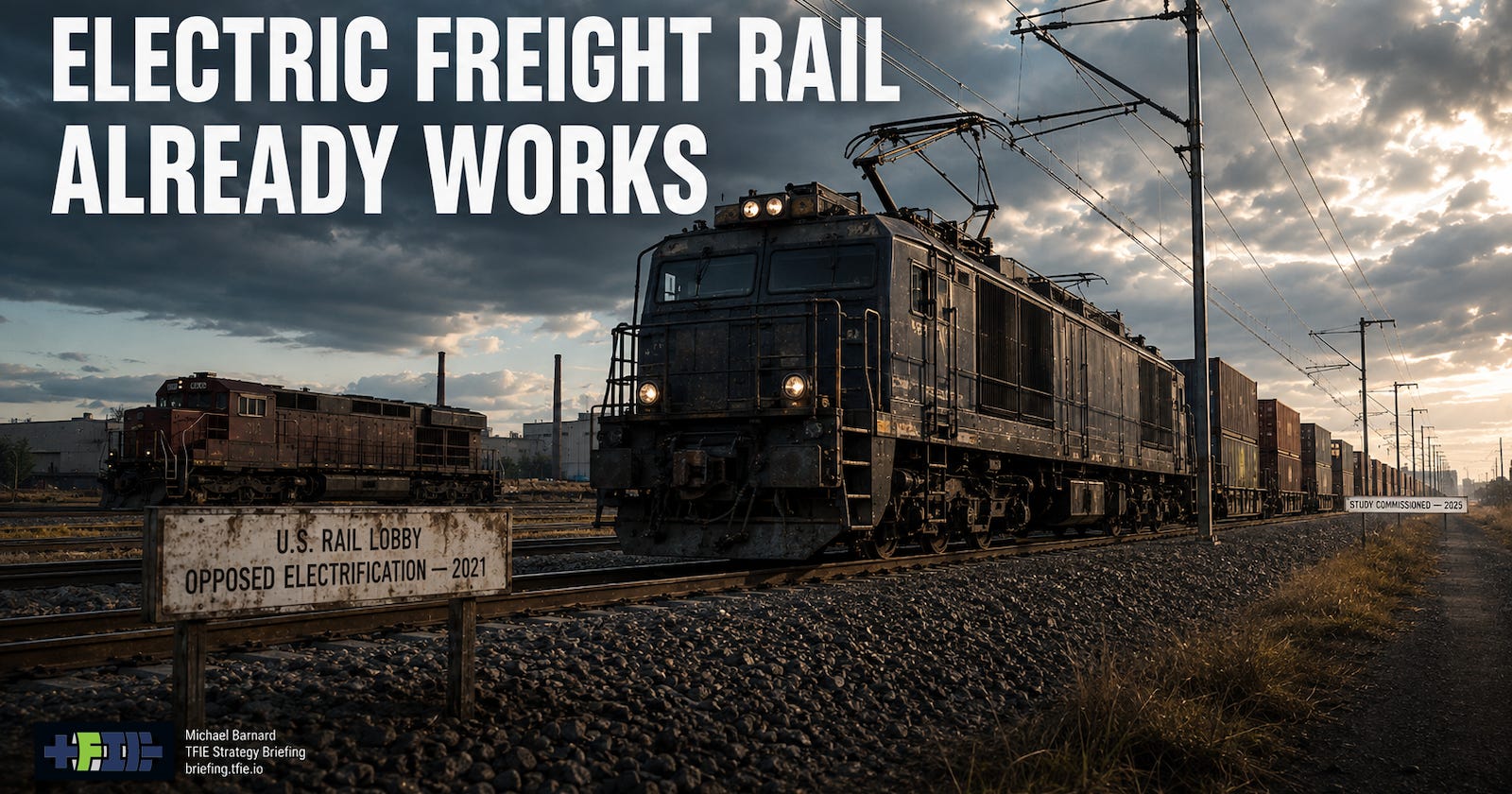
Direct electric freight rail is not speculative technology. It operates across enormous railway systems, moves heavy freight, works in difficult climates and eliminates the need to carry a diesel power plant around on every locomotive. The interesting question for North America is not whether electric freight works, but where it should be deployed first, how much catenary should be built, where batteries or dual-mode equipment make sense, and whether the resulting energy and maintenance savings justify each successive tranche of investment.
That is not the question the Association of American Railroads chose to investigate. In January 2021, the organization representing North America’s major freight railroads published a position paper titled Oppose Rail Electrification & Support Sensible Climate Policy. AAR argued that proposals to electrify all or part of the U.S. freight network should be set aside, framed the exercise around catenary spanning close to 140,000 miles, emphasized hundreds of billions of dollars in costs, bridge and tunnel difficulties and grid requirements, and argued that partial electrification would create operational problems around locomotive changes. Its position was not waiting for a new study. It was already public.
Four years later AAR commissioned HDR to perform a conceptual assessment of catenary electrification across the North American Class I network. HDR examined a lower case of roughly 105,000 track-miles and an upper case approaching the entire 139,000-track-mile network, producing conceptual capital estimates of $870 billion to $1.1 trillion including contingency. AAR then announced that an “independent analysis” had confirmed catenary was infeasible.
That sequence does not prove that HDR was instructed to manufacture a predetermined answer. But as a technology and strategy consultant who has worked inside a global consultancy and regularly assesses reports like this from major firms, my professional judgment is that this study was framed to produce the conclusion AAR had already adopted.
HDR also deserves more responsibility here than simply being described as AAR’s engineering contractor. It is a major freight-rail consultancy with the technical capability to understand the difference between a gross engineering cost stack and a decision-grade investment analysis. It is also an AAR Gold Associate, part of a program AAR itself describes as giving engineering firms access to Class I railroads, technical committees and policy discussions that shape the industry. That relationship does not invalidate HDR’s engineering work, but it makes AAR’s description of the report as an “independent analysis” considerably less persuasive. This was not an arms-length academic assessment by an uninterested third party; it was commissioned industry work produced by a consultancy deeply embedded in the freight-rail ecosystem.
That said, the report contains substantial engineering work that may be entirely reasonable. Poles and foundations cost money, traction substations and grid interconnections cost money, bridges and tunnels complicate overhead systems, and construction beside an operating railroad requires careful staging. Some costs outside HDR’s railway boundary, including additional transmission reinforcement and generation that could ultimately be required, could even raise the cost of a full network transformation. The problem is not that every unit cost must be inflated for the exercise to fail as decision analysis. It is that AAR asked for the cost of an enormous physical transformation and then promoted that answer as though it established whether electrification itself makes economic sense.
HDR’s lower case still assumes catenary over about 105,000 track-miles. Its upper case approaches 139,000. Neither begins by asking which corridors should electrify first, which stretches consume the most diesel, where gradients improve the value of electric traction, how batteries could bridge selected expensive gaps, or where existing grid infrastructure makes early deployment easiest. That distinction is fundamental because a multi-decade infrastructure transition is made through sequences of investment decisions, not by deciding on Monday whether to purchase an entire future continental system on Tuesday.
The methodological choices continue in the same direction. Meaningful partial electrification is not optimized as a combination of route selection, wire, battery capacity and staged deployment. New electricity and catenary-maintenance costs are quantified while reductions in existing railroad costs are explicitly put outside the scope of the operating-cost analysis. Electric locomotives are counted at gross procurement cost without treating ordinary diesel locomotive rebuilding and replacement as the economic counterfactual. The $1.1 trillion conceptual upper case contains a 50% contingency and is then compared with one year of Class I railroad net income. Electricity demand is translated into six nuclear reactors even though the report itself says the high-end demand is only a little over 1% of current U.S. annual electricity generation. A quarter-century copper requirement is compared with one year of domestic mine output when the USA only produces 5% of global copper, and multi-decade steel requirements are similarly placed against annual production. The arithmetic can be correct while the framing consistently pushes perceived scale in the same direction.
Bent Flyvbjerg’s reference class forecasting was developed precisely to get away from this kind of inside-view estimating. Instead of deciding that a project feels uncertain and attaching a round contingency, RCF starts with the actual performance of comparable completed projects, builds a distribution of outcomes and then chooses an explicit confidence level for the forecast. HDR did none of that. Its conceptual cost estimate cites generic megaproject overruns and AACE guidance, then applies a flat 50% contingency to every capital category in its already expansive near-network scenarios. The displayed upper-case line items imply roughly $747 billion before that uplift and about $1.12 trillion afterward. The trillion-dollar headline is therefore not the result of a Flyvbjerg-style outside view of comparable electrification programs; it is an inside-view stress case with a blanket contingency added on top. That does not prove near-total electrification could never cost a trillion dollars. It does mean AAR cannot credibly present $1.1 trillion as though conservative forecasting independently discovered that number.
Reliability gets a similar treatment. The report dwells on overhead-wire damage, extreme weather, grid outages and regenerative braking that cannot immediately find another electrical load, even while specifying a sectionalized 2×25 kV traction-power architecture with redundancy and the ability for adjoining substations to support sections when one substation is unavailable. The diesel counterfactual never receives comparable scrutiny for washed-out track, bridges, signaling failures, fuel terminals, pipelines, pumps, refineries and the rest of the infrastructure required to keep diesel locomotives moving. That does not make catenary immune from failure. It means a useful resilience study should compare competing systems symmetrically.
The international reference class makes attempts to turn North American operating conditions into physical barriers even weaker. HDR itself acknowledges electric freight operation in India, South Africa, Kazakhstan and Azerbaijan. India reported in July 2026 that 99.6% of its broad-gauge railway network is electrified, while China operates another enormous, heavily electrified network. HDR itself cites a South African electrically hauled test train approaching 50,000 U.S. tons, far heavier than the representative North American train in its model. None of those systems provides a plug-and-play American cost estimate, but they dispose of the easy claims that continental scale, difficult operating environments or very heavy trains somehow make direct electric traction technically unsuitable.
The stakes are not confined to accounting conventions. According to HDR’s own figures from the report, U.S. Class I line-haul locomotives burned 2.89 billion gallons of diesel in 2023. Direct electric traction can use substantially less purchased energy, eliminates diesel exhaust at the locomotive and removes diesel prime movers and fuel systems from the maintenance burden. Those benefits matter along the freight corridors and around the yards where people live, not just inside railroad carbon inventories. Whether a specific American corridor saves money once capital, electricity, maintenance, financing, grid upgrades and normal asset replacement are treated properly has to be demonstrated corridor by corridor. Pricing almost the whole network before doing that work protects the incumbent diesel architecture more effectively than it evaluates the alternative.
None of this is unusual behavior for an industry advocacy organization. AAR opposed electrification, commissioned a study framed around a near-network transformation that produces a formidable gross cost, and promoted that upper-bound number as evidence against the transition. The more consequential issue is what happens when that advocacy framing escapes its original context and acquires the authority of a technical verdict. That is already happening. The Railway Association of Canada subsequently characterized the AAR/HDR work as finding full or partial catenary implementation infeasible because of cost and infrastructure challenges, even though HDR itself says partial electrification was not studied further after considering a restrictive locomotive-exchange model. The caveat disappeared while the conclusion expanded.
HDR has a separate professional problem, and there is at least one relevant precedent. In 2016, CSX, acting at FRA’s direction, engaged HDR to model restoration of Gulf Coast passenger rail. CSX had an obvious commercial incentive to make that restoration as non-disruptive to freight operations as possible: scheduled Amtrak trains would share infrastructure CSX controlled, constrain dispatching flexibility and carry statutory preference over freight traffic. The resulting CSX/HDR analysis identified more than $2.3 billion of infrastructure improvements. The federal Gulf Coast Working Group ultimately identified roughly $118 million of capital improvements for its preferred restoration plan, with acknowledged differences in scope and unresolved items, and the discrepancy was large enough that Florida commissioned HNTB to conduct another independent review. That episode does not establish that HDR manipulated its model—the assumptions and operating requirements were themselves disputed—but it is a relevant precedent for a freight incumbent translating its preferred operating constraints into a very large engineering requirement through HDR modeling.
The present case is more awkward still because HDR’s own report explicitly concludes that catenary electrification of the North American Class I network is “technically feasible,” while AAR’s headline became “Study Confirms Catenary System Infeasible for U.S. Freight Rail Network.” HDR’s Code of Business Ethics and Conduct says its professionals should safeguard independent professional judgment, avoid undue influence and not deliberately mislead others. Whether HDR is comfortable with AAR’s characterization is unknowable from the public record, but the discrepancy itself is not: HDR wrote “technically feasible,” and its client sold “confirmed infeasible.”
The number has escaped the railway-industry bubble as well. Reuters later reported that North American catenary electrification “would cost more than $1.1 trillion” while investigating freight-rail pollution, attributing the number to the AAR study without carrying forward the fact that it is a contingency-loaded estimate for catenary extending across as much as 139,000 track-miles. This is how an advocacy claim becomes received wisdom: the sponsor disappears, the assumptions disappear and the headline number survives. There is no corresponding evidence that the Federal Railroad Administration has accepted AAR’s verdict and closed the question. FRA’s contemporary work instead asks how catenary, batteries, dual-mode locomotives and staged deployment can be combined and optimized. The issue is not that a rail lobby lobbied. It is that its lobbying document is beginning to circulate as though it settled a technical and economic question its methodology never actually tested.
Below the paywall are the receipts: how the 105,000–139,000-track-mile scenarios shape the answer before the cost stack is built; how HDR disposes of partial electrification; why its operating-cost section cannot establish economic infeasibility; how ordinary locomotive replacement disappears from the counterfactual; what sits inside the $1.1 trillion number; how electricity, copper and capital are framed; where the reliability argument conflicts with the engineering architecture; what FRA was modeling instead; and what the international heavy-rail reference class actually tells us.