

Walking around Edinburgh this week, I’ve been gobsmacked by the enormous gardens in the middle of the city that are locked to everyone except residents of the surrounding terraces. Edinburgh’s public transport is equally difficult to miss: electrified regional rail, trams and a conspicuous number of electric buses.
The electric double-deckers were satisfying but expected. The Yutong coach beside Edinburgh Bus Station was not.
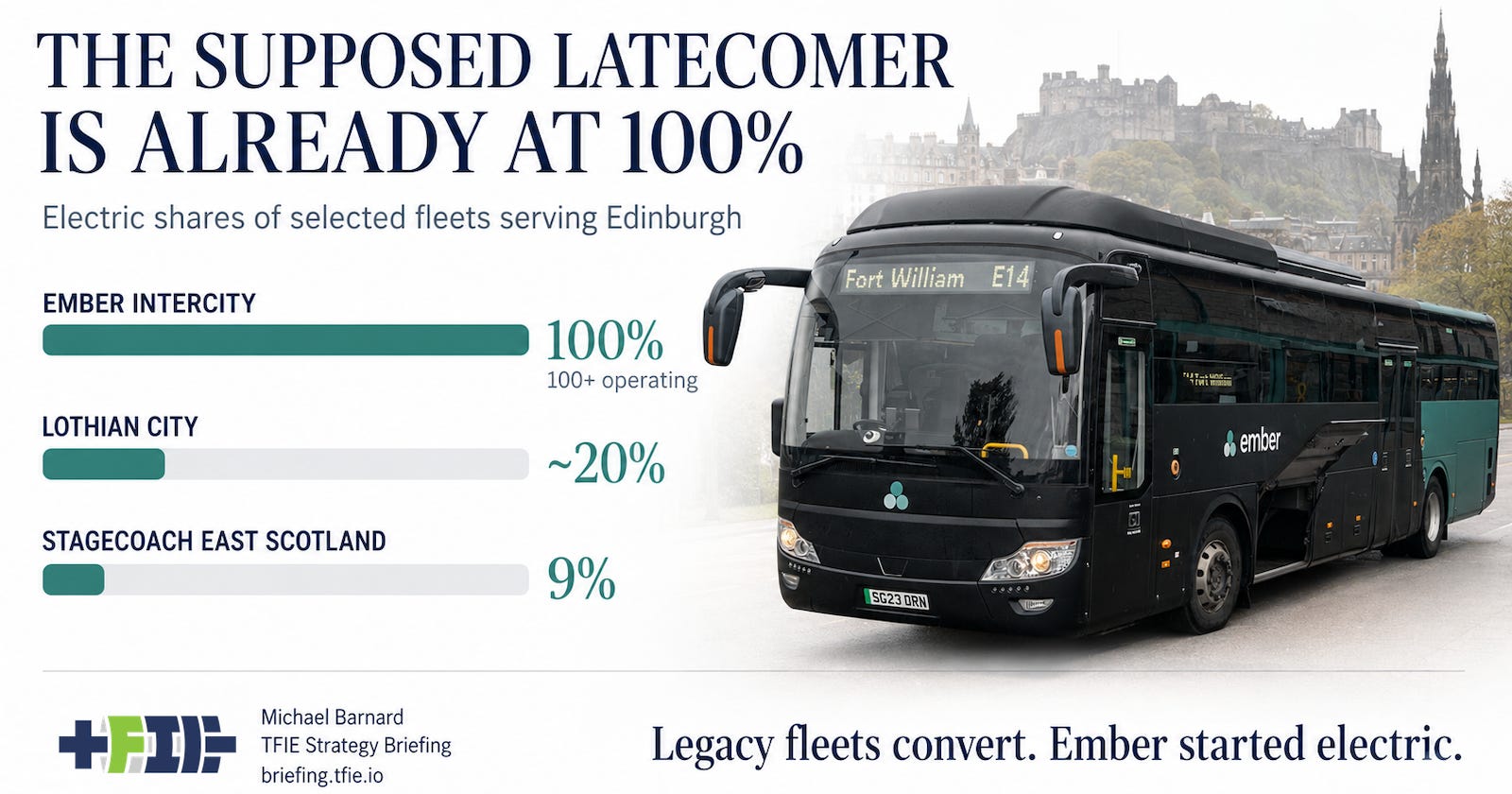
Lothian, the publicly owned operator that dominates the city, is doing what a large urban transit company should now be doing. About one bus in five assigned to its main Edinburgh depots is battery-electric. Most are large Volvo double-deckers, which helps explain why they seem even more common from the pavement. Nine Wrightbus single-deckers entered service in June, and Scotland’s latest zero-emission bus funding round supports another 60 electric double-deckers for the operator.
The wider regional picture is less advanced. Stagecoach East Scotland reports 41 electric vehicles among 477 buses and coaches, or 9% across a territory extending well beyond Edinburgh. Smaller regional operators also enter the city, but there is no clean Edinburgh-specific denominator for their fleets. Pretending otherwise would produce a precise-looking number that meant very little.
Lothian’s pace makes sense for an inherited fleet. It must rebuild depots, secure electrical capacity, replace hundreds of vehicles and keep a dense urban network running throughout the conversion. Urban buses were always expected to be early battery candidates. They follow known routes, return regularly to controlled facilities and accumulate enough mileage to use lower energy and maintenance costs intensively.
The Yutong I saw belonged to Ember, an Edinburgh company that launched the UK’s first all-electric scheduled intercity coach service in October 2020. It began with two coaches running between Dundee and Edinburgh. Less than six years later, Ember has more than 100 electric coaches operating across Scotland.
The network now reaches Edinburgh, Glasgow, Dundee, Aberdeen, Inverness, Fort William, Oban and Thurso, serving airports, towns and smaller communities along the way. Several corridors run at frequencies that resemble a rail timetable more than a conventional coach excursion, including overnight and round-the-clock services. Over the year to January 2026, Ember reported carrying more than 1.5 million passengers and delivering over 120 million zero-emission passenger-km.
Scotland makes that result more demanding than the same fleet operating on a flat, low-relief network. Ember’s Edinburgh–Fort William route passes through Lochearnhead, Tyndrum and Glencoe, while its western and Highland services reach Oban, Inverness and Thurso. A loaded coach climbing repeatedly through that terrain draws much more power than one crossing the Dutch lowlands. Regenerative braking recovers part of the energy on the descent, but not all of it. Scotland’s winters add another operational load: temperatures around freezing require battery conditioning and sustained heating of a large passenger cabin, reducing the margin available for propulsion. Intercity coaches lose less heat through frequent door openings than urban buses, but Ember must still preserve range, charging and timetable resilience across cold, windy and hilly routes. This is not a conveniently flat, mild demonstration corridor.
That scale overturns the expected sequence. Battery coaches were widely assumed to trail city buses through another cycle of battery improvement. Ember did not wait.
Its coaches can travel up to about 350 miles—Scotland still has an imperial system hangover, never having completed the transition to metric—on one charge, according to the company, but the business is not built around extracting one heroic journey from each battery. Vehicles charge several times a day and can cover almost 200,000 miles annually. Ember operates charging facilities in Dundee, Aberdeen, Inverness, Oban, Thurso, Fort William and Perth, with chargers rated at up to 300 kW and further sites planned.
The timetable, charging network and booking system reinforce one another. Many intermediate stops require advance booking, often only ten minutes ahead. When nobody has booked, the coach bypasses the stop, preserving journey time and avoiding an unnecessary diversion. Vehicle allocation and charging can be planned against routes whose distances, termini and likely dwell times are known.
That makes scheduled intercity service a different problem from unrestricted touring. A charter coach may spend several days following a customer’s itinerary, with uncertain stops, changing routes and no assured high-power charging. Ember controls its network and knows where its coaches should be throughout the day. Charging is part of the timetable rather than an external inconvenience.
This does not make every coach duty easy to electrify. Long tours, irregular charter work and multi-day itineraries remain harder. Ember has shown something narrower and more consequential: scheduled regional and intercity coach service is already a practical battery market when routes, vehicles, terminals, charging and software are planned together.
The procurement also exposes an industrial gap. Lothian’s electric purchases draw on Volvo, Wrightbus and Alexander Dennis. Ember buys complete coaches from China’s Yutong because established British and European manufacturers did not have a comparable battery-electric coach available when the company needed one.
Ember says it repeatedly approached Alexander Dennis, Scotland’s major bus manufacturer, and was told that no suitable product was available or planned. Yutong had one and continued developing it with the operator. That is Ember’s account, but the resulting order book makes the missing domestic product visible.
Scotland’s latest zero-emission bus programme now supports another 100 Yutong coaches and 43 chargers for Ember. The £53.8 million project includes £13.2 million of public funding and £40.6 million of private investment. The planned purchase is approximately the size of Ember’s current operating fleet.
The same funding round supports 60 more electric buses for Lothian and 44 zero-emission vehicles for Stagecoach. Scotland is backing two different transition models at once: conversion of large established fleets and expansion by an operator that started with batteries.
Lothian is replacing an inherited fleet while keeping Edinburgh moving. Ember started with an electric coach and built the operation around it. The electric double-deckers show an established transit system changing. The coach beside the bus station is already doing the work many assumed would come later.
Subscribe to TFIE Strategy Briefing. Use it as your due-diligence layer for transit electrification: fleet denominators, procurement evidence, charging constraints, operating economics, and the difference between announcements, orders and vehicles in service.