

RheEnergise has built working high-density pumped hydro in Devon. That deserves to be stated plainly because Cornwood is a real engineering achievement, not another storage technology represented by attractive renderings and performance claims. The company built upper and lower reservoirs, installed pipes, pumps and generating equipment, manufactured hundreds of cubic metres of its R-19 dense fluid, pushed it uphill and then ran it back through a turbine. The plant reached its design power of 500 kW.
Unfortunately, power is not the main value proposition of pumped hydro. Energy is. Cornwood was originally designed to run at 500 kW for four hours. Problems producing enough acceptable high-density fluid led RheEnergise to cut the intended inventory from 1,420 m³ to 540 m³, reducing full-power operation to about 15 minutes. The finished demonstrator therefore proved roughly 0.125 MWh of full-power discharge rather than the intended 2 MWh. It also measured only 59% round-trip efficiency, before parasitic loads that had not yet been measured, according to the final government-funded demonstrator report.
There was little reason to debate whether an engineered mineral suspension 2.5 times the density of water could be used in hydroelectric machinery, and now RheEnergise has demonstrated that it can be. The real question has always been whether replacing water with that suspension improves the economics enough to justify manufacturing, transporting and maintaining it. Pumped hydro has been commercially useful for decades because its machinery can be attached to very large quantities of exceptionally cheap stored energy. Water is inexpensive, stable, non-abrasive and available by the millions of tonnes without developing an industrial mineral supply chain. Cornwood demonstrates the machinery needed to replace that unusually convenient working fluid. It does not yet demonstrate a reason to do so.
That sharpens the assessment I made in my 2024 review of RheEnergise and dense-fluid pumped hydro. I concluded that the technology would physically work. The concerns were cost, settling, abrasion, lower efficiency and the difficulty of competing with batteries at the relatively small scales RheEnergise was pursuing. I also inferred that barite and a clay such as bentonite were likely constituents.
We now know considerably more. A RheEnergise patent published in 2026 describes high-density fluids containing 70% to 90% weighting agent by mass, gives an explicit example containing 80% barium sulfate, or barite, and adds swelling clay, lignosulphonate, alkali and water. It also discusses intentional settling and subsequent remixing. The chemistry is very close to what I inferred. My earlier mass and cost calculation, however, was too favorable because I understated how much weighting mineral a 2.5-times-water-density suspension requires by mass. The better information makes the commercial problem larger.
RheEnergise’s response to my 2024 analysis concentrated heavily on siting. Its case was that high-density fluid allows the same energy to be stored with much less fluid volume, opening lower hills and smaller reservoirs than conventional pumped hydro requires. Its 2026 project report makes the commercial logic unusually explicit. The company models high-density hydro as cheaper than the other storage technologies it considers beyond roughly four hours, with one exception: conventional pumped hydro. Its proposition therefore depends heavily on reaching sites where ordinary pumped hydro supposedly cannot compete economically.
The relevant comparison is closed-loop, off-river pumped storage, not a great dam across a river or an Alpine valley flooded behind a wall. Australian National University researchers identified about 616,000 prospective off-river closed-loop sites globally with roughly 23,000 TWh of theoretical storage potential. These are GIS-screened prospects, not construction-ready projects, and detailed geology, grid connection, environmental assessment and economics will eliminate most of them. The scale of the surplus is nevertheless enormous. Vertical head matters greatly to an individual project, but globally it is not a particularly scarce resource.
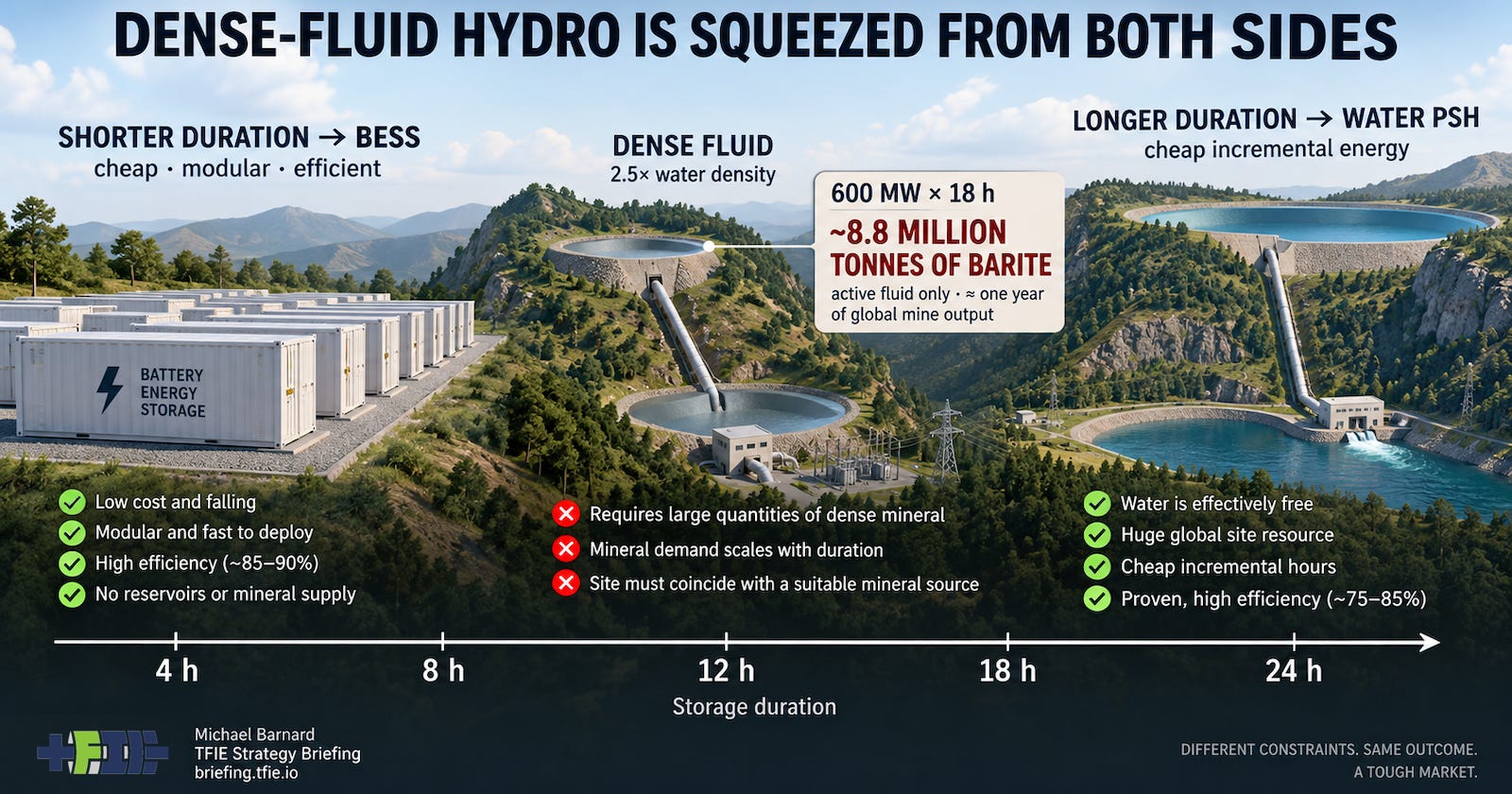
Consider a real long-duration pumped-hydro scale: 600 MW of power, 18 hours of storage, or 10.8 GWh, with three 200 MW machines and 400 metres of head. Assuming 90% generating efficiency, water requires about 11 million m³ of active reservoir volume. A fluid at 2.5 times water’s density requires about 4.4 million m³. Using representative screening assumptions of 20 metres average reservoir depth and 85% usable volume, the two water reservoirs together occupy about 1.3 km² of surface, while the dense-fluid reservoirs occupy about 0.52 km². That is a genuine advantage. Two reservoirs of roughly 65 hectares each shrink to roughly 26 hectares each.
The civil-engineering saving is much smaller than that 60% reduction in fluid volume suggests.