

I was halfway through Paul Feyerabend’s Against Method: Outline of an Anarchistic Theory of Knowledge when one idea started to bother me in a useful way. Not the slogan usually attached to the book, “anything goes,” which is more provocation than method. Not the defense of the Catholic Church in the Galileo affair, which reads as an overcorrection that treats Galileo’s rhetoric with suspicion while giving institutional coercion too much charity. The idea that stuck was counterinduction, because it named something I have been doing for years in climate, energy, industry, and transportation analysis, while also exposing that I have not always made the method visible enough.
Counterinduction is the deliberate testing of whether facts normally treated as support for a dominant theory may instead be artifacts of that theory’s assumptions, categories, instruments, or incentives, and may support a rival interpretation. In practical analysis, the fact is real. The meaning attached to the fact may not be. A pilot project can be evidence of progress, or evidence that the technology cannot escape the pilot stage. A grant can show strategic importance, or it can show that private capital will not carry the risk. A large orderbook can show market pull, or it can show policy hedging.
That is different from ordinary induction. Induction says that because a pattern has repeated, we should expect more of it. Counterfactual reasoning asks what would have happened under a different causal path. Counterinduction asks a third question. What if the evidence used to show hydrogen buses are maturing is evidence that the market is not maturing at all? The same fact can sit inside three different arguments. More hydrogen bus pilots can mean learning. They can invite the counterfactual question of what battery-electric buses would have done with the same subsidies. They can also invite the counterinductive question of whether more pilots after decades of effort are a sign of non-convergence.
Climate and energy analysis needs this because the transition is full of numbers that look meaningful before they have earned that status. There are project counts, memoranda of understanding, demonstration plants, patents, announced capacity, grant awards, small fleets, first-of-a-kind facilities, offtake agreements, levelized cost projections, and policy targets. None of these are useless. Many are early signals worth watching. The mistake is allowing the proponent’s interpretation to travel with the number as if it were part of the number. Ten pilots are not 10 proofs of commercial readiness. They are 10 observations requiring classification.
Hydrogen transport is the cleanest example. The usual reading is that more hydrogen bus, truck, train, aviation, and maritime projects show a technology climbing the maturity curve. The rival reading is that repeated pilots across many transport modes show failure to converge on a durable use case. If the optimistic view is right, we should see repeat orders from operators without special subsidies, high vehicle availability, ordinary maintenance regimes, high station utilization, delivered fuel costs approaching alternatives, and private firms carrying normal business risk. If the rival view is right, we should see small fleets, cancellations, low station utilization, high fuel costs, maintenance issues, and proponents shifting from one niche to another as each earlier niche disappoints.
The evidence has been much closer to the second pattern. Hydrogen buses have been trialed in city after city, but battery-electric buses have moved into volume procurement. China alone has put hundreds of thousands of battery-electric buses on the road, while hydrogen buses remain a rounding error globally. Hydrogen trucks keep appearing in announcements, but battery-electric trucks are scaling where routes, depots, payloads, and charging can be matched. Hydrogen trains have a role only where electrification and batteries both fail, which is narrower than early stories implied. Hydrogen aviation remains crushed by energy density, aircraft integration, and infrastructure penalties. Hydrogen maritime demonstrations exist, but battery-electric and hybrid-electric vessels have moved much further in operations. The fact of hydrogen pilots is real. The claimed meaning is weak.
Small modular reactors show the same pattern in a different institutional setting. The usual reading is that government support, site selection, early regulatory work, and vendor announcements signal a coming new nuclear era. The rival reading is that those signals may show political insulation rather than market readiness. If small modular reactors are becoming commercial products, we should see firm orders from non-captive buyers, transparent prices, construction schedules that survive contact with reality, supply chains ready to build repeated units, and financing structures that do not hide first-of-a-kind risk inside public accounts. If they are politically protected technologies, we should see governments carrying the risk, costs moving upward, timelines slipping, designs multiplying, and proponents leaning on strategic language more than buyer economics.
That is not an anti-nuclear argument. It is a market-formation test. Large nuclear programs that worked historically had conditions of success: national priority, one or a few standardized designs, state-backed finance, large grids, experienced industrial bases, and often military or strategic alignment. Small modular reactors generally ask for the benefits of standardization before the units exist, the benefits of factory production before the factories exist, and the benefits of learning curves before there are enough orders to learn from. The counterinductive question is whether policy attention is proof of market arrival, or proof that the market has not arrived without policy protection.
Maritime fuels forced me to apply the method to my own work. For some time, I treated methanol’s orderbook and dual-fuel momentum with skepticism. The proponent’s inference was that methanol was becoming the shipping fuel of the future. My rival reading was that the supply of low-carbon methanol was tiny, expensive, and competed poorly against batteries and biofuels. That was not a bad argument. It was incomplete, because I had stopped the counterinductive work too early.
The system-level merit order changed the conclusion. Aviation will bid hard for limited biological oils because long-haul flight has fewer options. Batteries will take more short-sea, inland, and port-adjacent maritime work than many shipping fuel models assume. Longer-route shipping still needs a practical liquid molecule, and biomethanol moved up the ranking once the competition for feedstocks and the split between electrons and molecules were put into the same frame. That update matters. A method that never changes the analyst’s mind is not a method. It is a costume. Counterinduction should generate rival interpretations, not lock in the analyst’s first inversion.
Battery-electric maritime vessels show another useful aspect of the method: denominator discipline. English-language coverage has often given disproportionate attention to hydrogen vessels because they are novel, visible, and aligned with large hydrogen strategies. The counterinductive question is whether novelty is being mistaken for significance. If there are perhaps dozens of hydrogen or hydrogen-adjacent commercial vessels and more than 1,000 battery-powered vessels operating or under construction, the denominator changes the story. The relevant comparison is not press releases. It is vessels in service, useful work performed, installed battery capacity, route fit, repeat orders, and whether the vessels are doing propulsion work rather than just hotel loads.
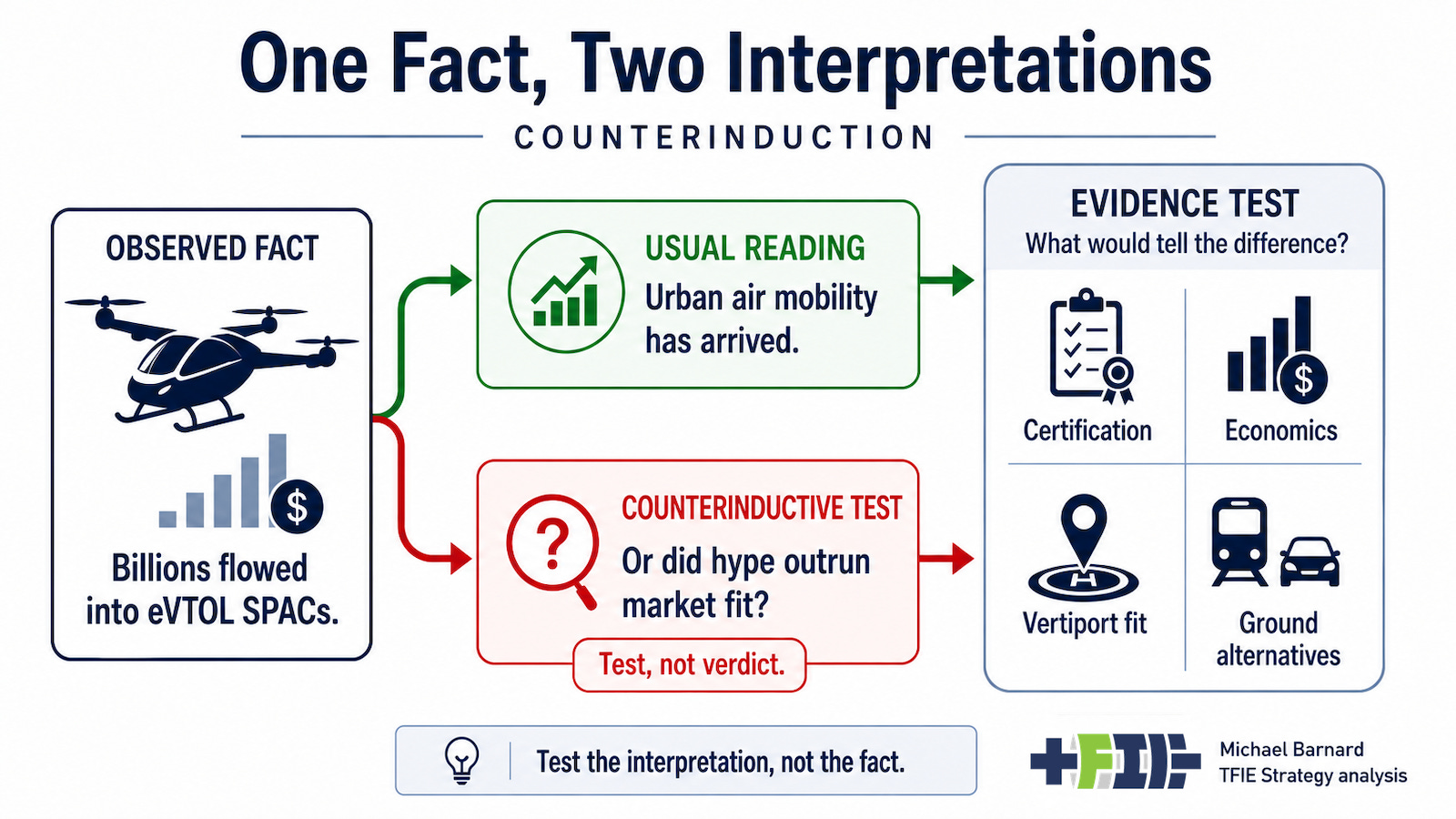
A similar distinction matters in aviation. Electric aviation is not one thing. Urban air mobility, advanced air mobility, regional air mobility, eVTOLs, eCTOLs, and hybrid CTOL aircraft are too often collapsed into one bucket. The hype-cycle interpretation was that vertical takeoff air taxis were the visible edge of an electric aviation revolution. The rival reading is that eVTOLs attracted attention because they looked futuristic, while the practical early market was more likely to be runway-based regional aircraft using existing airports.
The evidence points toward the runway-based option being more credible. eVTOLs face certification burdens, downwash, noise, vertiport constraints, insurance questions, low passenger throughput, short ranges, and expensive urban real estate. Vertical lift is costly physics. Runways are already paid-for infrastructure. Fixed-wing electric conventional takeoff and landing aircraft have a simpler proposition. Use existing underused small airports. Fly short regional routes. Avoid vertical-lift energy penalties. Let batteries improve. Hybrid CTOL aircraft may bridge larger regional missions by using electric propulsion for most energy and liquid fuels for reserve, diversion, and range extension. Counterinduction helps separate the glossy category from the practical one.
Wave energy is another field where the ordinary signal can reverse. The usual reading is that recurring prototypes show persistence, innovation, and a sector getting closer to commercialization. The rival reading is that recurring prototypes show non-convergence. After decades, if devices keep changing shape, mooring, power take-off, survivability assumptions, and market story, that may be evidence that the ocean is breaking the economics faster than engineering can repair them. Salt water corrodes. Storms overload. Fouling accumulates. Maintenance windows close. Subsea cables, moorings, and moving parts face loads that solar panels and wind turbines do not. The test is not whether a prototype can generate electricity. The test is multi-year survival, maintainability, capacity factor, insurance, grid connection, repeat procurement, and cost against offshore wind, solar, storage, transmission, and demand flexibility.
Long-horizon projections through 2100 create a harder problem. I have published decade-by-decade views on hydrogen demand, aviation, shipping tonnage, steel, cement, biofuel allocation, and ground transport electrification. For those, counterinductive evidence arrives slowly. We cannot wait until 2070 to ask whether the model is useful. The answer is to track early-warning indicators. The projection is not judged only at the end point. It is reviewed through the signs that should appear along the way.
For aviation, those indicators include passenger demand, efficiency, contrail policy, airport electricity demand, battery energy density, hybrid aircraft progress, and sustainable aviation fuel supply. For steel, they include scrap availability, electric arc furnace shares, direct reduction pathways, material efficiency, construction demand, and China’s steel plateau. For cement, they include clinker substitution, electrified heat, carbon capture economics, alternative materials, and actual concrete demand. For hydrogen demand, they include refinery decline, ammonia pathways, fossil-fuel processing decline, direct electrification in heat and transport, and whether proposed new uses become durable markets without permanent subsidy.
Hydrogen demand through 2100 is a good example. The dominant assumption in many strategies is that hydrogen demand will grow because hydrogen can be used in many sectors. The counterinductive interpretation is that the largest existing sources of demand will shrink as refining declines, fossil-fuel processing falls, ammonia production changes, and direct electrification wins in transport and heat. End-use possibility is not demand. Demand requires a buyer, a price, infrastructure, conversion efficiency, and an alternative that is worse. If low-carbon hydrogen gains large, durable markets in steel, shipping fuels, chemicals, or seasonal storage, the projection changes. If demand remains concentrated in legacy uses while proposed new uses keep failing cost tests, the decline thesis strengthens.
There are failure modes. The first is inversion bias, where the analyst assumes the opposite of the mainstream is smarter. It is not. Sometimes the obvious interpretation is right. Solar deployment did signal learning. Battery volume did signal cost decline. Wind turbine scaling did create cheaper electricity until siting, transmission, and supply-chain constraints became more important. The second failure mode is enemy-only skepticism. If counterinduction is applied only to hydrogen, nuclear, carbon capture, and wave energy, it becomes a habit of opposition. It has to be applied to favored technologies as well, including batteries, heat pumps, transmission, grid-enhancing technologies, and China’s clean-tech scale.
The third failure mode is denominator abuse. A technology can be irrelevant at system scale and still useful in a niche. The correct answer is sometimes “small but real,” not “meaningless.” Forklifts in large controlled warehouses gave hydrogen one of its few transport niches because the operating environment, refueling pattern, and legacy lead-acid battery constraints made the comparison different for a time. The fourth failure mode is reference-class blindness. Some technologies escape old patterns because a material constraint changes. Solar, wind, and batteries did. The fifth failure mode is delayed updating. Once evidence shifts, the analyst has to move. Methanol for shipping was a useful reminder of that.
The practical answer is a prediction and update ledger, which is less a spreadsheet than a memory system for claims. Each serious claim needs a date, the usual interpretation, the rival interpretation, a confidence level, evidence that would strengthen it, evidence that would weaken it, a review date, and current status. Long-horizon projections need leading indicators and update triggers. Changed views need a source chain, because reversals are more useful when they are explicit than when they are buried as tone changes across articles.
That ledger would have caught several things more cleanly in my own work. It would have separated hydrogen transport skepticism from hydrogen demand projections. It would have split electric aviation into eVTOL failure, eCTOL regional air mobility, and hybrid CTOL bridging. It would have treated methanol shipping as a reversal rather than a minor edit. It would have distinguished a denominator correction, such as overstating the battery ferry orderbook share, from a thesis failure. It would also force a regular question that is easy to avoid in narrative analysis: what evidence would make me change my mind?
Counterinduction does not replace evidence. It improves the questions asked of evidence. It slows the jump from fact to interpretation. It asks whether a progress signal is progress, whether a failure signal is failure, and whether the category being used is doing more work than the data. In a transition involving trillions of dollars, decades of infrastructure, and large differences between technologies that look similar from a distance, that is not philosophical decoration. It is basic analytical hygiene.
Counterinduction is one of the practical disciplines behind TFIE Strategy Briefing: starting from incentives, constraints, denominators, and institutional behaviour rather than polished claims. Paid subscribers get that method applied across power, fuels, transport, industry, storage, and critical minerals, with evidence notes, scorecards, update triggers, and strategy implications behind the public argument.