

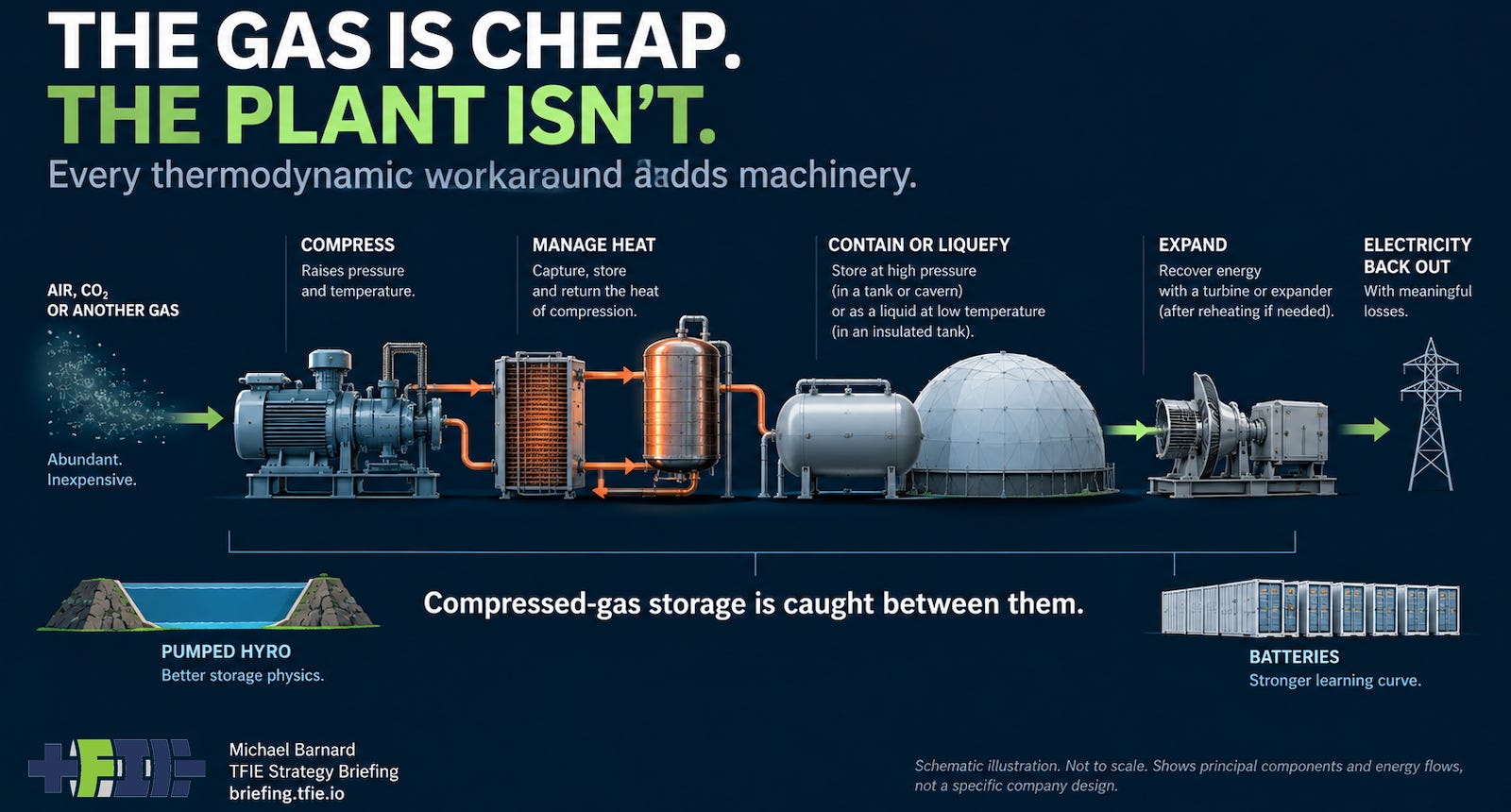
In May 2024 I argued that compressed-gas electricity-storage claims were mostly hot air. The article spent more time with thermodynamics and phase diagrams than with startups because the weaknesses of compressed air, liquid air and compressed or liquefied CO₂ begin with the working fluids. Gases heat when compressed, cool when expanded and occupy inconveniently large volumes unless they are pushed to high pressure or across a phase boundary. Every attempt to recover the energy that would otherwise disappear as heat or cold adds equipment, interfaces and capital.
Two years later there is enough new hardware to ask whether that assessment has aged badly. China has commissioned compressed-air storage at hundreds of megawatts. Energy Dome has built a full-scale CO₂ Battery in Sardinia. Highview Power has finally moved commercial-scale liquid-air storage into construction, while Hydrostor has taken a 500 MW / 4 GWh advanced compressed-air project through California’s permitting process. At first glance this looks like the kind of evidence that should force a substantial correction.
It mostly does not. The original criticism was never that sufficiently competent engineers could not force a gas through a complicated thermodynamic loop and recover electricity later. Germany’s Huntorf plant had already been operating for decades, and Alabama’s McIntosh plant followed it in the 1990s. The question was whether adding pressure, thermal storage, refrigeration, phase change, caverns, vessels and turbomachinery created a better grid-storage proposition than alternatives which start with either better physics or much stronger manufacturing economics.
There are a few technical points I would change. Advanced adiabatic compressed-air storage appears capable of somewhat better efficiency than I expected. China reports about 71% conversion efficiency for its Huai’an project, so the upper end of my earlier CAES expectations was too pessimistic if that number persists under long-term commercial operation. I was also too categorical about supercritical CO₂ turbomachinery. And when I said compressed-gas storage would not “scale,” I should have distinguished the physical size of one installation from large-scale market replication. Engineers can plainly build enormous individual systems.
Those corrections leave the strategic comparison largely intact. Pumped hydro is also heavy civil engineering, but it begins with a mature cycle around 80% round-trip efficiency and stores energy by changing the elevation of liquid water. It does not need a heroic experience curve to overcome weak thermodynamics. Batteries approach storage from the opposite direction: significant site work remains, but cells, racks, containers, inverters and controls are products of an enormous manufacturing system. The IEA reports that average global BESS prices in 2025 were roughly one-third of their 2020 level.
Compressed-gas storage is caught between them. It carries much of the engineering and construction burden of infrastructure without pumped hydro’s efficiency, while competing with batteries without anything close to their manufacturing volumes or learning mechanism. A fifth compressor train can be better specified than the first, and repeated plants can reuse engineering, procurement and construction methods, but that is FOAK-to-NOAK improvement. It is not a battery experience curve. Excavation, pressure vessels, thermal stores, piping, heat exchangers, foundations and field commissioning remain infrastructure.
Two more years of projects therefore make the old argument easier to audit rather than harder to defend. Below the paywall I return to the phase diagrams, then look at what China’s giant CAES plants actually establish, why Hydrostor still resembles inefficient pumped hydro with more machinery, why liquid-air storage remains trapped in a refrigeration problem, and whether Energy Dome’s efficiency, cost and thirty-year durability claims have acquired evidence proportional to the capital invested in them.