

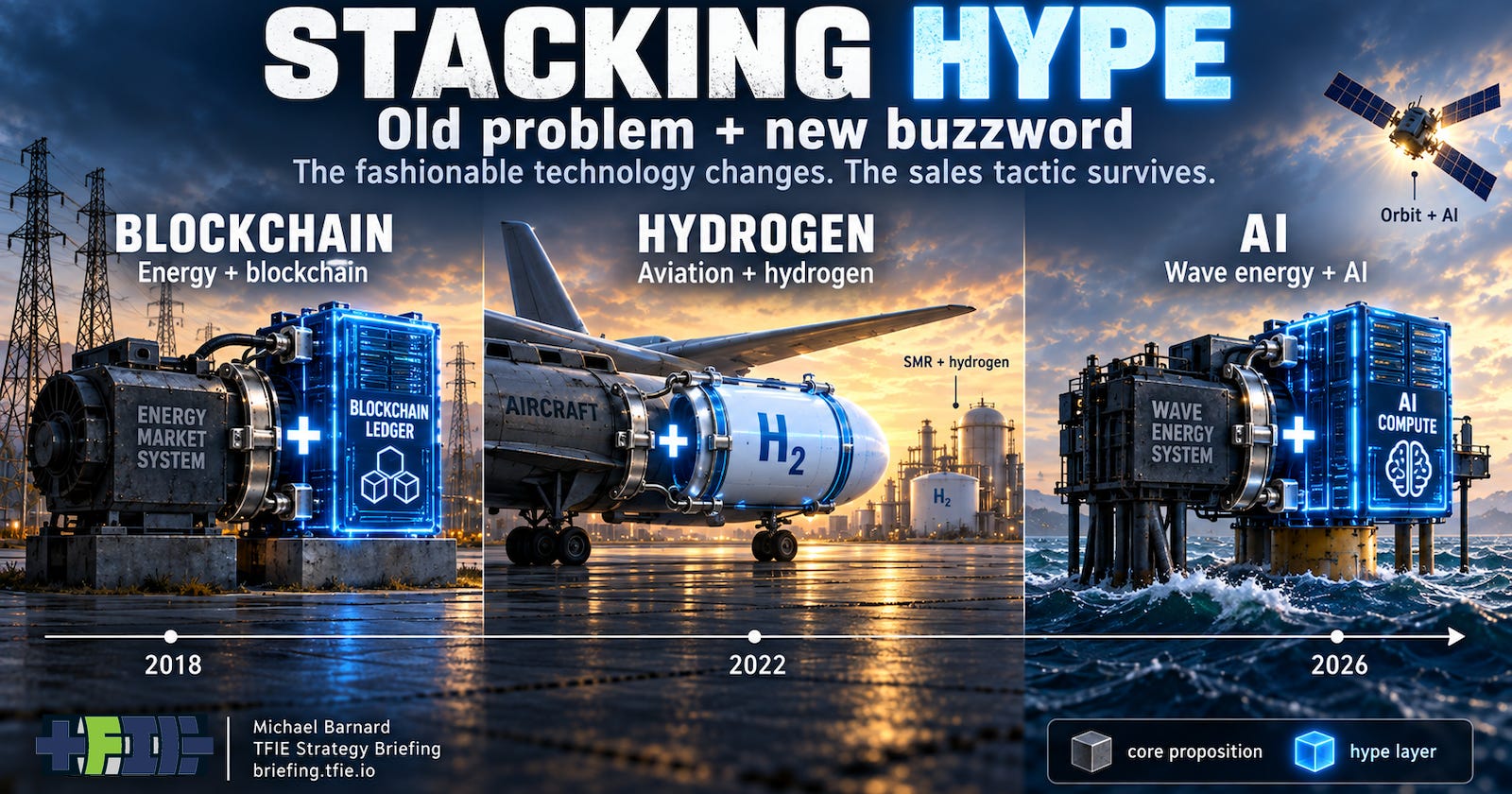
In 2026, AI has become the latest technology capable of making an old engineering problem sound new. Panthalassa raised $140 million around the idea of putting AI inference compute at sea with wave-energy machines, while SpaceX has proposed an enormous orbital computing architecture powered by solar energy. Both propositions begin with legitimate constraints: AI data centers require electricity, land, cooling and grid connections, and the last of those can take years. The unusual move is answering those problems by attaching a second industrial system whose own economics and operating constraints are unresolved. Wave energy gains relevance because AI needs electricity, while offshore AI gains relevance because wave machines make electricity offshore; orbital infrastructure gains relevance because AI wants power, while orbital AI gains relevance because sunlight is abundant in space. Each side of the proposition lends glamour to the other before the combined system has demonstrated that it is better than the mundane alternative.
I had seen the pattern before. In a March 2023 CleanTechnica article, “Two Wrongs Don’t Make A Right: Adventures In Multiplying Hype”, I wrote about what looked like an unusually rich crop of technology combinations. The trigger was Destinus and public support for work associated with liquid-hydrogen supersonic passenger aircraft. Supersonic passenger travel already had severe energy, noise, propulsion, certification and market-size problems; hydrogen added cryogenic storage, bulky tanks, a new fuel system and airport infrastructure. Around the same time, Aptera was trying to make an unconventional three-wheel car more compelling by covering it in solar cells, Gravitricity was adding underground hydrogen storage to its mine-shaft gravity-storage story, and hydrogen was finding its way into an already speculative eVTOL market. Blockchain was still being added to electricity markets whose real constraints remained wires, meters, regulation and physical power flows. I treated those examples mostly as comedy. Three and a half years of outcomes make them much more useful as evidence of a recurring commercialization strategy.
Destinus is particularly revealing because the company did not simply disappear. Its commercial centre moved toward defence, autonomous systems and missile technology, and by 2026 Rheinmetall and Destinus were building a missile-system joint venture. That outcome says something useful about the original proposition. Aerospace engineering, propulsion, autonomy and high-speed flight can have valuable markets without hydrogen supersonic passenger travel ever becoming a sensible product. Destinus found customers prepared to pay for range, payload, speed, manufacturing and operational capability in a very different context. Its survival did not vindicate the hydrogen-supersonic combination; it demonstrated that the underlying engineering capabilities had value once they were separated from a futuristic passenger-market narrative whose fuel, vehicle, infrastructure and certification requirements all had to mature together.
Aptera has done much less to escape the original criticism. The company now has production-intent validation vehicles and has reported good solar-generation results under favourable Southern California conditions, but the commercial denominator is still where cars actually spend their days. Garages, residential parkades, office parkades, covered parking, buildings and tree cover all reduce the useful solar contribution, so the owner who regularly captures something close to the showcase yield needs a sunny climate and a great deal of unshaded outdoor parking. Detached ranch homes with open driveways and workplaces surrounded by exposed asphalt certainly exist, but that combination of housing, climate and parking behaviour is not an automotive market large enough to make body-integrated solar a compelling mass-market feature. Conventional EV manufacturers have meanwhile continued lowering drag while retaining five seats, conventional crash structures, useful cargo space and ordinary consumer utility, which makes Aptera’s extreme efficiency less strategically distinctive than the company’s story requires.