

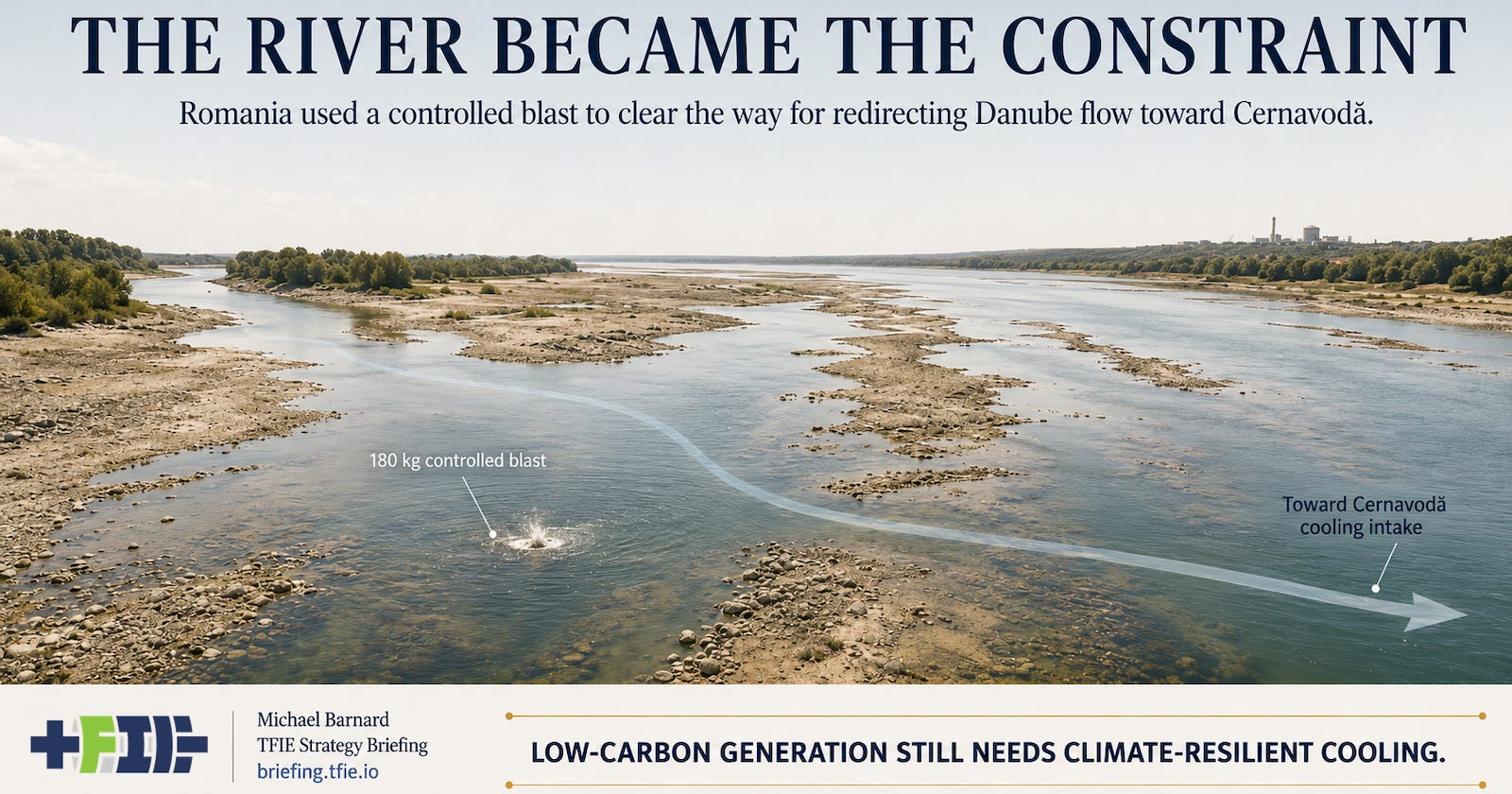
On 3 August, Romanian naval engineers used 180 kilograms of explosives to remove a rock outcrop in the Bala Canal, a branch of the Danube. The controlled blast cleared the way for construction of a temporary dam intended to direct more water into the river channel serving the Cernavodă nuclear plant. One of Romania’s two reactors had already stopped as Danube flow fell to about 1,500 cubic metres per second, less than one-third of the normal July level, leaving the country trying to preserve the remaining unit through emergency river engineering.
The intervention made a normally hidden dependency visible. Nuclear reactors produce heat continuously and require somewhere to reject the larger quantity of waste heat that does not become electricity. Fuel supply may be largely insulated from weather, but the cooling systems, intake structures and environmental permits of river-cooled plants are tied to local hydrology. Much of Europe’s existing nuclear fleet was designed around historical ranges of water temperature and flow that are becoming less dependable.
The national consequences are much larger than a Europe-wide fleet percentage suggests. The most severe documented exposure is in Hungary, where the four-reactor Paks plant normally supplies 45.2% of national generation. By the morning of 4 August, the plant had been reduced from 1,916 MW to one 240 MW turbine, leaving nuclear capacity equivalent to approximately 39.5% of Hungary’s normal annual generation unavailable. A complete stop would expose the full 45.2% nuclear share.
Romania’s loss of one 650 MW Cernavodă unit represented about 10.3% of normal national generation on the same annual-equivalent basis. France reached a similar national figure through a much larger absolute reduction in July, when heat constrained more than 9 GW across 12 of its 57 reactors. The reduction was 14.6% of French nuclear capacity, equivalent to about 10% of normal national generation given France’s 68.1% nuclear share. Both Beznau units in Switzerland were shut during the July heatwave when the Aare reached 25°C, representing approximately 6.7% of normal Swiss generation.
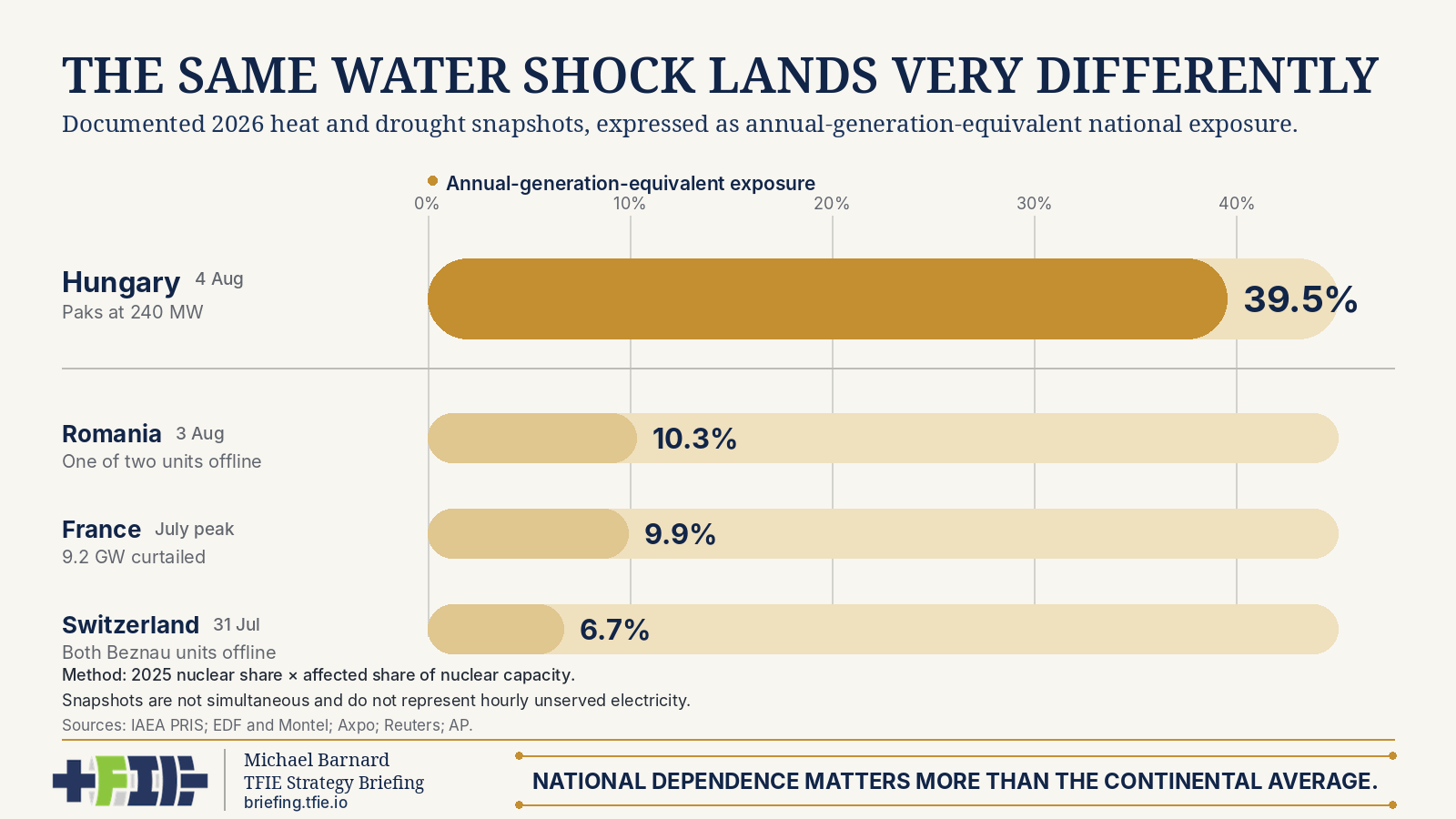
Those figures are comparison indicators, not synchronized measurements of electricity actually lost. Hungary and Romania reflect conditions on 3–4 August, while France and Switzerland reflect their July peaks. Each value multiplies the country’s 2025 nuclear generation share by the proportion of nuclear capacity constrained at that snapshot. The method is intentionally simple, but it shows why a moderate continental effect can become a national emergency when a country depends heavily on one plant or river.
Two mechanisms are operating. France and Switzerland primarily faced hot-water constraints. Cooling water returned to an already warm river can push downstream temperatures above environmental limits, so plant operators reduce output or stop reactors to protect river ecosystems. Axpo reduced and subsequently shut the Beznau units when the Aare reached 25°C, while French plants along several rivers reduced production as temperatures crossed site-specific limits.
Hungary and Romania faced insufficient river flow as well as heat. Paks and Cernavodă require adequate water level and flow at their intake systems to operate at power. Record-low Danube levels forced Paks down to just over 10% of capacity and removed half of Cernavodă’s nuclear fleet. The reactors were shut or reduced safely; the power-system problem was that safe operation still removed large blocks of electricity during peak cooling demand.
Human-caused warming is clearly present in the heat component. World Weather Attribution found that the June western European heatwave was about 3.5°C hotter during the day than the same circulation pattern would have produced in the 1976 climate, and about 2°C hotter than a comparable event in 2003. No attribution study has calculated exactly how many megawatt-hours of the French or Swiss nuclear reductions would have remained available without climate change, but the water-temperature thresholds were being crossed in a heat regime substantially intensified by fossil-fuel emissions.
Attribution of the Danube’s low flow is less direct. Eastern Europe entered 2026 with persistent rainfall deficits, but the observed six-month precipitation trend was not statistically robust enough to assign the missing rainfall primarily to climate change. Warming had a much clearer influence on the rate at which the atmosphere pulled moisture from vegetation and soils. The January-to-June eastern European soil-moisture drought became about 11 times more probable because of human-induced climate change, while the extreme potential evapotranspiration became about 40 times more likely and about 8% more intense. Conditions of similar rarity in a climate 1.4°C cooler would have produced moderate rather than extreme drought in eastern Europe.
The defensible interpretation is that natural variability contributed much of the initial rainfall deficit while climate change materially deepened the resulting drought. That does not establish an anthropogenic percentage of the Danube’s missing cubic metres. It does establish that a dry period now loses more water to heat, reaches severe soil-moisture deficits more readily and is more likely to push river-dependent infrastructure across operating thresholds.
The electricity-system problem is the correlation among impacts. Extreme heat raises demand for air conditioning while warming cooling water, increasing evaporation and reducing river flow. Hydropower production falls with depleted rivers, gas turbines lose some output in hotter air, and persistent high-pressure weather can bring weak wind. Reuters reported European summer electricity prices reaching levels usually associated with winter stress as cooling demand increased and French nuclear output was reduced by more than 9 GW.
Air conditioning cannot be treated as a uniformly disposable load during a severe heatwave. Hospitals, care homes, cooling centres and vulnerable households require reliable electricity precisely because the heat is dangerous. The more useful flexibility is found first in industrial production, commercial loads that can be rescheduled, storage, imports and safe thermostat adjustments. Hungary’s voluntary conservation effort reduced demand by 700 MW on 2 August, nearly three times the output of the final Paks turbine, demonstrating that contracted or coordinated demand reduction can provide more immediate capacity than the reactor output still being defended.
Nuclear generation is not uniquely exposed to climate change. Hydroelectric, gas, coal, biomass, transmission and renewable generation all have different weather and climate dependencies. Nuclear’s exposure is unusually consequential because individual units are large and some national systems concentrate much of their electricity production at a single site. Its high historical capacity factors remain valuable, but they do not remove the need to plan for correlated periods of high temperature, low water and high demand.
This matters directly for reactor life extensions. Evaluations that add another 20 or 30 years of operation should use forward projections of river temperature, seasonal flow and extreme low-water events rather than treating the historical record as stationary. The engineering options include modified intakes, additional pumping, cooling towers, hybrid or dry cooling, and revised operating limits, each with costs and efficiency penalties that should be included in the life-extension case.
The grid response is broader than plant adaptation. Stronger interconnection reduces dependence on one national fleet, batteries and demand response cover the evening period when cooling demand remains high and solar production falls, and additional solar generation supplies electricity during many of the hottest daytime hours without depending on river flow. Planning also has to recognize that nuclear and hydro constraints can occur together across the same watershed rather than treating each generator’s risk independently.
Romania’s river intervention does not show that nuclear power has ceased to be a useful low-carbon resource. It shows that a reactor can be technically sound while its inherited cooling assumptions become less reliable. Climate resilience for legacy nuclear generation now belongs inside capacity planning, life-extension economics and grid design, not in an environmental appendix written after the major investment decisions have already been made.
Free posts carry the public argument. Paid TFIE Strategy Briefing posts provide the professional layer: denominator checks, evidence notes, update triggers and decision-grade context for grids, generation and climate resilience.
Good point. We forget (or at least I do) that nuclear power generation produces rejected heat just as any other thermal generation process does.
Meanwhile, a top comment in the WSJ is the climate change hoax. There should have been a moon-shot pivot to nuclear after the '72 oil crisis.