

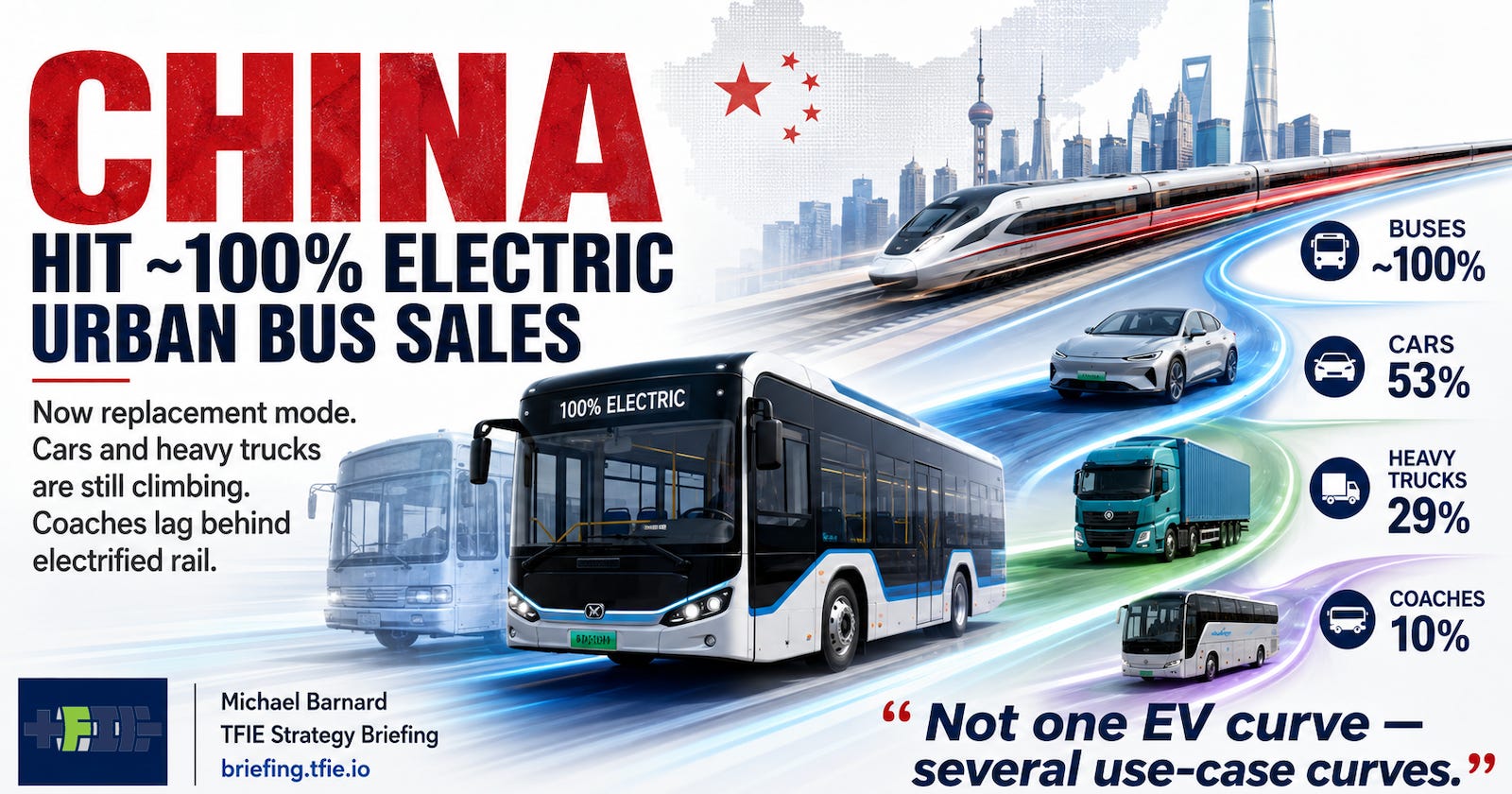
China has crossed an electric-vehicle milestone that is less flashy than another record sales number and more important. New urban buses are now essentially 100% electric. In many Chinese cities, the procurement question is no longer diesel versus battery. It is which electric bus replaces the electric bus already in service. The International Energy Agency says almost 70% of China’s more than 680,000 electric buses were deployed before 2020 and sees the recent rebound in sales partly as replacement of those older fleets.
That is what a mature transition looks like. The first big electric cohorts are aging out and the replacement cycle remains electric. Policy has not disappeared; its role has shifted toward renewing the fleet. China’s 2025 national programme explicitly subsidized replacement of new-energy city buses and even complete traction-battery replacement, and the equipment-renewal programme continues in 2026.
The useful denominator is therefore not “Chinese EVs.” It is the share of new sales inside each transport use case. City buses, passenger cars, heavy trucks and intercity coaches are all road vehicles, but operationally they are separate markets. They run different distances, stop in different places, have different charging options, earn or save money in different ways and face different competitors. Put them on one national EV curve and those distinctions vanish. Plot sales share by use case and the transition becomes much easier to read.
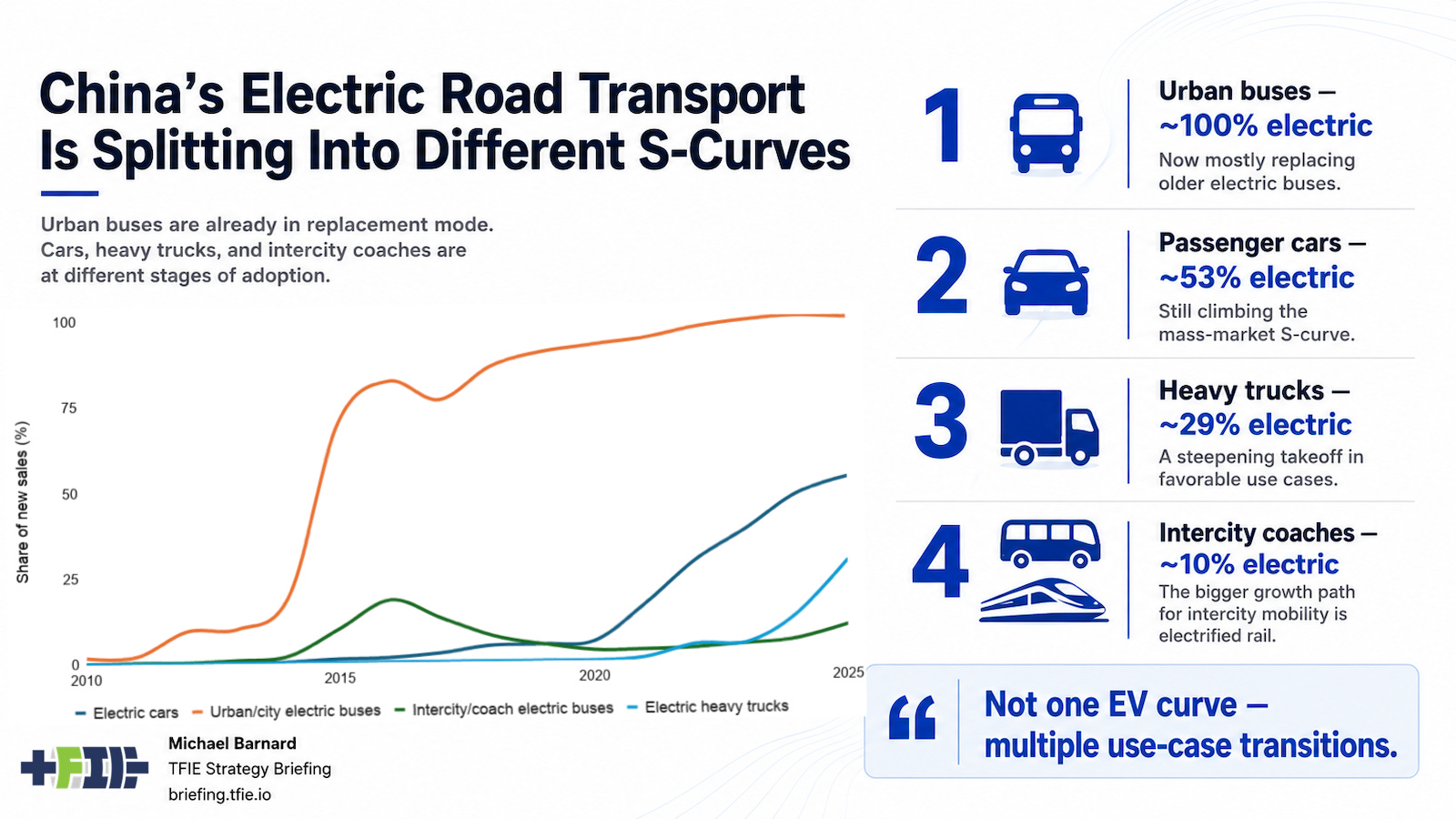
Passenger cars are already well into the mainstream. Electric cars accounted for just over half of Chinese new-car sales in 2025. China also had nearly 700 electric car models available by year end, more than the number of conventional models, and the IEA estimates that nearly 70% of battery-electric cars sold there were cheaper than comparable conventional cars even before incentives. The car curve is still rising, but electric is no longer the alternative drivetrain in China. It is one of the normal choices buyers see across the market.
Heavy trucks are farther down the curve and moving faster. Electric heavy-freight trucks reached about 29% of sales in 2025, roughly double their 2024 share. The strongest uptake is in applications with short or predictable routes around ports, mines, steel plants and industrial hubs, where high utilization makes fuel and maintenance savings matter quickly and charging or battery swapping can be organized around the work. Heavy trucks still trail cars in sales share, but their current slope is much steeper.
Intercity coaches are the revealing exception. Battery-electric coaches were only about 10% of Chinese coach sales in 2025. ICCT counted roughly 13,700 of them, up 66.7% from 2024, so this is no dead market. But it would be a mistake to assume that the destination is simply the city-bus curve shifted a decade to the right. Coaches have a harder duty cycle and, more importantly, they compete with a mode China electrified long ago.
China ended 2025 with more than 50,000 km of high-speed rail, and its railways carried more than 4.5 billion passenger trips during the year. High-speed rail reaches 97% of Chinese cities with more than 500,000 urban residents, with one-to-two-hour travel possible across many 500 km city clusters and roughly four-hour trips across 1,000 km corridors. Battery coaches can replace diesel coaches where road service remains useful, but the larger growth path for intercity passenger mobility does not have to be another road vehicle. Much of it is already rail.
For countries that are years behind China, that changes the forecasting problem. A low electric share today does not imply a slow linear climb toward China’s current share. China’s heavy-truck market shows how quickly a commercial segment can move when vehicle capability, infrastructure and operating economics align. Conversely, electrification does not require every vehicle category to reach the same endpoint. If rail takes more of the intercity work, coaches can electrify while the coach market itself remains bounded. The objective is not to maximize the electric share of every vehicle label. It is to provide mobility and freight with less fossil fuel.
The historical bus data deserve one caveat. Chinese sources have used overlapping definitions such as “new energy bus,” and successive IEA editions have changed classifications. The IEA’s 2026 edition explicitly revised China’s historical bus data using CATARC data to better match its current definitions. That is why the chart separates urban buses from coaches and why some older points are reconstructed rather than presented as a pristine official series. The exact shape in a given early year is less certain than the large pattern: city buses surged first and are saturated, cars followed, heavy trucks are now accelerating, and coaches remain much less electrified.
China’s transport transition is therefore a poor advertisement for one master EV adoption curve and a good advertisement for looking at useful work. Fixed-route urban buses went early because batteries fit the duty cycle and policy pushed hard. Cars became mainstream as models multiplied and prices fell. Heavy trucks are taking off first where commercial duty cycles reward electrification. Coaches are beginning to move in a market where electrified rail has already captured much of the attractive longer-distance growth. The lesson for countries behind China is not to draw a straight line from their current EV share to China’s. It is to identify which use cases are ready to climb next.
For more analysis of where electrification is actually scaling, subscribe to TFIE Strategy Briefing.