

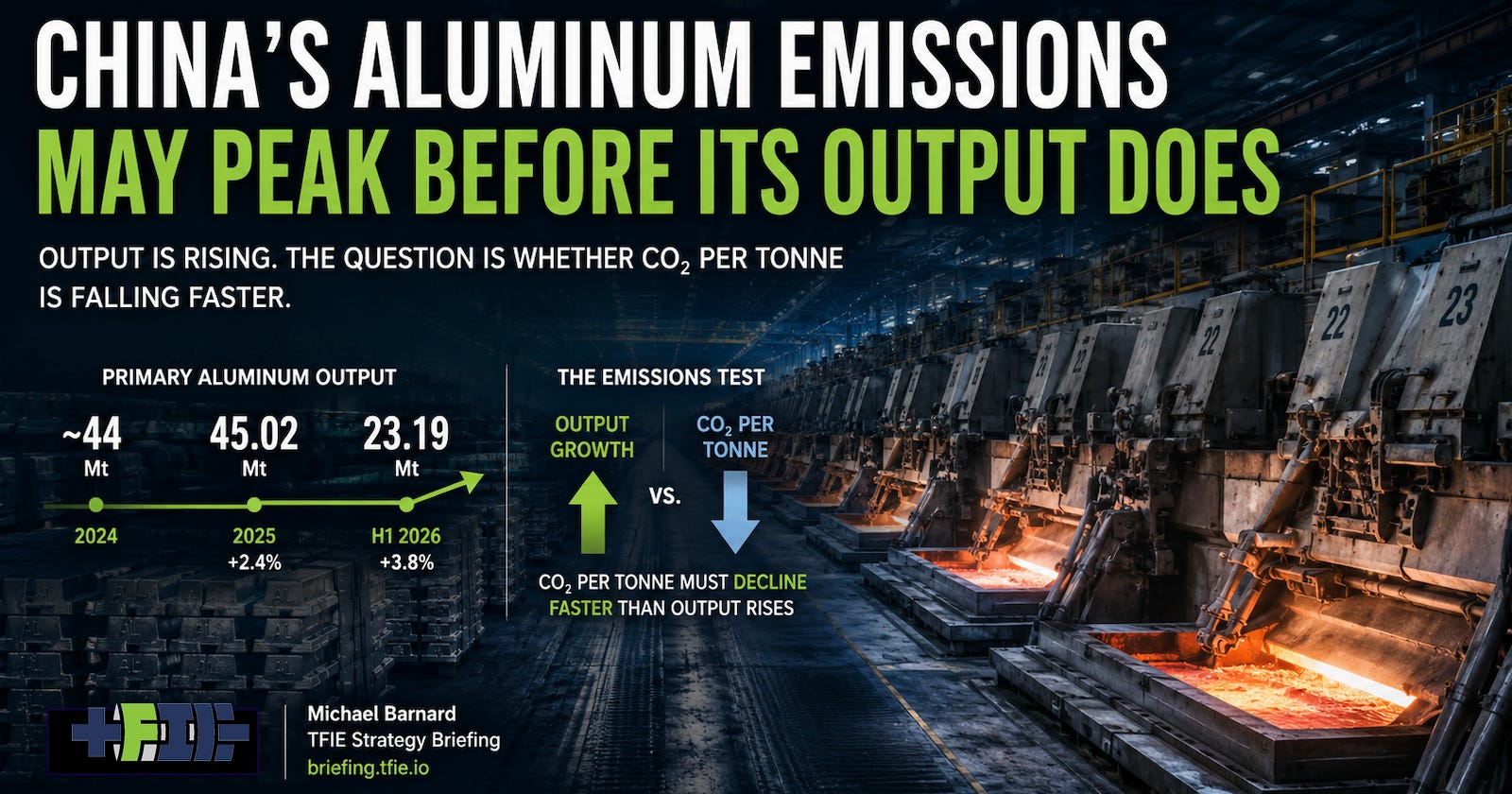
China produced 45.02 million tonnes of primary aluminum in 2025, 2.4% more than the year before. During the first half of 2026 it produced another 23.19 million tonnes, up 3.8% year over year. Those numbers complicate the argument I made earlier this year that China’s aluminum-sector carbon dioxide emissions had probably peaked around 2024, because one of the expected contributors to that peak—saturation of primary aluminum output near China’s nominal 45-million-tonne capacity constraint—has not yet appeared in the production statistics.
The more interesting possibility is that the emissions thesis may survive the production surprise. Aluminum is sufficiently dominated by electricity that absolute sector emissions do not have to move in lockstep with tonnes of metal. If average emissions per tonne decline faster than production rises, China can continue making more primary aluminum while its total aluminum emissions flatten and eventually fall.
That turns China’s aluminum industry into a cleaner test of industrial decarbonization than it looked like six months ago. A peak caused by declining production would be straightforward. A peak occurring while output is still reaching records would indicate that the structure of production itself had changed enough to break the historic link between industrial growth and emissions growth.
