

China spent much of the 2010s electrifying its urban bus fleets while the rest of the world was still debating whether battery-electric buses were practical. In 2021, its government was actively encouraging companies to take retired electric vehicle batteries and give them second lives in stationary storage, telecommunications backup systems and other applications. By the middle of 2026, China had dismantled the dedicated regulatory framework it had created for that industry. That reversal deserves attention from policymakers, investors and battery manufacturers elsewhere.
The original thinking was straightforward. An electric vehicle battery that has degraded to 70% or 80% of its original capacity might no longer meet the demands of daily vehicle operation, but it still holds substantial energy. Stationary storage is less demanding in some respects, so why manufacture another battery when an old one might serve for another decade? China’s 2021 regulations explicitly encouraged this practice, known as cascade utilization, including applications in backup power, storage and charging infrastructure.
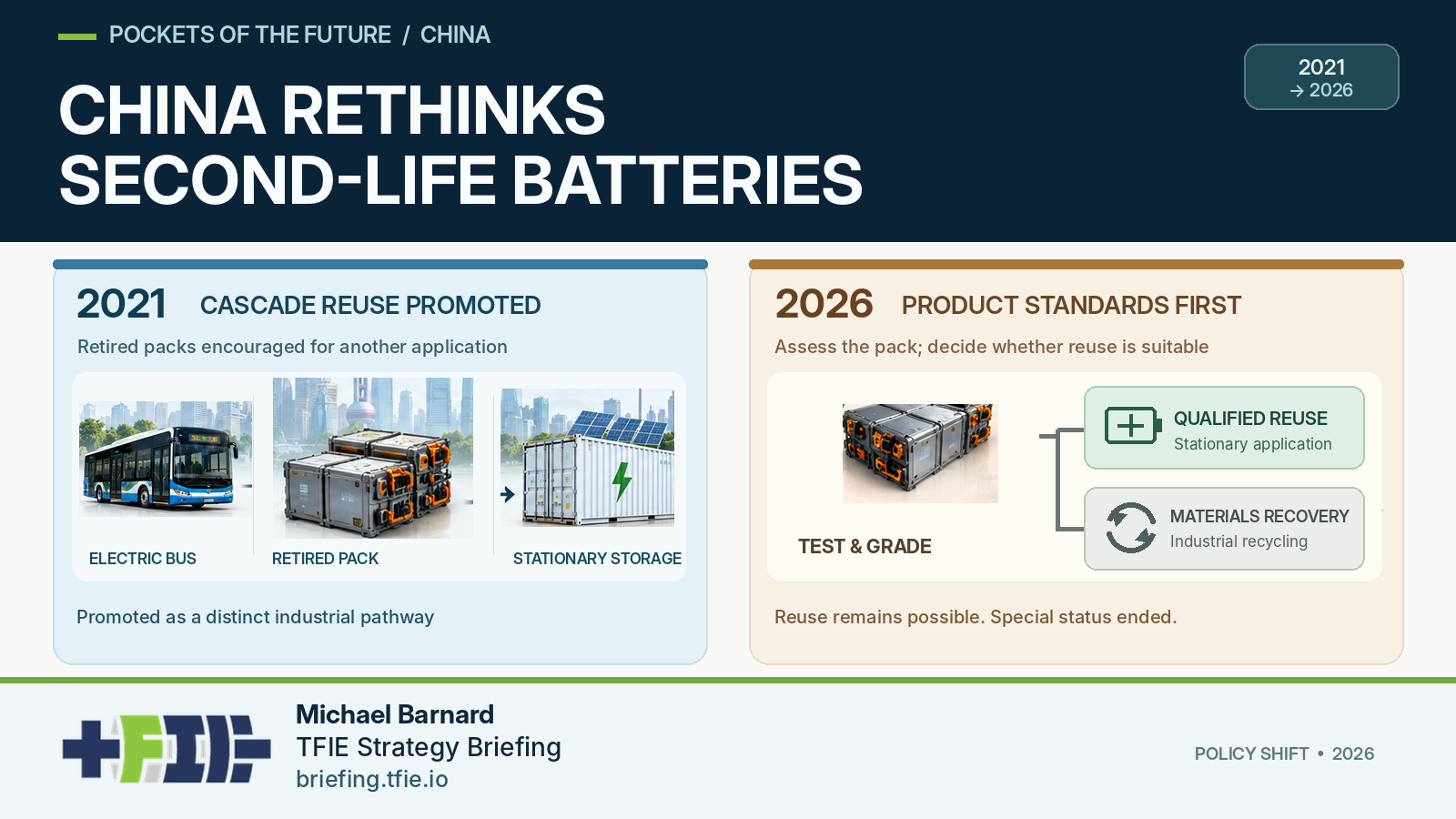
In April 2026, new national battery recycling regulations took effect. They repealed the 2021 cascade-utilization rules and stopped including that activity in the formal definition of battery resource recovery. On July 30, the Ministry of Industry and Information Technology went further, withdrawing the special recognition of cascade-utilization companies and directing industry organizations to discontinue promotional activities associated with the category. Companies engaged in actual materials recycling retained their recognition.
This is not a ban on using retired vehicle batteries for stationary storage. China is requiring battery products manufactured from retired cells to meet the standards of their intended applications, while explicitly prohibiting their reuse in electric bicycles and other restricted applications. The ministry’s explanation focuses on companies selling inadequately tested and reassembled batteries, varying remaining capacity, inconsistent cell condition and the associated risk of thermal runaway. Some businesses had been using the attractive language of second-life batteries to sell products that should not have been on the market.
What makes this particularly interesting is where China sits on the battery adoption curve. At the end of 2025, China had 551,400 new-energy urban buses, representing 87.5% of the country’s urban bus fleet. Most are battery-electric. The first major generations are now old enough that buses and their battery packs are reaching replacement decisions. Some packs were replaced during the vehicles’ operating lives; others have continued working despite significant degradation. China is confronting these questions at a scale few other countries have approached.
This fits a framework I return to frequently: pockets of the future. Author William Gibson’s observation that the future is already here, just unevenly distributed, is particularly useful when examining the energy transition. China is so far ahead in battery manufacturing, electric vehicle deployment and battery recycling that it is encountering industrial realities other countries will face years from now. Its experience offers evidence about which assumptions survive mass deployment and which need revision.
China’s official explanation is about safety and regulatory clarity. But its decision comes at a time when the economics of batteries have also changed dramatically. The question is no longer whether an aging battery can technically store electricity. It is whether making it suitable for another application is worthwhile when new batteries have become so cheap.
China’s regulators are explicit about the safety problems, but there’s a larger commercial question: does the second-life battery business still make economic sense? New LFP batteries keep getting cheaper, industrial recycling is scaling, and the batteries themselves aren’t necessarily aging as expected. China’s experience is exposing some uncomfortable assumptions about a market that was supposed to become enormous. Below, I examine where reuse still works, why the anticipated flood of cheap retired batteries may not materialize as predicted, and what investors, utilities and European policymakers should learn before making the same bets.