

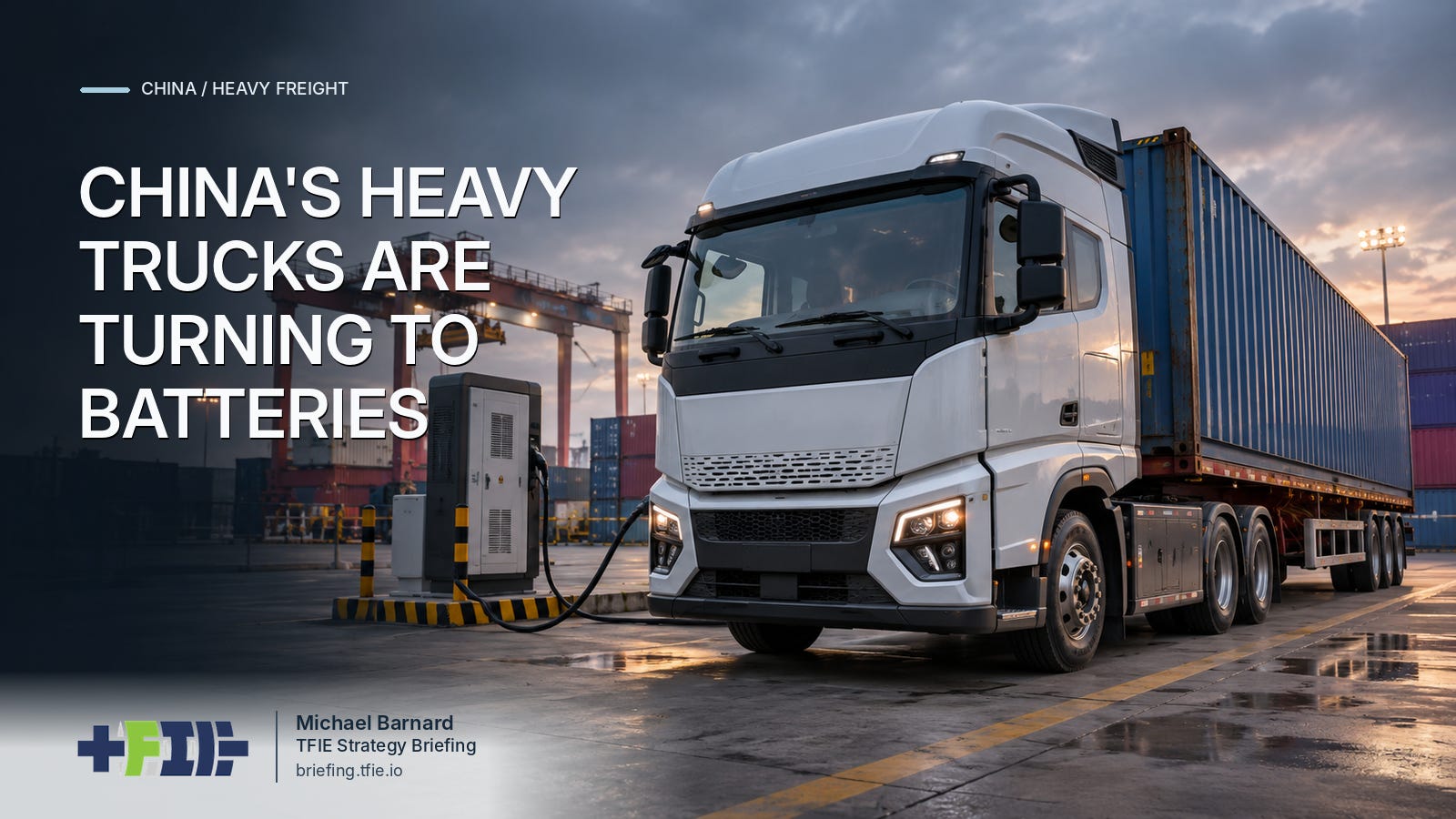
In September 2026, almost half of China’s new heavy trucks were battery electric. Some 32,800 of the 65,800 trucks registered that month ran on batteries, a 49.8% market share. Add a homeopathic 36 hydrogen fuel-cell trucks and a small number of hybrids, and the official Chinese category of new-energy heavy trucks reached 33,100 registrations, or 50.28%. Battery electric accounted for 99.09% of that category. This is overwhelmingly a battery-electric transition, not a broad movement toward alternative drivetrains.
Battery swapping is a substantial but secondary part of this transition. In September, 20.09% of battery-electric heavy trucks were classified as swapping models. Across the first nine months of 2026, the share was 22.92%, compared with 30.39% for full-year 2025. Yet swap-classified registrations grew approximately 19% compared with the same nine months of 2025. Swapping is growing, but conventional charging is capturing more of the expanding battery-electric market. The classification includes some trucks with leased batteries that recharge rather than exchange packs. About four in five new battery-electric heavy trucks registered in September were outside the swapping category.
I recorded a Redefining Energy conversation with Will Rowe, founder of Swaptopus, a couple of months ago about swapping economics and where it works in freight. That episode is scheduled for release in December.
The figures come from compulsory-insurance registrations of new domestic trucks, excluding exports and military vehicles. New-energy heavy-truck registrations rose 37% from September 2025 even as the total market fell 21%. Battery-electric trucks were gaining sales as well as market share.
December 2025 had already crossed the halfway mark for the broader new-energy category, reaching 53.9% as buyers rushed to register trucks ahead of changes to incentives and purchase costs. The more substantial development is what followed. From May through September 2026, new-energy heavy trucks held more than 40% of monthly sales for five consecutive months. China registered approximately 226,400 of them through September, up 64% year over year and representing 38.1% of all new heavy trucks. Almost 99% were battery electric.
Preliminary October figures indicate that the transition continued. First Commercial Vehicle Network estimated about 34,000 new-energy heavy-truck registrations and a share approaching 55%. A separate operating-permit series recorded 29,600 vehicles and 56.4% penetration. Both show momentum beyond September, using different reporting populations.
The shift is particularly visible among tractor units, the trucks that pull semi-trailers. Some 25,600 new-energy tractors were registered in September, representing 64.48% of new tractor sales. Port drayage and industrial bulk haulage often involve repeated routes suitable for electrification, while regional distribution adds longer journeys and tighter schedules. Batteries are taking a growing share of vehicles doing substantial freight work.
The battery-electric gains are occurring in a domestic truck market still well below its pre-pandemic levels. Diesel and LNG have lost market share. LNG trucks approached 30% of new registrations in 2024, when gas prices provided a substantial operating-cost advantage over diesel. That advantage has weakened as battery-electric sales continue to grow.
China has become a pocket of the future for heavy road freight. It has developed a large commercial market where established diesel manufacturers, LNG suppliers, hydrogen proponents and battery-electric truck companies compete for fleet purchases. Buyers are increasingly choosing batteries. The implications extend beyond vehicle technology to infrastructure, energy demand, manufacturing and the allocation of public and private capital.
Why are batteries winning, where do they still face operational constraints, and what should logistics and policy strategists do differently? The paid analysis examines the economics, the infrastructure choices, China’s coordinated deployment strategy and the consequences for diesel demand.