

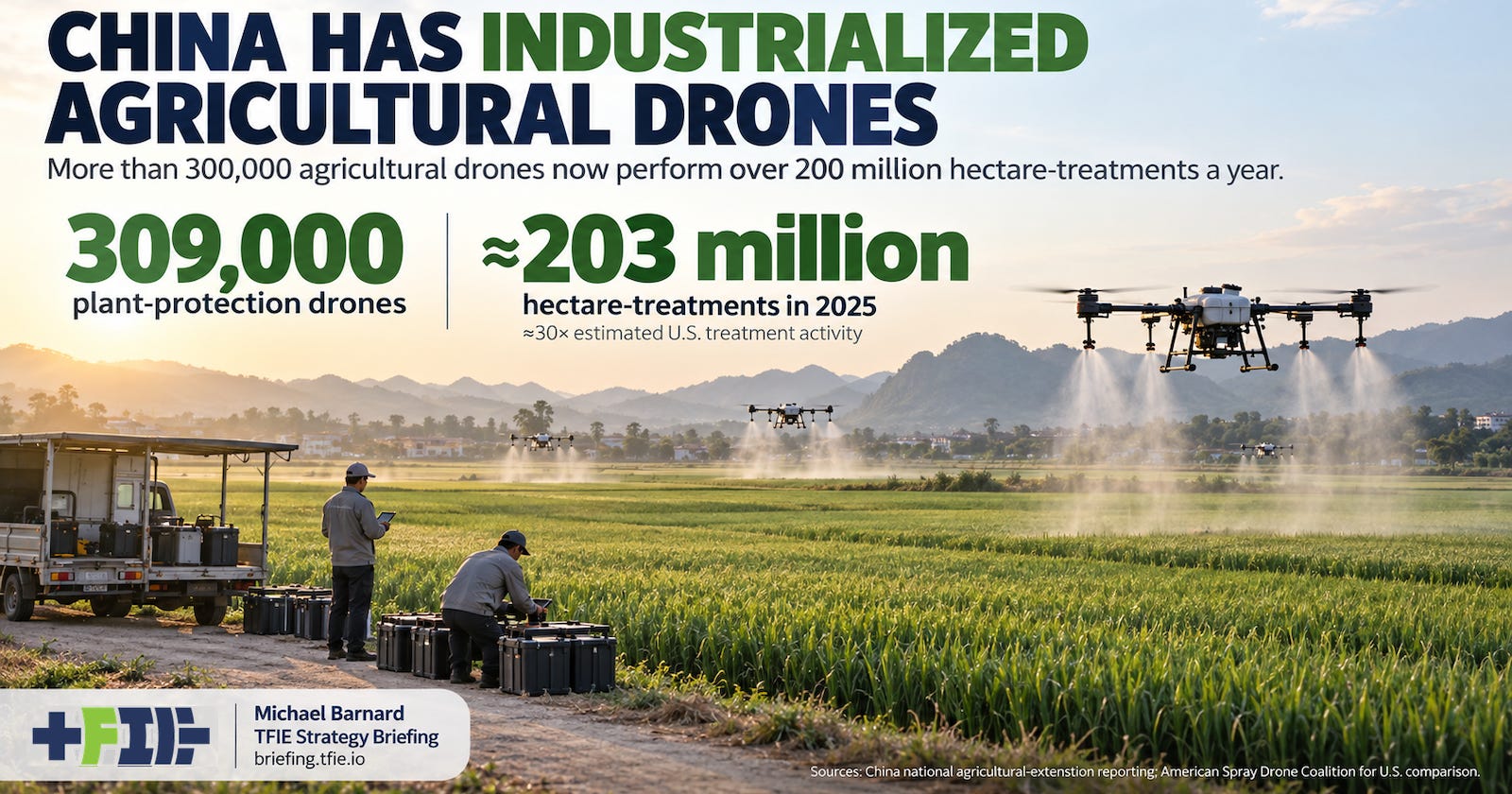
China entered 2026 with about 309,000 plant-protection drones in its reported fleet, up from 251,000 in 2024. Annual activity increased from roughly 178 million to 203 million hectare-treatments. One hectare treated three times counts as three hectare-treatments, so these figures measure agricultural work rather than unique land area. Even with that distinction, the scale is extraordinary: China added roughly 58,000 aircraft and 25 million hectare-treatments of annual activity in a single year from an already enormous installed base, according to China’s national agricultural-extension reporting.
The scale is visible well below the national level. Hubei recorded 6,087 subsidy applications for plant-protection drones during the first nine months of 2025, with purchases worth RMB2.67 billion (~€345 million). The province also reported a sharp increase in plant-protection-drone sales value from the same period a year earlier. This is subsidy-administration data rather than a complete provincial sales census, but Hubei’s agricultural-machinery reporting provides a useful view of the equipment volumes moving through a single Chinese province.
A compilation of provincial agricultural-machinery subsidy disclosures places plant-protection drones among China’s highest-volume subsidized machinery categories in 2025 and suggests annual purchases on the order of a hundred thousand machines. The provincial subsidy compilation is useful corroborating evidence of equipment flow, but it is not a harmonized national sales census, so the precise total should not carry the China-versus-U.S. comparison.
The stronger comparison is operational. China’s reported 203 million hectare-treatments were about 30 times the American Spray Drone Coalition’s estimated 6.64 million hectare-treatments in 2025. That gap is not explained by China having vastly more land under cultivation. China has about 128 million hectares of cultivated land, while the United States has roughly 133 million hectares of cropland actively used for crops and about 153 million hectares of total cropland. The two countries are therefore in the same broad range on physical cropland area. China’s roughly 203 million drone hectare-treatments versus the U.S. estimate of 6.64 million reflects dramatically greater use of drones per unit of agricultural land, including repeated treatments during the season, rather than anything approaching a thirtyfold difference in the amount of land available to farm. The source systems differ—China’s figures come through national agricultural reporting, while the American number is extrapolated from a survey of approved operators—so “about 30 times” is the appropriate level of precision. The two agricultural-drone industries are simply not at comparable scale.
China is also moving beyond the questions typical of a first-adoption market. In important segments, attention is shifting toward replacement cycles, contractor quality, drift, pesticide efficacy, crop-specific operating practices, repair networks and whether successive generations of machines justify retiring the existing fleet. Meanwhile, American farmers and contractors are expanding drone application rapidly, providing independent evidence that the technology solves agricultural problems even in a system already rich in tractors, high-clearance sprayers and crewed agricultural aircraft. They are doing so from a much smaller operating base while access to the dominant Chinese equipment ecosystem is becoming progressively more constrained.
The scale gap is only the visible part of the story. Once hundreds of thousands of aircraft become ordinary farm machinery, different questions emerge: when equipment should be replaced, whether low-price contracting is degrading application quality, which operating parameters work for different crops, and how field experience gets translated into standards and better machines. Europe provides another test because much of the same Chinese hardware remains available there without anything approaching Chinese deployment. The paid analysis follows those feedback loops and what they imply for countries still trying to catch up.